
Msemen (Moroccan Layered Flatbread)
Abuja, Nigeria · Voir toutes les recettes
Aperçu
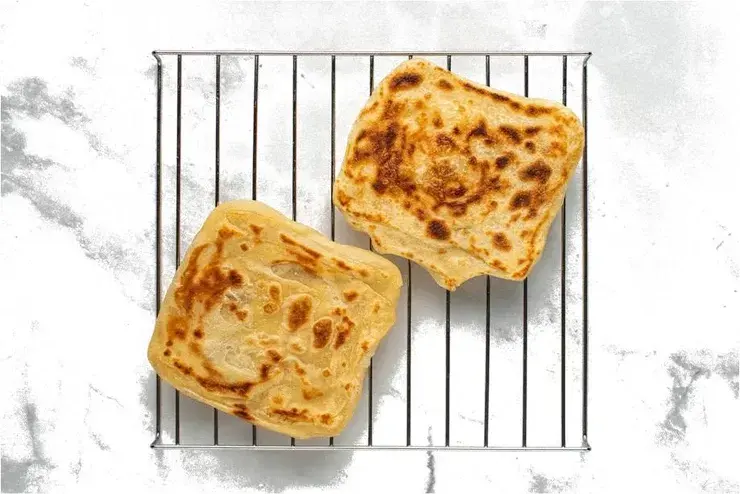
Msemen is a Moroccan flatbread made by spreading dough paper-thin, dotting it with butter and semolina, and folding it into a square, twice, before frying. The folding is what creates the layers, and the layers are the entire dish. The name is a description of the method. Msemen means oiled in Arabic, and the recipe uses a great deal of oil: on the work surface, on the hands, in the dough, dotted through the folds. That is not excess, it is technique. Oiled hands slide over the dough rather than tearing it, which is how you get it thin enough to see the surface through. The double fold is the structural step. Spread thin, dot with butter and semolina, fold into thirds, dot again, fold into thirds the other way. Each fold multiplies the layers, and the semolina between them keeps them from fusing, which is exactly the job flour does in a laminated puff pastry, arrived at from a completely different direction. Two things separate msemen from its Moroccan neighbours. Beghrir is the yeasted thousand-hole pancake, a different thing entirely. Rghaif is a broader family name that msemen belongs to. Cooking them in the order they were folded matters. The first ones have rested longest and spread most easily.
Note de Patrimoine AFN
Msemen is a Moroccan layered flatbread made by spreading dough thin and folding it twice with butter and semolina between the layers, then frying it on a griddle. The name means oiled in Arabic. It belongs to the rghaif family of Moroccan breads and is eaten at breakfast with tea or coffee.
Ingrédients
Les mentions alimentaires sont fournies par les contributeurs à titre indicatif. Elles ne sont pas vérifiées par AFN et dépendent des produits que vous achetez. En cas d’allergie grave, vérifiez vous-même chaque ingrédient. Cuisine, allergies et votre propre jugement
Préparation
- 1
Mix the dry ingredients in a large bowl. Pour in the water and combine into a dough.
- 2
Knead by hand or with a dough hook until very smooth, soft and elastic but not sticky. Adjust the water or flour as needed to get that texture.
- 3
Divide the dough into balls the size of small plums, making sure the tops and sides are smooth. Set them on an oiled tray, cover loosely and rest for 10 to 15 minutes.
- 4While the dough rests, set up
a large flat surface for spreading, bowls of vegetable oil, semolina and very soft butter, and your griddle or frying pan ready on the stove.
- 5
Oil your work surface and your hands generously. Dip a ball of dough in the oil and set it in the centre of the space. Using a light, quick sweeping motion from the centre outward, spread it into a paper-thin circle. Re-oil your hands as often as you need so they slide rather than drag.
- 6
Dot the spread dough with butter and scatter it with semolina. Fold it into thirds like a letter to make a long rectangle. Dot and scatter again, then fold into thirds the other way to make a square.
- 7
Set the folded square on the oiled tray and repeat with the rest, keeping track of the order in which you folded them.
- 8
Heat the griddle over medium heat until quite hot. Take the first square you folded, set it on the oiled surface, oil your hands and pat it firmly to flatten it to about double its size.
- 9
Cook on the hot griddle, turning several times, until cooked through, crisp outside and golden. Transfer to a rack.
- 10
Repeat with the rest, in the order they were folded. Once each has cooled a minute, pick it up by opposite ends and flex it gently to separate the layers.
Notes de l’Africook
- Oil everything, hands, surface, dough. Msemen means oiled and it is a technique rather than an indulgence.
- Spread, do not roll. A rolling pin compresses the layers you are trying to create.
- Semolina between the folds is what stops the layers fusing. Skipping it gives you a thick flatbread rather than a layered one.
- Cook them in the order you folded them. The first have rested longest and spread most easily.
- Flex each one gently once it has cooled a minute. It separates the layers and is oddly satisfying.
- Sweet version: serve with melted butter and honey. Savoury: stuff before folding with onion, tomato and spices.
Questions fréquentes
What makes msemen layered?
The double fold. The dough is spread paper-thin, dotted with soft butter and scattered with semolina, then folded into thirds; that is dotted and scattered again and folded into thirds the other way, producing a square. Each fold multiplies the number of layers, and the semolina between them prevents them fusing together as they cook. It is the same principle as laminated puff pastry, reached by an entirely different route.
How is msemen different from beghrir?
Completely. Beghrir is a yeasted semolina pancake cooked on one side only, with hundreds of holes across its surface, served with honey butter. Msemen is a folded, layered flatbread fried on a griddle. Both are Moroccan, both are breakfast, and both are sometimes loosely called Moroccan pancakes, which is where the confusion comes from. Both have their own recipes on this site.
Why so much oil?
Because it is what lets you spread the dough thin enough. Oiled hands slide over dough where dry or floured hands drag and tear it, and getting the dough down to near-transparency is the whole prerequisite for the layers. The oil also goes between the folds alongside the butter and semolina. The name msemen literally means oiled, which tells you the technique was never considered separable from the dish.
Can they be stuffed?
Yes, and stuffed msemen is common. Onion, tomato and spices, sometimes with minced meat, are spread over the dough before the first fold, so the filling ends up distributed between the layers rather than sitting in a pocket. Keep the filling dry and finely chopped, since anything wet or chunky will tear the thin dough as you fold it. The sweet version, with honey and butter, needs no filling at all.
Avis
Soyez le premier à noter cette recette
Vous l’avez cuisinée ? Votre note aide la personne suivante à se décider.
Aucun avis sur cette recette pour le moment. Si vous l’avez cuisinée, le vôtre serait le premier.
Vous Aimerez Aussi
Voir toutes les recettes Morocco →
Moroccan Chicken Rfissa
Tanjia Marrakchia
Chebakia (Moroccan Sesame Cookies)