

Nsala Soup (White Soup)
Aperçu
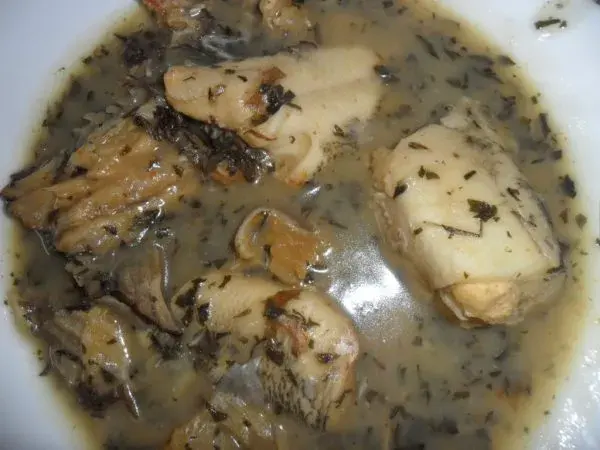
Ofe nsala is called white soup for a reason that will be obvious to anyone who knows Nigerian cooking: it contains no palm oil. Almost every soup of the Nigerian south is built on palm oil, and its absence here is not a simplification but the defining decision. What is left is a clear, pale, intensely aromatic broth in which every other ingredient has nowhere to hide. It belongs to the Igbo of eastern Nigeria and is particularly associated with Anambra State. Catfish is the traditional protein, and the pairing of fresh river fish with a clean broth is the point of the dish, though goat meat, old chicken and smoked turkey are all used. Its aromatic character comes from uziza seed, ehuru, ogiri and utazi leaf, the last of which is bitter and used in deliberately small quantities. The thickener is pounded yam, added to the broth in small amounts and dissolved. This is what gives nsala its body without any oil or seed, and it is the same technique used in fisherman soup further south. Nsala has a particular place in Igbo households as a soup made for new mothers and for people recovering, which is a role that follows from its lightness rather than being asserted on top of it.
Note de Patrimoine AFN
Ofe nsala is documented as an Igbo soup of eastern Nigeria and is particularly associated with Anambra State. It is distinguished within the Nigerian repertoire by its complete omission of palm oil, and is thickened instead with pounded yam.
Ingrédients
Les mentions alimentaires sont fournies par les contributeurs à titre indicatif. Elles ne sont pas vérifiées par AFN et dépendent des produits que vous achetez. En cas d’allergie grave, vérifiez vous-même chaque ingrédient. Cuisine, allergies et votre propre jugement
Préparation
- 1
Peel the yam cubes, wash and boil them. After 10 minutes, drain and pound to a smooth paste with a mortar and pestle, or blend with a little of the cooking water. Set the paste aside as the thickener.
- 2
Wash the goat meat and season with onions, a seasoning cube and salt. Parboil for at least thirty minutes.
- 3
While the meat parboils, wash the dried fish, removing the entrails so the bile does not make the soup bitter. Add the cleaned fish to the meat.
- 4
Once the proteins have softened, add the quantity of water needed to make the soup, judged by how many ingredients you have and how many people are eating.
- 5
While the stock boils, add the pepper and the pounded yam thickener a little at a time, making sure each addition dissolves so it does not leave lumps.
- 6
After 10 minutes add the ground uziza seeds and leave to boil.
- 7
Wash and chop the utazi leaves. Keep the quantity small, as they are bitter.
- 8
Add the ground crayfish and the utazi leaves, boil for 2 minutes, then turn off the heat.
- 9
Serve with pounded yam, fufu, eba or semolina.
Notes de l’Africook
- Add the yam paste in small amounts and let each dissolve before the next. Lumps of undissolved thickener are the most common fault in this soup and cannot be removed once set.
- Use utazi sparingly. It is genuinely bitter, it is meant to be present rather than prominent, and there is no way to pull it back once too much is in.
- Clean the dried fish properly, removing the entrails. The bile is bitter and will carry through the whole pot.
- Cocoyam, achi or yam flour all work as thickeners in place of fresh pounded yam. Cocoyam brings a slimy consistency that changes the texture, so use it knowingly.
- Catfish is traditional, but old chicken, goat and smoked turkey all suit the clean broth. Add fresh catfish late so it does not break up.
Questions fréquentes
Why is nsala called white soup?
Because it contains no palm oil, which is what colours almost every other southern Nigerian soup deep orange or red. Without it the broth stays pale, and that lightness is the point of the dish rather than an omission. The name describes the colour, not the ingredients.
What thickener should I use for nsala soup?
Pounded yam is the proper thickener and is what this recipe uses, added to the broth in small amounts until it dissolves. Achi and yam flour both work. Cocoyam is used too, but it brings a slimy consistency that noticeably changes the soup, so choose it deliberately rather than as a default substitute.
What is the difference between nsala and afia efere?
They are closely related white soups from neighbouring traditions. Ofe nsala is Igbo, particularly from Anambra. Afia efere is the Efik version, and it is distinguished by additional condiments that the Igbo preparation does not use. Both omit palm oil and both are built on fresh fish, so the family resemblance is strong.
Can I make nsala soup without utazi leaves?
Yes. Utazi has no close substitute, and if you cannot get it the soup still works, losing only a slight bitterness in the background. Dried utazi is an acceptable stand in for fresh. Uziza leaf, which is separate and adds aroma and heat rather than bitterness, is the more noticeable of the two if you have to choose.
Avis
10 avis
Vous Aimerez Aussi
Voir toutes les recettes Nigeria →
Edo Black Soup
Nigerian Fisherman Soup
Igbo Yam Porridge
My husband was a bit skeptical when I told him I was cooking goat meat, but the broth turned out amazingly flavorful. I had to order ground uziza seeds online because none of the Asian or Latin markets near me carried them. Adding the yam paste in small bits was crucial, it dissolved smoothly and gave the soup a velvety texture without making it heavy like a Western stew.
Sourcing uziza outside Nigeria is no be small thing, Megan! Living here in Birmingham, I also have to order online sometimes when my local African shop runs out. You are very right about adding the yam paste in small bits, that is the exact secret to keeping Nsala light instead of thick like porridge. Glad your husband enjoyed the goat meat o!
Pounding the boiled yam into a paste to thicken the broth felt so similar to how my grandmother thickens certain South Indian gravies with boiled colocasia. I used fresh catfish from the fishmonger on Belgrave Road. The heat from the uziza seeds gives it such a distinct peppery bite compared to standard black pepper.
That colocasia comparison is so interesting, I never thought of it that way! You are very right about the uziza seeds o, that unique heat is what gives Nsala its true character. Standard black pepper just cannot replicate it at all.
herh this soup is very close to how my Igbo roommate back in university used to make it. In the Bronx here I couldn't find fresh catfish at the market on 182nd so I used goat meat. Just make sure you don't forget to clean the dried fish entrails like the recipe says oo, or that bitter bile will spoil the whole pot.
Herh Nana Ama, goat meat actually works so well for Nsala soup paa! Finding fresh catfish here in Leeds is a real struggle, chale, so I use goat meat too. But that bitter fish bile warning is so true oo, if you don't clean it properly the whole pot will just spoil.
abeg go easy on the utazi leaves if you are making this for the first time, it can overpower the whole soup if you add too much. I had to use yam flour stirred with warm water for my paste because getting fresh yam here was too expensive this week. Still came out very nice and smooth, no lumps at all.
You are so right about that utazi, it ruined my first attempt years ago! The price of fresh yam in London these days is no be small thing o, so using yam flour is such a smart move. Glad yours came out smooth sha.
finding real ogiri in Toronto is stress o! I had to visit three African shops around Scarborough before I got small wrap. I used frozen yam for the thickener since I couldn't get fresh ones, pounded it well after boiling so it dissolved without lumps. Taste took me straight back to Enugu sha.
Eish, stuck in traffic at every robot just to find one ingredient is so frustrating! I also resort to using 250g of frozen yam when fresh ones are out of stock. Boiling it for 15 minutes and pounding it down gives the broth such a lekker, smooth texture without any lumps.