
Merveilles
Aperçu
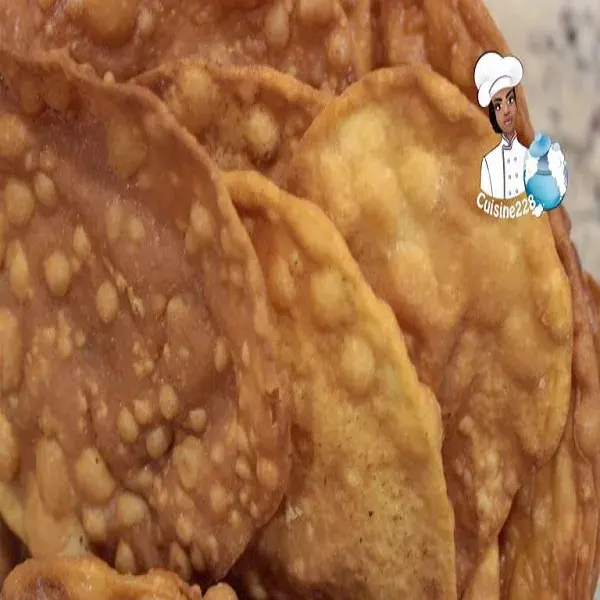
Merveilles are thin strips of fried sweet dough dusted with icing sugar, and they are sold as street food in Togo and Senegal. They are crunchy rather than soft, closer to a biscuit than a doughnut, and comparable to the fried pankere sold in Nigeria. The pastry is European in origin and travelled with colonisation. Its original name is Fasnachtschuechli in German-speaking Switzerland, and it appears in Italy as frittelle di carnevale, both carnival pastries eaten in the weeks before Lent. French speakers took the name merveilles, meaning wonders, and it is under that name that the pastry reached francophone West Africa. That it arrived from Europe does not make it any less genuinely a Togolese and Senegalese street food now. It is fried and sold locally, eaten locally, and made at home. What it is not is a dish with African origins, and the About says so rather than implying otherwise. Nutmeg in the dough is a small local touch. The source's method calls for yeast, which does not appear in its ingredient list, and no rise time is given, so the dough as written is unleavened.
Note de Patrimoine AFN
Merveilles is a European carnival pastry, known as Fasnachtschuechli in German-speaking Switzerland and frittelle di carnevale in Italy, that reached francophone West Africa through colonial contact and is now sold as street food in Togo and Senegal.
Ingrédients
Les mentions alimentaires sont fournies par les contributeurs à titre indicatif. Elles ne sont pas vérifiées par AFN et dépendent des produits que vous achetez. En cas d’allergie grave, vérifiez vous-même chaque ingrédient. Cuisine, allergies et votre propre jugement
Préparation
- 1
Make a well in the flour. Pour the powdered sugar, eggs, nutmeg and melted butter into the centre.
- 2
Knead by hand to obtain a smooth, even paste.
- 3
Form the dough into a ball, then roll it out thinly on a floured surface and cut into strips.
- 4
Heat the oil in a large pan and fry the pieces of dough.
- 5
Drain on paper towels, arrange on a dish, dust with icing sugar and serve.
Notes de l’Africook
- Roll the dough genuinely thin. These are meant to be crunchy, and thick pieces stay soft in the middle.
- Fry in batches so the oil temperature holds. Crowded, they absorb oil and go heavy.
- Dust with icing sugar while still warm so it sticks, and again just before serving.
- The nutmeg is assertive at a full teaspoon for 200 g of flour. Reduce it if you prefer a plainer pastry.
- They are best on the day and go soft within a day or two, so make what you will eat.
- The source's method mentions yeast, which is not in its ingredient list and would need a rise. As written the dough is unleavened, which suits the crunchy result.
Questions fréquentes
Where are merveilles from?
The pastry is European: Fasnachtschuechli in German-speaking Switzerland and frittelle di carnevale in Italy, both carnival sweets. French speakers named it merveilles, meaning wonders, and it reached francophone West Africa through colonial contact. It is now genuinely a Togolese and Senegalese street food, but its origin is European and this entry says so.
What is pankere?
Pankere is a Nigerian fried dough snack that the source compares merveilles to. Both are strips of sweet dough fried until crisp and sold from street stalls. West Africa has a wide family of fried dough snacks, including puff puff, bofrot and chin chin, each with its own texture and shaping.
Why are mine soft rather than crunchy?
The dough was rolled too thick, or the oil was not hot enough. Merveilles should be rolled very thin, which is what allows them to dry out and crisp in the oil. Frying too cool means they absorb oil and stay heavy rather than crisping.
Can I use a different spice?
Yes. Nutmeg is what this version uses and is a common choice, but cinnamon, vanilla, orange zest and lemon zest all work and appear in European versions. Keep the quantity modest, since the pastry itself is plain and the spice carries a lot of the flavour.
Avis
Soyez le premier à noter cette recette
Vous l’avez cuisinée ? Votre note aide la personne suivante à se décider.
Aucun avis sur cette recette pour le moment. Si vous l’avez cuisinée, le vôtre serait le premier.
Vous Aimerez Aussi
Voir toutes les recettes Togo →
Liver Fried Rice
Pig Feet Stew

Amasi Recipe