

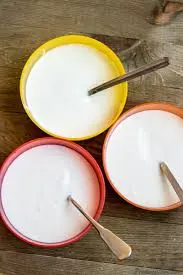
Homemade Yogurt
Aperçu
Yoghurt is milk fermented by bacteria, and making it at home requires two things: milk, and a spoonful of existing yoghurt to introduce the culture. The process is worth understanding because it explains every step. Milk is heated, then cooled to around body temperature, and a live culture is stirred in. The bacteria, chiefly Lactobacillus bulgaricus and Streptococcus thermophilus, consume the lactose and produce lactic acid. That acid is what gives yoghurt its tang and what causes the milk proteins to coagulate into a set. Everything about the method exists to keep those bacteria in the temperature range where they work. Which is why the two common failures are temperature failures. Milk still too hot kills the culture outright; milk too cool, or a room too cold, and the bacteria work too slowly to set. Longer fermentation gives a tangier, firmer result. Straining it afterwards produces a thicker yoghurt, and taken far enough, something close to labneh or Greek-style yoghurt. **Filed as Worldwide**, fermented milk is genuinely global, with strong traditions across Africa, but the recipe makes no specific national claim.
Note de Patrimoine AFN
Yoghurt is produced by bacterial fermentation of milk, chiefly by Lactobacillus bulgaricus and Streptococcus thermophilus, which convert lactose into lactic acid, giving both the characteristic sourness and the coagulation that sets it.
Ingrédients
Les mentions alimentaires sont fournies par les contributeurs à titre indicatif. Elles ne sont pas vérifiées par AFN et dépendent des produits que vous achetez. En cas d’allergie grave, vérifiez vous-même chaque ingrédient. Cuisine, allergies et votre propre jugement
Préparation
- 1
Warm the milk to right below boiling, about 200°F. Stir the milk gently as it heats to make sure the bottom doesn’t scorch and the milk doesn’t boil over.
- 2
Cool the milk. Let the milk cool until it is just warm to the touch, 112°F to 115°F. Transfer the to storage containers
- 3
Add ½ cup commercial yogurt containing active cultures and 1 cup of powder milk. Then whisking gently
- 4
Take advantage of the heat during the hot summer months by culturing outside. Simply set your yogurt jars in a closed cooler and then set it in the sun.
- 5
After the set time, take the jars out of the yogurt maker, close them with their lids, and put the yogurt jars in the refrigerator for storage.
- 6
Serve with some sugar (or honey) and some fruits.
Notes de l’Africook
- Let the heated milk cool to body temperature before adding the culture. Too hot and you kill it.
- Use a shop-bought yoghurt with live cultures as your starter, and check the label says so.
- Keep it warm and undisturbed while it sets, an oven with the light on, or a wrapped bowl, works.
- Ferment longer for a tangier, firmer result. Strain through muslin for a thicker one.
Questions fréquentes
Why did my yoghurt not set?
Almost always temperature. If the milk was still too hot when the starter went in, the bacteria were killed and nothing happened. If the mixture was kept too cool, they worked too slowly. Aim for around body temperature when adding the culture, and keep it warm and undisturbed for several hours after.
What can I use as a starter?
Any shop-bought plain yoghurt whose label says it contains live or active cultures. A couple of tablespoons is enough. Once you have made a batch you can use some of your own as the starter for the next, though most people find it weakens after several generations and start again with a fresh pot.
How do I make it thicker?
Strain it through muslin or a fine cloth over a bowl, the longer you strain, the thicker it gets, and taken far enough you reach something like Greek yoghurt or labneh. Fermenting for longer also firms it up, at the cost of a sharper taste. Using whole milk rather than skimmed helps too.
Avis
Soyez le premier à noter cette recette
Vous l’avez cuisinée ? Votre note aide la personne suivante à se décider.
Aucun avis sur cette recette pour le moment. Si vous l’avez cuisinée, le vôtre serait le premier.