
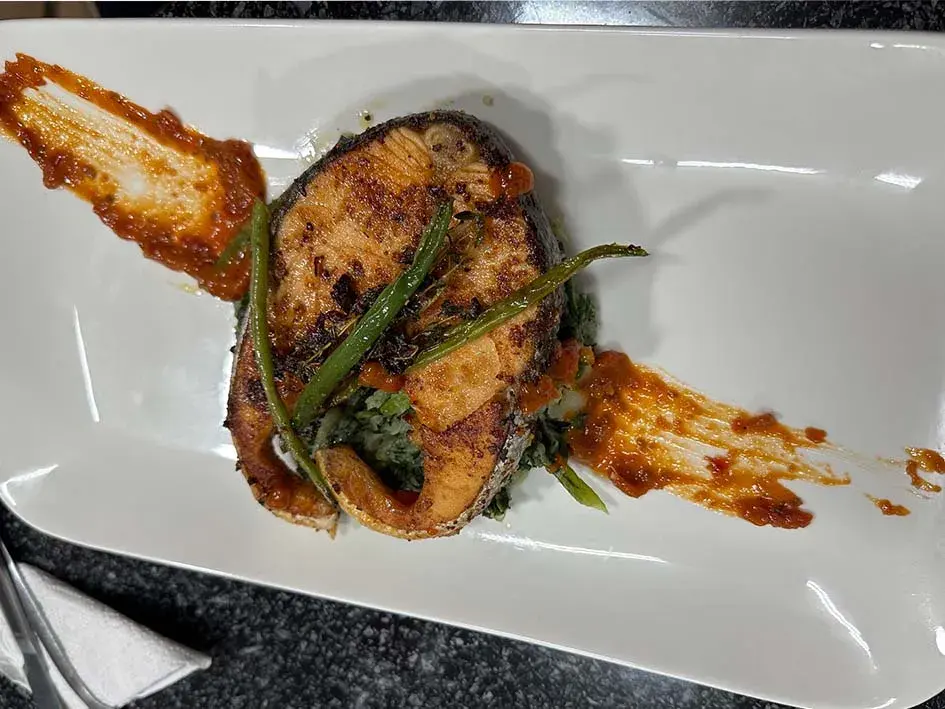
Pan-Seared Salmon
Aperçu
A salmon steak seasoned with Cajun spice and paprika, then cooked in butter until the outside colours and the inside stays just short of firm. No country is claimed and none applies: pan-searing is a technique rather than a tradition, and salmon is a cold-water North Atlantic and Pacific fish with no African tradition attached to it. The contributor is South African, and the Cajun seasoning is the giveaway that this is a contemporary home-cooking recipe rather than an inherited one. Cajun spice blends are Louisiana in origin and reached South African kitchens through the same route as most global pantry seasonings. There is one technical point worth stating clearly, because the source gets it slightly wrong. It has you melt the butter over low heat, then sear. Searing needs high heat, and butter alone burns before it gets there, because its milk solids scorch well below searing temperature. A neutral oil to start, with butter added towards the end for flavour and basting, is the standard way round this. Left as written, you will steam the fish rather than sear it. This page carries the traffic on this dish, so it is the one being kept even though its slug ends in a duplicate suffix.
Ingrédients
Les mentions alimentaires sont fournies par les contributeurs à titre indicatif. Elles ne sont pas vérifiées par AFN et dépendent des produits que vous achetez. En cas d’allergie grave, vérifiez vous-même chaque ingrédient. Cuisine, allergies et votre propre jugement
Préparation
- 1
Pat the salmon dry with kitchen paper. A wet surface will steam rather than colour.
- 2
Rub both sides with the salt, Cajun spice, fish seasoning and paprika.
- 3
Get a non-stick or heavy-based pan properly hot and pour in the neutral oil.
- 4
Lay the salmon in the pan and leave it undisturbed for about 4 to 5 minutes, until a crust has formed and it releases from the pan on its own.
- 5
Turn it over, drop in the butter, the crushed garlic and the thyme, and cook for a further 4 to 5 minutes, spooning the foaming butter over the fish as it goes.
- 6
Take the pan off the heat while the centre is still slightly translucent, salmon carries on cooking once it leaves the pan.
- 7
Finish with a squeeze of lemon juice and serve.
Notes de l’Africook
 Notes personnelles de Cedukwazi Nhlengethwa
- Dry the fish thoroughly first. This matters more than anything else in the method: moisture on the surface prevents a crust forming.
- Start in oil, not butter. Butter alone burns before the pan is hot enough to sear, and butter added later gives the flavour without the scorching.
- Leave it alone once it is in the pan. Moving the fish repeatedly is the main reason home-cooked salmon has no crust.
- Take it off slightly under-done. Residual heat finishes it, and salmon goes from moist to dry very quickly.
- Skin-on fillets do well here, start skin side down and press gently for the first few seconds so it stays flat and crisps evenly.
- Cajun spice blends vary in salt content, so taste before adding the extra pinch.
Questions fréquentes
Why start with oil rather than butter?
Because butter burns before the pan is hot enough to sear. The milk solids in butter begin to scorch at around 150°C, well below the temperature needed to form a crust, and the result is a bitter taste and a fish that steams rather than colours. A neutral oil handles the initial heat, and butter added in the second half gives you the flavour and the basting without the burning. The source's method skips this and suffers for it.
How do I know when salmon is done?
Take it off while the very centre is still slightly translucent. Salmon continues cooking from residual heat for a minute or two after it leaves the pan, and the window between moist and dry is narrow. The flesh should flake under gentle pressure but still look darker in the middle. If you prefer to measure, the standard guidance for fish is 63°C at the thickest point, though many cooks pull salmon a few degrees earlier.
Is this an African dish?
No. Salmon is a cold-water North Atlantic and Pacific fish with no African tradition behind it, and pan-searing is a technique rather than a cuisine. The Cajun seasoning is Louisiana in origin. It sits in Worldwide Recipes under Global, with its URL unchanged so that existing search traffic to the page is preserved. Africa's own seared and grilled fish traditions, Nigerian grilled mackerel, Kenyan samaki wa kukaanga, are separate dishes on this site.
What should I serve it with?
It is deliberately plain and takes almost anything. A green vegetable and a starch is the standard approach, new potatoes, rice, or a salad. The garlic butter left in the pan is worth spooning over whatever else is on the plate rather than discarding. If you want to stay closer to the Cajun seasoning, rice and a tomato-based vegetable dish suit it well.
Avis
Soyez le premier à noter cette recette
Vous l’avez cuisinée ? Votre note aide la personne suivante à se décider.
Aucun avis sur cette recette pour le moment. Si vous l’avez cuisinée, le vôtre serait le premier.