
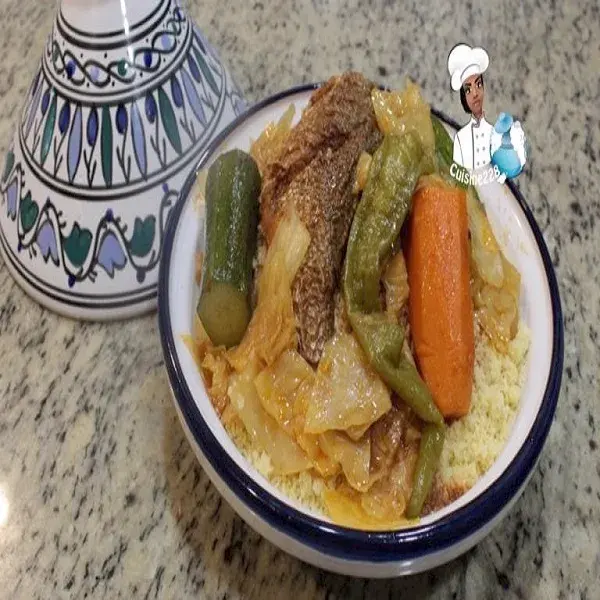
Fish and Vegetable Couscous
Aperçu
Semolina steamed into couscous from scratch, served with whole fish and root vegetables in a harissa and tomato broth. The source places it in Morocco but describes couscous correctly as a Berber dish and a staple across North Africa, so no single country has been assigned. What makes this page unusual in the archive is that it does not take the shortcut. Almost every couscous recipe in circulation uses instant couscous rehydrated with boiling water. This one starts from raw semolina and works it by hand, sprinkling water, rubbing the grains in a circular motion until absorbed, steaming, resting, breaking up the lumps by hand, and steaming again. That process is what produces genuinely light, separate couscous, and it is the traditional method rather than a flourish. Fish couscous is the coastal version. Inland couscous is built on lamb or chicken; along the Mediterranean and Atlantic coasts of Morocco, Algeria and Tunisia the same format takes fish, and the broth is sharpened with harissa and caraway rather than being purely savoury. Two problems with the source. Its ingredient list has a section heading absorbed into it, so the fish description ended up attached to the wrong item. And it omits the oil the method calls for. Both have been corrected. Its extended nutritional discussion of couscous has not been carried across.
Note de Patrimoine AFN
Couscous is a Berber dish and a staple of North African cooking, traditionally steamed from raw semolina in a couscoussier over the stew it is served with. Coastal versions across Morocco, Algeria and Tunisia are made with fish rather than the lamb or chicken used inland.
Ingrédients
Les mentions alimentaires sont fournies par les contributeurs à titre indicatif. Elles ne sont pas vérifiées par AFN et dépendent des produits que vous achetez. En cas d’allergie grave, vérifiez vous-même chaque ingrédient. Cuisine, allergies et votre propre jugement
Préparation
- 1
Mix the salt into cold water. Sieve the semolina into a large dish. Sprinkle a handful of water over the surface and work it in with a circular rubbing motion until absorbed. Repeat, working steadily, until the grains are evenly moistened.
- 2
Steam the couscous for about 20 minutes.
- 3
Sprinkle it with about half a litre of water and leave it to swell for 30 minutes. Turn it out once cool and separate the grains by rubbing them between your hands to break up every lump. A tablespoon of oil helps.
- 4
Steam it again until the steam comes through, then turn it out. It should now separate easily with a large spoon. Season with salt if needed and mix through olive oil or butter to keep the grains apart.
- 5
Set the couscous aside until you need it, it can be re-steamed briefly to warm through.
- 6
Clean the fish thoroughly and let them drain. Pound garlic and salt together in a mortar, then work in the cumin, turmeric, pepper and salt. Rub this mixture inside and all over the fish and leave to marinate somewhere cool for at least 30 minutes.
- 7
Clean the vegetables and cut them in half or into large pieces.
- 8
Fry the fish in very hot oil.
- 9
In a pot over medium heat, cook the grated tomato and onions in oil. Work in the tomato purée and a little water.
- 10
Put in the vegetables and the fried fish, cover with water and bring to the boil. Cook for 10 to 15 minutes.
- 11
Serve the couscous in a large deep dish, drizzled with olive oil and mixed through. Moisten it with a ladle or two of the broth and arrange the vegetables, fish and peppers over the top.
Notes de l’Africook
- Steam the couscous twice with a rest between. This is the whole difference between light, separate grains and a heavy mass, and it is why the traditional method exists.
- Break up every lump by hand between steamings. A lump that survives into the second steaming will still be a lump on the plate.
- Use a fish without heavy scales, as the source specifies. Bream and grouper are both good; heavily scaled fish is a great deal of work.
- Marinate the fish properly before frying. Half an hour is the minimum for the garlic and spices to reach the flesh.
- Do not cook the fish long in the broth. It is already fried and will fall apart if it simmers.
- Harissa varies enormously in heat between brands. Start with less than the recipe states.
Questions fréquentes
Why steam the couscous twice?
Because it is what makes couscous light. The first steaming partly cooks the grains; the rest and the rubbing between your hands separates every lump; the second steaming finishes them individually rather than as a mass. Instant couscous rehydrated with boiling water is convenient and perfectly edible, but it is denser and clumps more. The double steaming is the traditional method across North Africa and the difference is immediately obvious.
What fish should I use?
The source specifies fish without heavy scales, and names bream and grouper. Both are good choices, firm enough to survive frying and then a short spell in the broth without disintegrating. Sea bass, snapper and mullet all work. Avoid very delicate fish, and avoid oily fish such as mackerel, whose strong flavour overwhelms the broth. Whole fish is traditional and gives more flavour than fillets.
Is fish couscous a particular regional version?
Yes, it is the coastal form. Inland North African couscous is built on lamb or chicken; along the Mediterranean and Atlantic coasts of Morocco, Algeria and Tunisia the same format takes whatever the boats bring in. Tunisian fish couscous in particular is well known and tends to be spicier, leaning on harissa and caraway. The vegetables stay much the same wherever you are.
Can I use instant couscous instead?
You can, and most people do. Pour equal volumes of boiling stock over the couscous, cover tightly, leave for ten minutes and fluff thoroughly with a fork. The dish will work and the broth carries most of the flavour. What you lose is the texture, instant couscous is denser and clumps more readily than grains steamed twice from raw semolina. There is a separate page on this site covering the instant method.
Avis
Soyez le premier à noter cette recette
Vous l’avez cuisinée ? Votre note aide la personne suivante à se décider.
Aucun avis sur cette recette pour le moment. Si vous l’avez cuisinée, le vôtre serait le premier.