
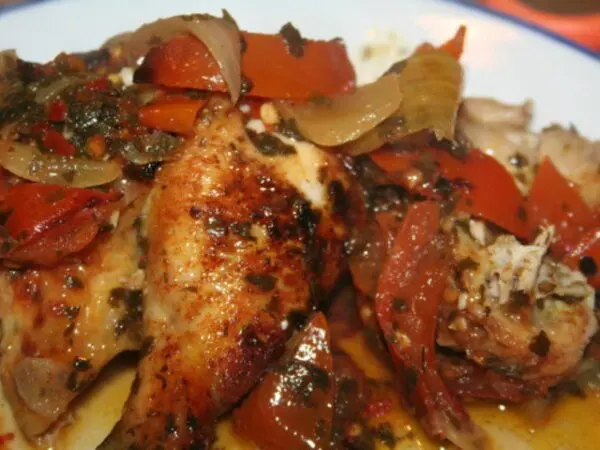
Poulet Fafa
Aperçu
Poulet fafa is Tahitian, chicken braised with taro leaves and coconut milk, and one of the defining dishes of French Polynesia. It takes its name from fafa, the Tahitian word for the taro leaf that goes into it. That leaf is the whole dish. Cooked long enough it collapses into something dark, soft and faintly earthy, closer in character to spinach or callaloo than to anything else, and it is what the coconut milk is there to carry. It is normally served alongside ahima'a, the Polynesian pit oven, the same underground cooking method found across the Pacific under different names, where food is buried over hot stones and left for hours. Poulet fafa is the pot dish that accompanies that, and it can be made entirely on a stovetop. Its close relative is chicken luau in Hawai'i, which is the same idea, chicken, taro leaf, coconut milk, under a different name, reflecting the shared Polynesian food culture across a very large stretch of ocean. **This is not an African dish.** It sits in the Worldwide collection because it is genuinely from Tahiti in French Polynesia, and it is kept on the platform rather than removed because people already visit the page. One thing matters for safety: taro leaves must be cooked thoroughly.
Note de Patrimoine AFN
Poulet fafa is a traditional dish of Tahiti in French Polynesia, named for fafa, the Tahitian word for taro leaf. It is commonly served alongside ahima'a, the Polynesian earth oven, and has a close relative in Hawai'i in chicken luau.
Ingrédients
Les mentions alimentaires sont fournies par les contributeurs à titre indicatif. Elles ne sont pas vérifiées par AFN et dépendent des produits que vous achetez. En cas d’allergie grave, vérifiez vous-même chaque ingrédient. Cuisine, allergies et votre propre jugement
Préparation
- 1
If using taro leaves, bring a large pot of salted water to a boil.
- 2
Add the taro leaves, reduce heat and simmer for 30 to 40 minutes. Drain and squeeze dry.
- 3
Heat the oil over medium-high flame in a large pot.
- 4
Brown the chicken on all sides in the hot oil and remove to a plate.
- 5
Saute the onion, garlic and ginger in the remaining oil until the onion is translucent.
- 6
Add back the chicken pieces and the stock or water, salt and pepper.
- 7
Reduce the heat to low and simmer, covered, for about 20 minutes. Add the taro leaves or spinach and simmer for another 15 minutes, or until the chicken is tender.
- 8
Stir the cornstarch or arrowroot into 2 or 3 tablespoons of cold water and then stir the slurry into the simmering sauce to thicken it lightly.
- 9
Stir in coconut cream to finish and serve over rice.
Notes de l’Africook
- Cook the taro leaves thoroughly and never eat them raw or lightly cooked, see the FAQ below.
- Brown the chicken first and remove it, then build the sauce in the same pan. The fond is worth having.
- Add the coconut milk late and keep it below a hard boil, or it splits.
- Cornflour or arrowroot slaked into the coconut milk thickens the sauce without dulling it.
- Spinach or callaloo can stand in for taro leaf if you cannot get it, though the flavour is milder.
Questions fréquentes
Is poulet fafa African?
No. It is Tahitian, from French Polynesia in the Pacific. It appears on the African Food Network in the Worldwide collection, which exists for dishes that are not African but already have pages people visit. Removing the page would break links that currently work, so it is reclassified rather than deleted.
What is fafa?
Fafa is the Tahitian word for taro leaf, and it names the dish. The leaves cook down into something dark and soft, comparable to spinach or callaloo but with a distinct earthiness. Taro is a staple root crop across the Pacific and the leaves are used as a vegetable in their own right.
Are taro leaves safe to eat?
Only when thoroughly cooked. Raw or undercooked taro leaves contain calcium oxalate crystals which cause intense irritation and burning in the mouth and throat. Long cooking breaks them down completely, which is why traditional recipes simmer them at length. This is not optional and it is not a matter of taste, do not shorten the cooking time for the leaves.
What is the difference between this and chicken luau?
Very little. Chicken luau is the Hawaiian version of the same dish, chicken, taro leaves and coconut milk, and the two reflect a shared Polynesian food culture across the Pacific. Details of seasoning and thickening vary, but they are recognisably the same preparation under different names.
Avis
Soyez le premier à noter cette recette
Vous l’avez cuisinée ? Votre note aide la personne suivante à se décider.
Aucun avis sur cette recette pour le moment. Si vous l’avez cuisinée, le vôtre serait le premier.