

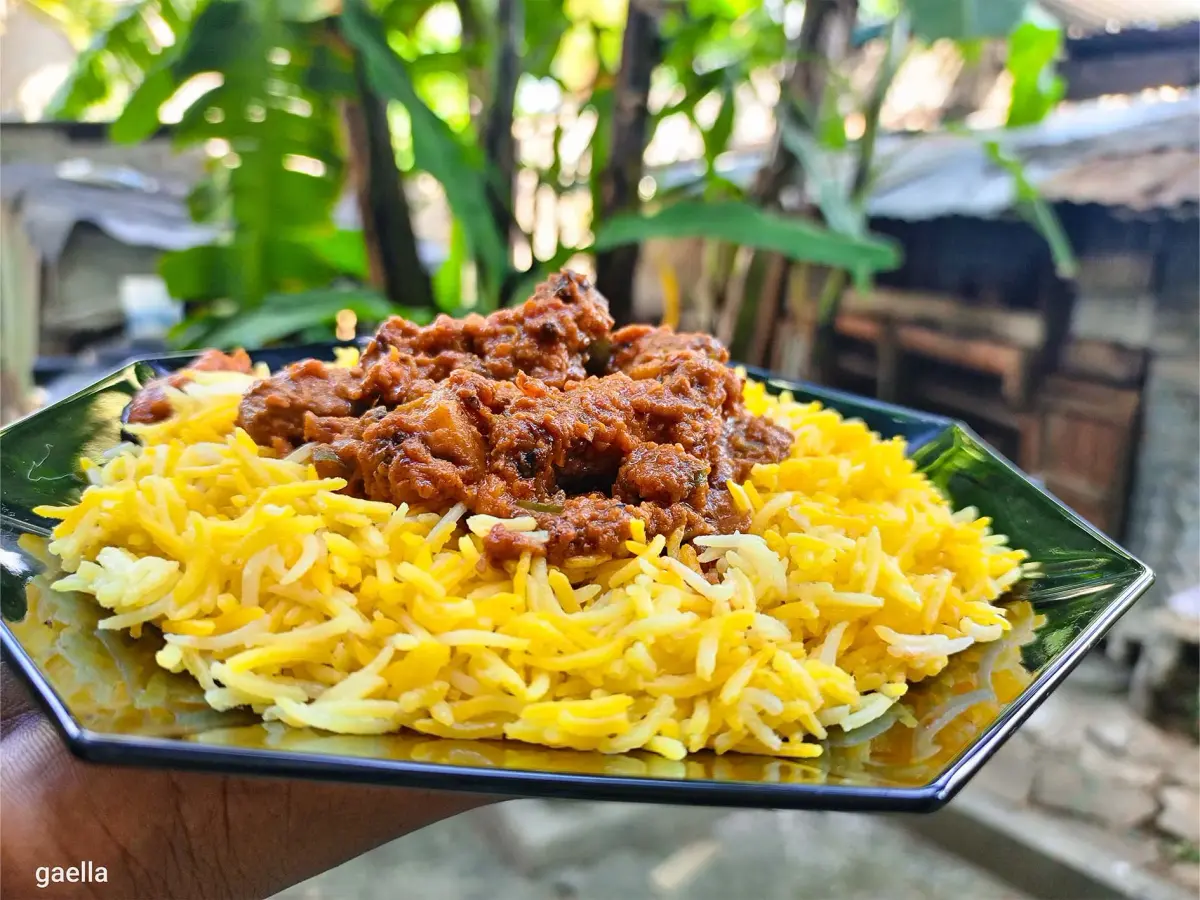
Kenyan Beef Biryani
Aperçu
Kenyan biryani is a Swahili coast dish, and the coast is where the Indian Ocean has been depositing influences on East Africa for more than a thousand years. Arab, Persian and Indian traders working the monsoon routes brought rice, spices and techniques to Mombasa, Lamu and Zanzibar, and what developed there is neither Indian nor Arab but Swahili. The biryani method itself is unmistakably South Asian: meat cooked in a spiced yoghurt gravy, rice parboiled separately with whole spices, the two layered and steamed together so the rice finishes in the gravy's steam. The Kenyan version keeps that structure. What it does differently is in the details, with fried onions used in quantity, tomato leaning heavier than in most Indian versions, and fried potatoes worked through the meat rather than served alongside. It is occasion food. Biryani appears at Kenyan weddings, at Eid, and at the large family meals where the effort is justified by the number of people eating. The orange food colouring streaked through part of the rice, which purists elsewhere would query, is standard in Kenya and is part of what a Kenyan expects a biryani to look like. Served with kachumbari, the raw tomato and onion salad, it is one of the clearest expressions of what the coast is.
Note de Patrimoine AFN
Biryani reached the East African coast through Indian Ocean trade routes connecting the Swahili city states of Mombasa, Lamu and Zanzibar with Arabia, Persia and the Indian subcontinent. The Swahili coast developed its own preparations from these exchanges, distinct from both their South Asian and Arabian sources.
Ingrédients
Les mentions alimentaires sont fournies par les contributeurs à titre indicatif. Elles ne sont pas vérifiées par AFN et dépendent des produits que vous achetez. En cas d’allergie grave, vérifiez vous-même chaque ingrédient. Cuisine, allergies et votre propre jugement
Préparation
- 1
Mix the steak with the marinade ingredients and leave to marinate for 2 hours in the fridge.
- 2
Heat the oil in a saucepan, add the cubed tomatoes and cook until they are mushy and the oil begins to separate.
- 3
Add the ginger and garlic paste, then the cinnamon stick and chopped chillies, and cook for a few seconds. Add the marinated steak and fry on high heat for 4 to 5 minutes.
- 4
In a separate bowl, mix the yogurt with the crushed fried onions, tomato paste, sugar and salt. Pour into the pan and cook until the gravy is dry. Add water, turn the heat down and cover.
- 5
Simmer gently for 15 to 20 minutes until the beef is tender, then adjust the salt and spices. Add the fried potatoes and mix through with a wooden spoon.
- 6
Bring a pot of water to the boil and add the cardamom pods, cinnamon stick and oil.
- 7
Wash the rice, drain it and add it to the boiling water. Cook for 8 minutes, until almost done, then strain out all the water.
- 8
Return the rice to the empty pan and sprinkle over a handful of fried onions and some chopped coriander. Drizzle with oil.
- 9
Mix a quarter teaspoon of food colouring with water, add it to one side of the rice and mix it in a little with a fork. Cover the pot.
- 10
Steam over low heat for 15 minutes.
- 11
Serve hot.
Notes de l’Africook
 Notes personnelles de Abigael Alfredah
- Parboil the rice to eight minutes and no more. It finishes in the steam over the meat, and rice cooked through at this stage turns to mush in the final layering.
- Fry the onions properly to a deep golden brown. They go into the yogurt mixture crushed and they are carrying a large part of the flavour, so pale onions give a flat biryani.
- Cook the gravy dry before the water goes in. That reduction stage is where the depth comes from and rushing it leaves the dish thin.
- Add the colouring to one side only and mix it in partially. The streaked effect is what a Kenyan biryani looks like, and mixing it through evenly loses it.
- Kachumbari, the raw tomato and onion salad, is the standard accompaniment and its acidity cuts the richness.
Questions fréquentes
What makes Kenyan biryani different from Indian biryani?
The balance rather than the method. Kenyan biryani uses fried onions in quantity, leans more heavily on tomato, and works fried potatoes through the meat rather than serving them separately. The layering and steaming technique is the same. Orange food colouring streaked through part of the rice is standard in Kenya and would be unusual in most Indian versions.
What is the difference between biryani and pilau?
The cooking method. In biryani the meat and the rice are cooked separately and then layered and steamed together, which is why the rice shows different colours. Pilau cooks the rice in the spiced meat broth from the start, so it is uniformly coloured throughout. Both are eaten on the Swahili coast and they are distinct dishes.
Can I skip the food colouring?
Yes, and the biryani will taste identical. The streaked orange is a visual convention rather than a flavour, though it is genuinely what Kenyans expect a biryani to look like. Saffron steeped in warm milk is the traditional alternative and gives colour and aroma, at considerably more cost.
What is Kenyan biryani served with?
Kachumbari, the raw salad of tomato, onion, chilli and coriander dressed with lime, which is the standard and whose acidity cuts the richness of the dish. Plain yogurt or a yogurt raita also work. It is a complete meal otherwise, and needs nothing else beyond something fresh alongside.
Avis
4 avis

In Seattle it takes some hunting at the East African markets to get decent whole cardamom pods, but it was worth the trip. The warmth from the cumin and black pepper in the yogurt sauce feels so familiar, even if it is completely different from our Ethiopian spices. Used chuck roast instead of steak because beef is so expensive here now and it came out very tender after simmering.
Herh, mixing the fried potatoes straight into the beef gravy at the end is what makes this true Swahili biryani oo. My friend from Mombasa taught me this years ago. Just a small warning paa, 1 whole tablespoon of black pepper plus the chopped green chilli gives it a very sharp kick, so reduce it if your kids are eating it. Delicious dish.
The flavor of this gravy was incredible with the fresh cardamom and cinnamon stick, but I ran into an issue with the timing. Should the fried potatoes be fully cooked before stirring them in, or just par-fried? Mine broke apart a little bit when I folded them into the sauce at the end, though my family still ate every bit.
Got nice halal beef steak from my butcher in Sparkbrook and left it in the ginger garlic paste overnight instead of two hours. Abeg that step of stirring the crushed fried onions directly into the plain yogurt before adding it to the pan is genius, the sauce got so thick and glossy. E sweet no be small thing o.