
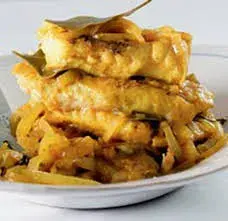
Cape Malay Pickled Fish
Abuja, Nigeria · Voir toutes les recettes
Aperçu
Firm white fish, floured and fried, then layered under a sweet-sour curried onion sauce and left in the fridge for at least a day before it is eaten. It is Cape Malay, it is South African, and in Cape Town it is inseparable from Easter. The Cape Malay community descends from people brought to the Cape from Southeast Asia, largely from the Indonesian archipelago, as slaves and political exiles by the Dutch from the seventeenth century onwards. Their cooking is the origin of much of what is now considered characteristically Cape cuisine, and pickled fish belongs squarely to it, the turmeric, the coriander seed, the bay leaves and the sweet-sour balance are all markers of that lineage. The Easter association is real but the explanations for it vary, and the dish is not exclusively Christian: it is eaten in Muslim Cape Malay households too, which is one of the reasons the "made for Good Friday" account is contested. Its practical origin is simpler. Vinegar and sugar preserve cooked fish for weeks without refrigeration, which mattered a great deal in the early colonial Cape. It genuinely improves with time. A day in the fridge is the minimum; two or three is better, and it holds for several weeks. The source's nutritional claims have not been carried across.
Note de Patrimoine AFN
Pickled fish is a Cape Malay dish from South Africa, made by frying fish and preserving it under a curried vinegar and onion sauce. Cape Malay cooking derives from communities brought to the Cape from Southeast Asia by the Dutch from the seventeenth century onwards. The dish is strongly associated with Easter in Cape Town and is eaten across religious communities there.
Ingrédients
Les mentions alimentaires sont fournies par les contributeurs à titre indicatif. Elles ne sont pas vérifiées par AFN et dépendent des produits que vous achetez. En cas d’allergie grave, vérifiez vous-même chaque ingrédient. Cuisine, allergies et votre propre jugement
Préparation
- 1
Dust the fish pieces with the flour and season with salt and pepper.
- 2
Heat oil in a large frying pan and shallow-fry the fish for about 2 minutes on each side, until just cooked and lightly golden. Drain on kitchen paper.
- 3
In a large pot, warm the vinegar and water over medium heat.
- 4
Put in the sliced onions, sugar, salt, turmeric, roasted masala, peppercorns, coriander seeds, bay leaves and apricot jam, and cook for 8 to 10 minutes, until the onions have softened but still have some bite.
- 5
Mix the corn flour paste through the sauce and cook briefly until it thickens slightly.
- 6
Layer the fish and the onion sauce in a large heatproof dish, making sure the sauce covers the fish completely.
- 7
Cool, cover, and refrigerate overnight at minimum. Two or three days is better.
Notes de l’Africook
 Notes personnelles de Amarachi Irobi
- Give it at least a day in the fridge. This is not a dish to eat on the day it is made, the whole point is what happens while it sits.
- Cover the fish completely with the sauce. Anything sticking out above the liquid will not keep.
- Keep the onions slightly firm. They soften further over the days in the fridge, and mushy onions make for a poor texture at the end.
- Do not overcook the fish at the frying stage. It carries on firming up in the vinegar.
- Apricot jam is not optional decoration, it is what balances the vinegar, and it is standard in Cape Malay pickled fish.
- Keep it properly refrigerated. Stored at 4°C or below it holds for several weeks, but it depends entirely on the fridge being cold enough.
Questions fréquentes
What is Cape Malay cooking?
The cuisine of the Cape Malay community of South Africa, descended from people brought to the Cape from Southeast Asia, largely the Indonesian archipelago, as slaves and political exiles by the Dutch from the seventeenth century onwards. Its hallmarks are the use of turmeric, coriander, cinnamon and cardamom alongside sweet-sour combinations, and it shaped much of what is now regarded as characteristically Cape cooking. Bobotie, bredies and koeksisters all come from the same tradition.
Why is it eaten at Easter?
The association is strong in Cape Town but the reasons given for it vary. One common account is that it was made to feed crowds after the long Good Friday service, though this is contested, pickled fish is also eaten in Muslim Cape Malay households, so it is not straightforwardly a Christian observance. The more practical explanation is that vinegar and sugar preserve cooked fish for weeks, which made it useful whenever a large quantity of food had to be prepared ahead.
What fish should I use?
A firm white fish that will hold together through frying and several days in vinegar. Hake is the usual choice in South Africa and is what this recipe uses; snoek, kingklip and yellowtail are all traditional. Avoid delicate flaky fish, which disintegrates in the sauce, and avoid oily fish such as mackerel, whose flavour does not suit the sweet-sour treatment. Frozen fillets work perfectly well provided they are properly thawed and dried first.
How long does it keep?
Several weeks in the refrigerator, provided it stays properly cold, at or below 4°C, and the fish remains fully submerged in the sauce. The vinegar and sugar are doing the preserving, which is what the dish was developed for. In practice it rarely lasts that long. It is at its best from about the second day, once the fish has taken on the sauce and the flavours have settled.
Avis
Soyez le premier à noter cette recette
Vous l’avez cuisinée ? Votre note aide la personne suivante à se décider.
Aucun avis sur cette recette pour le moment. Si vous l’avez cuisinée, le vôtre serait le premier.
Vous Aimerez Aussi
Voir toutes les recettes South Africa →
Dombolo (Dumplings or Steamed Bread)

Boeber (Cape Malay Sweet Milk Drink)