
Tandoori Chicken
Aperçu
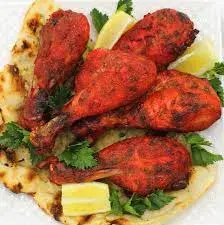
Tandoori chicken is chicken marinated in yoghurt and spices and roasted at very high heat in a tandoor, the cylindrical clay oven it takes its name from. The source states plainly that it originated in the Indian subcontinent, specifically the Punjab, and it sits in Worldwide Recipes under South Asian. The tandoor is what the dish is built around. It runs far hotter than a domestic oven, which is how the chicken cooks fast enough to char on the outside while staying moist inside. Cooking it elsewhere means adapting, and Western kitchens grill or roast instead. This recipe uses a conventional oven, which the source acknowledges as an adaptation. Two ingredients do the work. Yoghurt tenderises through its acid and lactic enzymes and keeps the meat moist, and garam masala provides the aroma. The food colouring in the ingredient list is worth knowing about: the characteristic red is achieved commercially with colouring rather than by any ingredient, and it can simply be left out with no effect on flavour. Tandoori chicken is also the foundation of butter chicken and several other cream-based curries.
Ingrédients
Les mentions alimentaires sont fournies par les contributeurs à titre indicatif. Elles ne sont pas vérifiées par AFN et dépendent des produits que vous achetez. En cas d’allergie grave, vérifiez vous-même chaque ingrédient. Cuisine, allergies et votre propre jugement
Préparation
- 1
Clean the chicken.
- 2
Add the rest of the ingredients to the chicken and mix well. A zipper bag makes this easier.
- 3
Marinate in the refrigerator for at least 8 hours, and preferably 24.
- 4
Remove the majority of the marinade before cooking.
- 5
Preheat the oven to 200°C and cook on a sheet pan for 25 to 30 minutes.
Notes de l’Africook
- Marinate for the full 24 hours if you can. Eight is the minimum and yoghurt works slowly.
- Scrape most of the marinade off before cooking. Thick yoghurt left on steams rather than chars, and the surface never colours.
- Skin off, always. The marinade cannot penetrate skin, and it stops the chicken taking on any char.
- The food colouring is cosmetic. The famous red comes from colouring rather than spice, and leaving it out changes nothing but the appearance.
- On a charcoal grill, bring the surface to around 230°C, arrange the legs skin side up over the cooler part, and turn as needed.
- Get the oven as hot as it will go if you want any char. A tandoor runs at close to 260°C, and a domestic oven at 200°C is already a compromise.
Questions fréquentes
What is a tandoor?
A cylindrical clay oven that reaches close to 260°C, far hotter than a domestic oven. Meat is cooked on long skewers lowered into it. That intense heat is what allows tandoori chicken to char on the outside while staying moist inside, and it is why home versions are always an adaptation.
Why is tandoori chicken red?
Food colouring, in almost all cases. The characteristic bright red or orange is cosmetic and comes from yellow and red colouring rather than from any spice, though paprika and cayenne contribute a little. It can be left out entirely with no effect on flavour, and many home cooks do.
Why yoghurt in the marinade?
It tenderises and moistens. The acid and enzymes in yoghurt break down the surface proteins of the meat over several hours, and its thickness keeps the spices in contact with the chicken. Greek yoghurt is used here because it is thick enough to cling rather than running off.
Is tandoori chicken African?
No. The source states it originated in the Indian subcontinent, in the Punjab, and it sits in Worldwide Recipes under South Asian. It is worth noting that tandoori cooking and Indian spice blends are genuinely present in East African food through the Indian communities of Kenya, Tanzania and Uganda.
Avis
Soyez le premier à noter cette recette
Vous l’avez cuisinée ? Votre note aide la personne suivante à se décider.
Aucun avis sur cette recette pour le moment. Si vous l’avez cuisinée, le vôtre serait le premier.