
Basbousa (Semolina Cake)
London, United Kingdom · Voir toutes les recettes
Aperçu
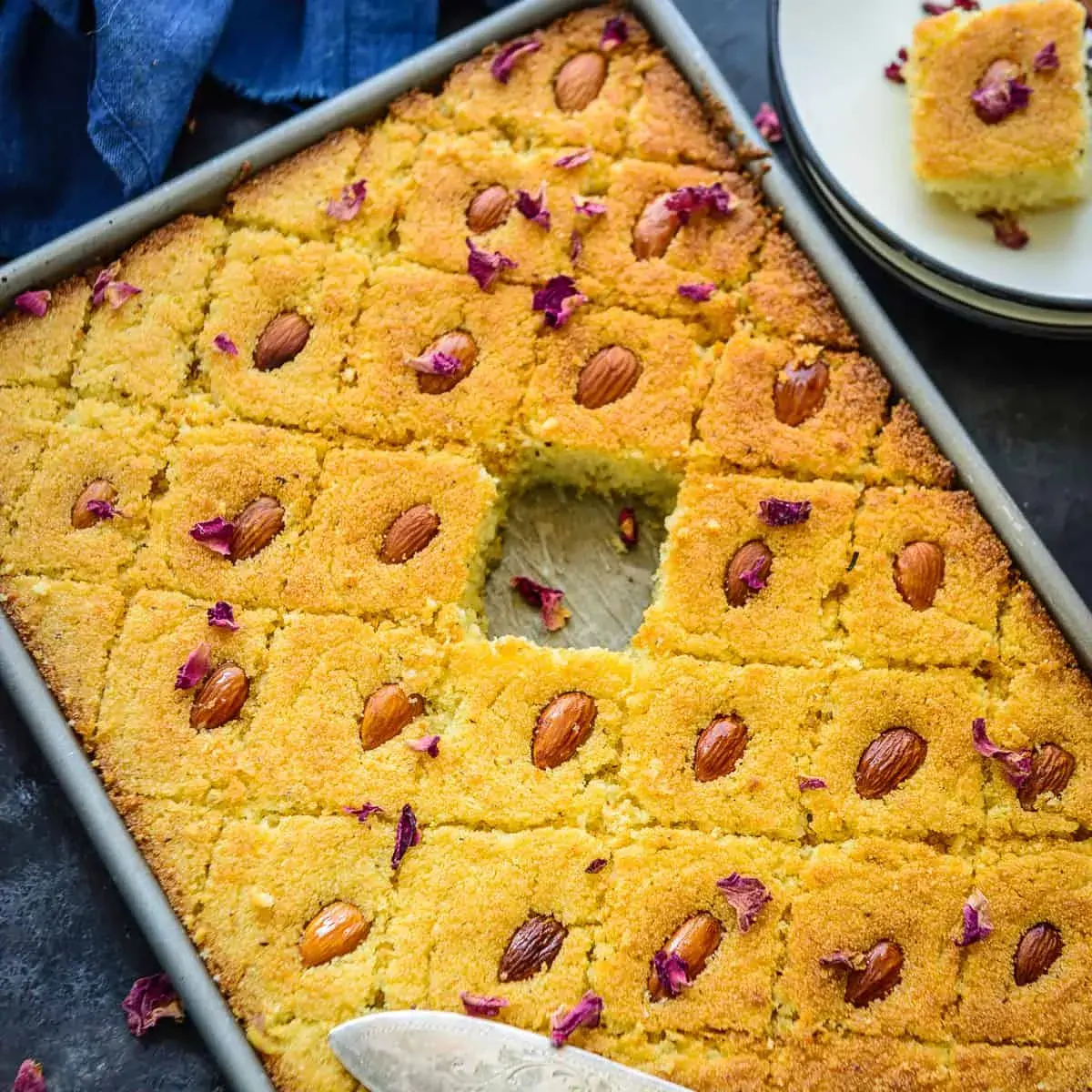
Basbousa is a semolina cake soaked in sugar syrup, and it is one of Egypt's best known desserts. It is scored into diamonds before baking, an almond pressed into each one, and the cooled syrup poured over while the cake is still hot. Its names change across the region. It is revani in Turkey and the Balkans, hareesa in the Levant, namoura in Lebanon, and basbousa across Egypt and much of the Arab world. The Arabic word basbousa translates roughly as just a kiss, which is an unusually charming piece of naming for a cake. Coarse semolina is the ingredient that defines it and desiccated coconut is the second. Semolina gives the slightly grainy, dense crumb that no flour cake reproduces, and it needs time to hydrate: the batter rests half an hour in the tin before baking, which is a step easy to skip and hard to recover from. The syrup rule is the one that decides the result: cooled syrup onto hot cake, then a final five minutes back in the oven so it is fully absorbed. The scoring must go all the way through after baking, or the syrup sits on top rather than sinking in.
Note de Patrimoine AFN
Basbousa is an Egyptian semolina cake soaked in sugar syrup, known as revani in Turkey and the Balkans, hareesa in the Levant and namoura in Lebanon. The Arabic name translates roughly as just a kiss.
Ingrédients
Les mentions alimentaires sont fournies par les contributeurs à titre indicatif. Elles ne sont pas vérifiées par AFN et dépendent des produits que vous achetez. En cas d’allergie grave, vérifiez vous-même chaque ingrédient. Cuisine, allergies et votre propre jugement
Préparation
- 1
First make the syrup. Combine the water, sugar and lemon juice in a small pan and bring to the boil. Lower the heat and simmer gently for 5 to 8 minutes.
- 2
Turn off the heat, stir in the rosewater or vanilla, and set the syrup aside to cool completely.
- 3
In a large bowl, mix the semolina, flour, baking powder, sugar, coconut and salt.
- 4
In a jug, mix the yoghurt, melted butter, eggs and vanilla.
- 5
Make a well in the dry ingredients and gradually add the liquid, mixing with a spatula into a thick batter.
- 6
Pour and level the batter into a greased 11x7 inch pan and lightly score the top into diamonds or squares.
- 7
Press a whole almond into the middle of each piece.
- 8
Cover and set the pan aside for half an hour so the semolina absorbs the liquid. Meanwhile preheat the oven to 180°C.
- 9
Uncover and bake for 40 minutes.
- 10
Remove from the oven and carefully cut all the way through the marks you scored earlier.
- 11
Pour the cooled syrup as evenly as possible over the hot basbousa.
- 12
Return the pan to the oven for a further 5 minutes.
- 13
Let it rest at least 30 minutes before cutting out the pieces and serving.
Notes de l’Africook
 Notes personnelles de Nympha Nzeribe
- Cooled syrup onto hot cake. This is the rule for every syrup-soaked cake in the region and getting it the wrong way round gives a soggy top and a dry middle.
- Rest the batter the full half hour before baking. Semolina needs that time to absorb the liquid, and skipping it gives a gritty cake.
- Cut all the way through after baking, before the syrup goes on. Scoring alone is not enough for the syrup to reach the base.
- Use coarse semolina rather than fine. The slightly grainy crumb is what basbousa is, and fine semolina gives something closer to a plain sponge.
- The extra five minutes in the oven after the syrup goes on is what finishes the absorption. Do not skip it.
- Let it rest thirty minutes before cutting the pieces out, or they fall apart.
Questions fréquentes
What does basbousa mean?
The Arabic word translates roughly as just a kiss. It goes by other names across the region: revani in Turkey and the Balkans, hareesa in the Levant, and namoura in Lebanon. All refer to essentially the same semolina cake soaked in syrup, with local variations in flavouring.
Can I use fine semolina instead of coarse?
You can, but the texture changes. Coarse semolina gives the slightly grainy, substantial crumb that basbousa is characterised by. Fine semolina produces something closer to a plain sponge cake. If coarse is all you can find, the recipe still works; it simply is not quite the same cake.
Why does the batter rest before baking?
So the semolina hydrates. Semolina absorbs liquid slowly, and half an hour in the tin lets it swell before it meets the heat. Baked immediately, the grains stay hard and the cake comes out gritty. This is the step most often skipped and it makes a real difference.
How do I stop it going soggy?
Pour cooled syrup over the hot cake, never hot onto hot. Cut all the way through the scored lines first so the syrup travels down rather than pooling. And give it the extra five minutes in the oven afterwards, which drives the absorption and firms the surface again.
Avis
Soyez le premier à noter cette recette
Vous l’avez cuisinée ? Votre note aide la personne suivante à se décider.
Aucun avis sur cette recette pour le moment. Si vous l’avez cuisinée, le vôtre serait le premier.
Vous Aimerez Aussi
Voir toutes les recettes Egypt →
Tarb (Grilled Kofta Wrapped in Lamb Fat)
Egyptian Meshabek