
Bamia
Aperçu
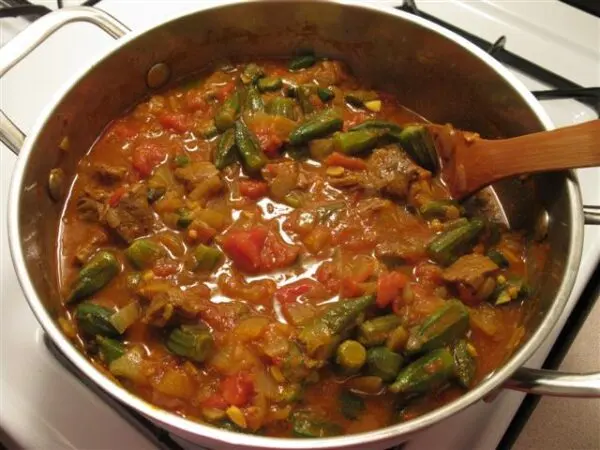
Bamia is a stew of lamb, okra and tomato, and the name is simply the Arabic word for okra, which tells you where the emphasis lies. It is eaten across an enormous area: all the Arab countries, Anatolia and Turkey, Greece, Afghanistan and Iran, with regional variations at every point. In Egypt it is a household staple and particularly associated with Ramadan, where it appears regularly on iftar tables. The construction is straightforward. Lamb is browned and stewed with onion, garlic and tomato, seasoned with coriander and cardamom, and okra is added to cook in the sauce. It is often finished in the oven in a clay dish, which is worth doing if you have one, the even, enclosed heat suits it. The okra question dominates how people feel about the dish. Okra releases a mucilaginous liquid when cut and cooked in liquid, which thickens the stew. Some cuisines prize this; others go to considerable lengths to avoid it. Using whole small okra rather than sliced, and not overworking it, keeps it to a minimum. Small young pods are much better than large ones, which turn woody.
Note de Patrimoine AFN
Bamia takes its name from the Arabic word for okra and is eaten across the Arab world, Anatolia, Greece, Iran and Afghanistan with regional variation. In Egypt it is a household staple with a particular association with Ramadan.
Ingrédients
Les mentions alimentaires sont fournies par les contributeurs à titre indicatif. Elles ne sont pas vérifiées par AFN et dépendent des produits que vous achetez. En cas d’allergie grave, vérifiez vous-même chaque ingrédient. Cuisine, allergies et votre propre jugement
Préparation
- 1
Wash the baby okra and trim the very tops without cutting into the pods. Keeping them whole prevents excess sliminess during cooking.
- 2
In a heavy-based pot, heat the olive oil over medium heat. Add the onion and cook until soft and lightly golden, about 8 minutes.
- 3
Add the garlic and cook for 1 minute until fragrant.
- 4
Add the tomatoes, tomato paste, cumin, coriander, cinnamon, and a pinch of pepper. Stir and cook for 5 to 6 minutes until the sauce thickens and darkens slightly.
- 5
If using lamb or beef, add the meat pieces now and brown lightly on all sides in the tomato base.
- 6
Add enough water to just cover the meat. Season with salt. Bring to a simmer, cover, and cook for 25 minutes.
- 7
Add the trimmed okra in a single layer over the stew. Do not stir, leave the okra to steam and cook undisturbed.
- 8
Cover and cook for a further 20 to 25 minutes on low heat until the okra is tender and the sauce has thickened. Finish with a squeeze of lemon juice.
Notes de l’Africook
- Use small young okra pods whole. Large ones are woody and slicing releases far more mucilage.
- Brown the lamb properly before the liquid goes in, it is the main source of depth.
- Add the okra later than you think. It needs far less time than the meat.
- A clay dish in the oven suits the finish if you have one; any deep baking dish works.
Questions fréquentes
How do I stop it going slimy?
Use small whole okra rather than slicing it, since cutting is what releases most of the mucilage. Adding it late, so it spends less time in liquid, helps considerably. Some cooks fry the okra briefly first or add a little lemon juice or vinegar. It will never be entirely absent, that thickening is part of what the dish is.
Can I use beef instead of lamb?
Yes. Lamb is the most traditional and gives the richest result, but beef is common and works well. Both need enough time for the meat to become genuinely tender before the okra goes in, so plan the order rather than putting everything in together.
Is bamia Egyptian or Middle Eastern?
Both, in the sense that it is genuinely widespread. It is cooked across the Arab world and well beyond, and Egypt has its own firmly established version that is a household staple. It is filed here as Egyptian because that tradition is real and long-standing, not because the dish originates only there.
Avis
Soyez le premier à noter cette recette
Vous l’avez cuisinée ? Votre note aide la personne suivante à se décider.
Aucun avis sur cette recette pour le moment. Si vous l’avez cuisinée, le vôtre serait le premier.
Vous Aimerez Aussi
Voir toutes les recettes Egypt →
Tarb (Grilled Kofta Wrapped in Lamb Fat)
Egyptian Meshabek