
Ghorayebah
Aperçu
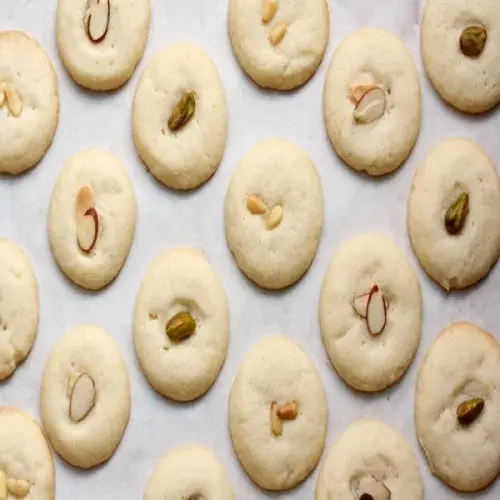
Ghorayebah is the Egyptian butter cookie, made with ghee and almost nothing else, and its whole character is texture. It is barely sweet, pale to the point of being off-white, and it disintegrates the moment it is bitten. Four ingredients make it: ghee, icing sugar, flour and a little vanilla, with baking powder for a very slight lift. The classic Egyptian version is flavoured with nothing beyond the ghee itself, which is the point of it. Elsewhere in the Arab world, in Syria and Lebanon particularly, it is flavoured with orange blossom and rose water, is slightly crunchier, and is pronounced graybeh. It also goes by ghraybeh and ghoraybeh. The comparison usually made is shortbread without the crunch, and that is fair as far as it goes. What ghorayebah has that shortbread does not is a fine, almost powdery crumb and a smooth finish with a faintly fuzzy outer surface. Two things produce it: ghee rather than butter, which contains no water, and a very low oven that dries the cookie without colouring it. It must not brown. A clove pressed into the centre of each is the traditional finish.
Note de Patrimoine AFN
Ghorayebah is an Egyptian butter cookie made with ghee, eaten for centuries and also known as ghraybeh and ghoraybeh. Levantine versions are flavoured with orange blossom and rose water and are pronounced graybeh.
Ingrédients
Les mentions alimentaires sont fournies par les contributeurs à titre indicatif. Elles ne sont pas vérifiées par AFN et dépendent des produits que vous achetez. En cas d’allergie grave, vérifiez vous-même chaque ingrédient. Cuisine, allergies et votre propre jugement
Préparation
- 1
Preheat the oven to 150°C.
- 2
Mix the sugar and ghee together until creamy, then stir in the vanilla extract and baking powder.
- 3
Add the flour in small batches until the dough is thickened and combined.
- 4
Roll the dough into walnut-sized balls and place them 5cm apart on baking sheets.
- 5
Flatten each slightly and press a clove into the centre.
- 6
Bake until ivory coloured, 10 to 20 minutes. They should not brown.
- 7
Cool on the sheets for 10 minutes before transferring to a wire rack to cool completely, another 10 to 20 minutes.
Notes de l’Africook
- They must not brown. Ivory is the colour to stop at, and a browned ghorayebah has lost the pale, delicate quality that defines it.
- Use ghee rather than butter. Ghee has no water in it, which is what gives the fine, powdery crumb; butter makes a different and heavier cookie.
- Add the flour gradually and stop when the dough just holds. Too much flour makes them dry rather than melting.
- Let them cool on the sheet before moving them. They are extremely fragile while warm and break if lifted early.
- The clove in the centre is traditional and is usually removed before eating rather than eaten.
- For the Levantine version, add a tablespoon of orange blossom or rose water with the vanilla.
Questions fréquentes
What is the difference between ghorayebah and shortbread?
Texture, mainly. Shortbread is crisp and crumbly with a definite bite. Ghorayebah is finer and softer, with a powdery crumb that disintegrates in the mouth rather than snapping. It is also barely sweet where shortbread is sweeter, and it is made with ghee rather than butter.
Why ghee rather than butter?
Because ghee contains no water. Butter is around fifteen percent water, which creates steam in the oven and changes the crumb. Ghee gives the fine, dry, melting texture that ghorayebah is defined by, along with its distinctive nutty flavour. Substituting butter makes a good cookie but not this one.
Why must they not brown?
Because the pale off-white colour is part of what the cookie is. The low oven dries them out rather than colouring them, and browning brings a caramelised flavour that overwhelms the delicate ghee taste. Take them out when they are still ivory, even if they seem underdone.
What is the clove for?
It is the traditional decoration, pressed into the centre of each cookie before baking, and it perfumes the surface lightly as it bakes. It is usually lifted off rather than eaten, since a whole clove is very strong. Some versions use a blanched almond or a pistachio instead.
Avis
Soyez le premier à noter cette recette
Vous l’avez cuisinée ? Votre note aide la personne suivante à se décider.
Aucun avis sur cette recette pour le moment. Si vous l’avez cuisinée, le vôtre serait le premier.
Vous Aimerez Aussi
Voir toutes les recettes Egypt →
Tarb (Grilled Kofta Wrapped in Lamb Fat)
Egyptian Meshabek