
Green Seasoning
Abuja, Nigeria · Voir toutes les recettes
Aperçu
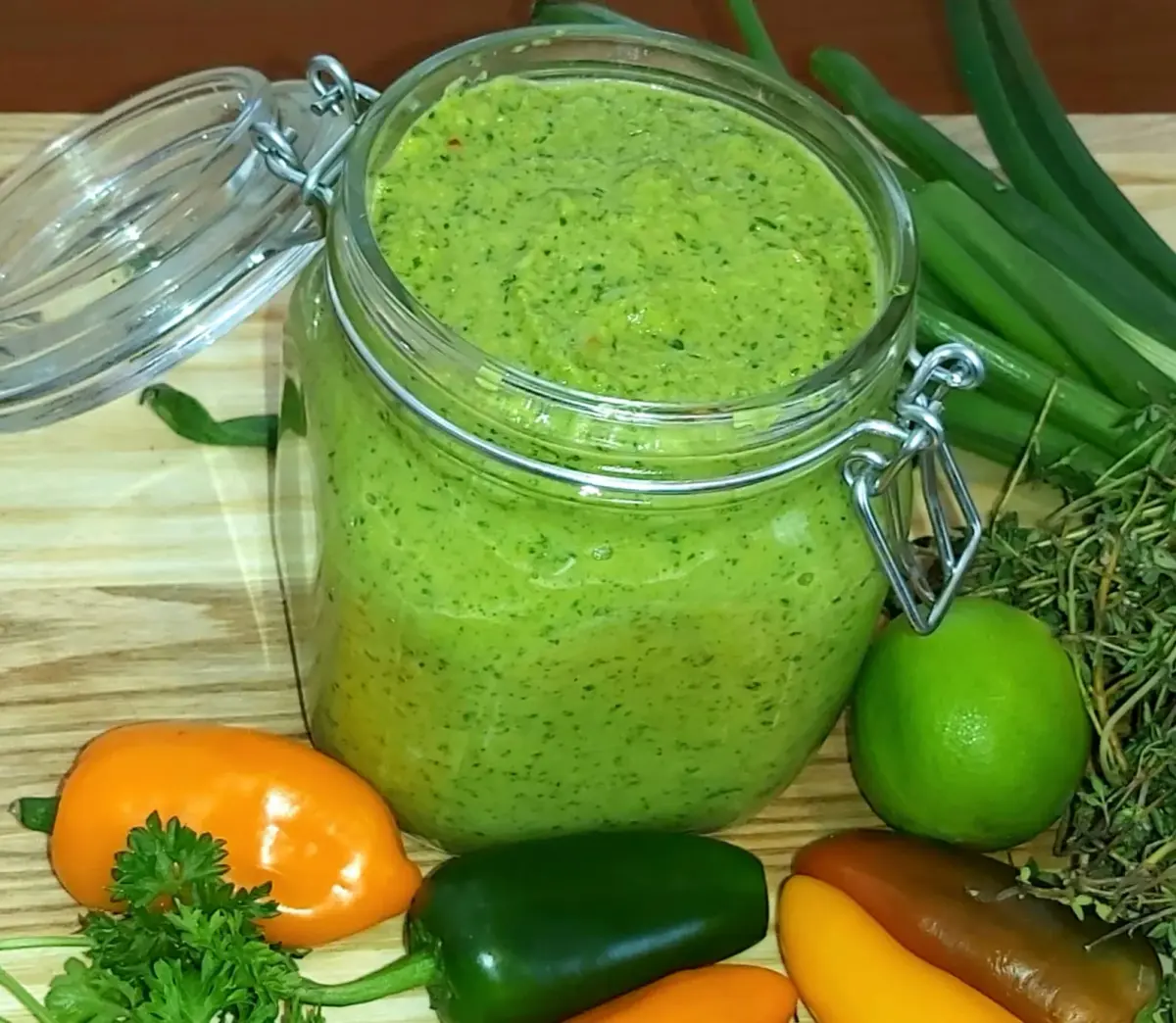
Green seasoning is a blended paste of fresh herbs, aromatics and chilli, used across the Caribbean as an all-purpose marinade and flavour base. Trinidad and Tobago is where it is most identified, and Guyana, Jamaica and the wider region all have versions. The source describes it as known to the Caribbean and some parts of Africa, which is a fair way of putting it. Its home is the Caribbean. What it resembles in Africa is a family of green pastes that do similar work: Senegalese nokoss, Moroccan chermoula, and the blended pepper bases used across West Africa. Those are related in function rather than in origin, and green seasoning as it is made here is Caribbean. It goes on everything: meat, seafood, grains, stews. Composition varies enormously by household and island, and the version here is a modest one built on parsley, coriander, celery, onion, garlic, scotch bonnet and thyme. Bigger versions include chive, culantro, pimento peppers and ginger. It keeps about a week refrigerated, and freezing it in ice cube trays is the standard way to hold a large batch, which is how most Caribbean kitchens handle it.
Ingrédients
Les mentions alimentaires sont fournies par les contributeurs à titre indicatif. Elles ne sont pas vérifiées par AFN et dépendent des produits que vous achetez. En cas d’allergie grave, vérifiez vous-même chaque ingrédient. Cuisine, allergies et votre propre jugement
Préparation
- 1
Add all the ingredients to a food processor or blender.
- 2
Blend until a smooth, uniform paste forms.
- 3
Add a tablespoon of water at a time if needed to help it blend.
- 4
Transfer to an airtight container and refrigerate for up to 1 week.
Notes de l’Africook
 Notes personnelles de Deborah Olayiwola
- Add water sparingly. A tablespoon at a time is enough to get the blades moving, and too much gives a thin sauce rather than a paste.
- Freeze it in ice cube trays. Each cube is roughly one portion and it keeps for months, which is how most Caribbean kitchens store a large batch.
- Seed the scotch bonnet unless you want it genuinely fierce. The flavour is in the flesh and most of the heat is in the seeds and membrane.
- The olive oil is optional and helps it keep. A film of oil on the surface in the jar slows oxidation and stops the green browning.
- Fresh thyme in place of dried is better if you have it, using about three times the quantity.
- It is a marinade and a base rather than a finished sauce. Rub it into meat or fish hours ahead, or start a stew with it.
Questions fréquentes
Where is green seasoning from?
The Caribbean, and Trinidad and Tobago most of all, with versions across Guyana, Jamaica and the wider region. The source describes it as known to the Caribbean and parts of Africa, which is fair, but its home is Caribbean. It sits in Worldwide Recipes under Caribbean for that reason.
What are the African equivalents?
Related in function rather than origin. Senegalese nokoss is a blended paste of onion, garlic, pepper and herbs used to start dishes. Moroccan chermoula is coriander, cumin, garlic and paprika, used mainly with fish. West African blended pepper bases do similar work. None of them is green seasoning, but all occupy the same place in a kitchen.
How long does it keep?
About a week refrigerated in an airtight container, and a film of oil on the surface helps. For longer storage, freeze it in ice cube trays and bag the cubes: it keeps for months that way and each cube is roughly one portion, which is how most Caribbean households manage it.
What do I use it for?
As a marinade for meat, poultry and seafood, rubbed in hours ahead, and as the base a stew or rice dish is started from. It also goes into soups and marinades for grilling. It is a foundation rather than a finishing sauce, and a couple of tablespoons goes a long way.
Avis
Soyez le premier à noter cette recette
Vous l’avez cuisinée ? Votre note aide la personne suivante à se décider.
Aucun avis sur cette recette pour le moment. Si vous l’avez cuisinée, le vôtre serait le premier.