
Rock Buns
Aperçu
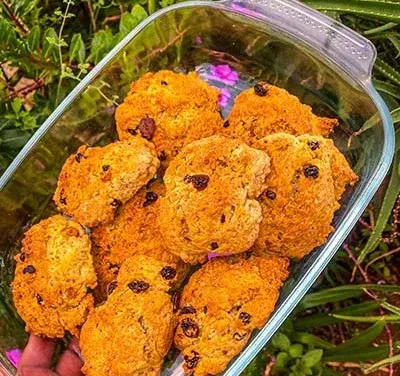
Rock buns are a British baked good, and the source says so plainly. Small, rough textured cakes made from flour, sugar, fat, eggs and dried fruit, they take their name from their craggy appearance rather than from their texture, which is tender and crumbly inside. They belong to British home baking of a particular era, when a cheap, quick cake made from pantry staples and eaten with tea was a household standard. The rough shape is not a matter of rusticity for its own sake: the dough is deliberately not shaped, only spooned onto a tray, and the peaks that form are what give the bun its name and its crisp edges. They travelled with the British empire and are still widely baked in Kenya, Uganda, Nigeria, Ghana and across the Caribbean, where they turn up in school canteens, bakeries and home kitchens and are treated as entirely local. That is a real part of their story, and it is why one appears in this archive. But the bun itself is British in origin, so it sits in the Worldwide Recipes collection rather than being presented as an African dish.
Ingrédients
Les mentions alimentaires sont fournies par les contributeurs à titre indicatif. Elles ne sont pas vérifiées par AFN et dépendent des produits que vous achetez. En cas d’allergie grave, vérifiez vous-même chaque ingrédient. Cuisine, allergies et votre propre jugement
Préparation
- 1
Preheat the oven to 180°C.
- 2
Mix all the dry ingredients together in a bowl.
- 3
Mix the wet ingredients together separately, then pour them into the dry ingredients.
- 4
Stir until it forms a stiff dough.
- 5
Scoop with a spoon and place in rough heaps on a baking tray. Do not shape them.
- 6
Bake until golden brown, about 25 minutes.
Notes de l’Africook
 Notes personnelles de iam.nkay
- Do not shape or smooth the heaps. The rough peaks are the whole point, and they are what crisp up and give the bun its name.
- Keep the dough stiff rather than loose. A wet mixture spreads into flat discs instead of holding its craggy shape.
- Leave space between them on the tray. They spread a little and rough edges need air to crisp.
- Do not overmix once the wet meets the dry. Overworking develops gluten and gives a tough, bready bun instead of a crumbly one.
- They are best on the day they are baked and go dry quickly, which is why the traditional serving is with tea.
Questions fréquentes
What is the difference between a rock bun and a scone?
Texture and handling. Rock buns are rough, craggy and crumbly, made from a stiff dough spooned straight onto the tray without shaping. Scones are smoother and softer, made from a wetter dough that is patted out and cut, then usually split and served with cream and jam. The ingredients overlap considerably; the treatment does not.
Are rock buns African?
No, they are British in origin, and the source says so directly. They are widely baked across Kenya, Uganda, Nigeria, Ghana and the Caribbean, where they arrived through British colonial contact and are now made as local everyday baking. That adoption is real, but the bun itself is not African, so it sits in the Worldwide Recipes collection.
Why are mine flat rather than craggy?
The dough was too wet, or it was shaped. Rock buns need a stiff dough that holds its form, spooned into rough heaps and left alone. If the mixture slumps on the tray, work in a little more flour. Smoothing the tops, however tempting, removes the peaks that define them.
Can I use butter instead of margarine?
Yes, and it gives a better flavour. Margarine is specified here and is what most home bakers of this recipe have traditionally used, but butter works identically in the method. Use it cold and rub it into the flour if you want a more crumbly texture, or melted for a quicker mix.
Avis
Soyez le premier à noter cette recette
Vous l’avez cuisinée ? Votre note aide la personne suivante à se décider.
Aucun avis sur cette recette pour le moment. Si vous l’avez cuisinée, le vôtre serait le premier.
Vous Aimerez Aussi
Voir toutes les recettes United Kingdom →
Tripe (Mogodu)
Isombe
Mozambique Matapa Recipe