
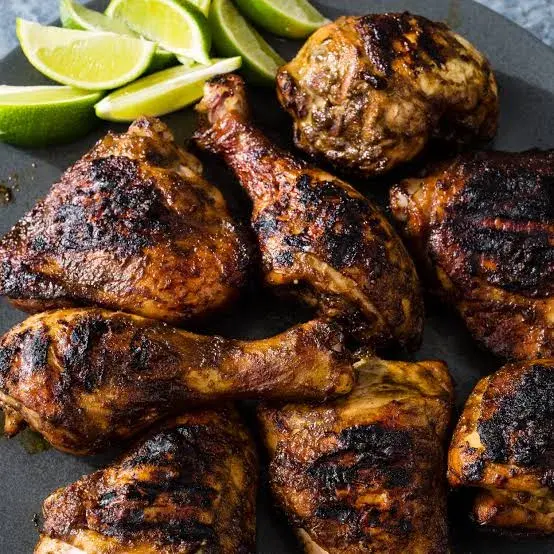
Jerk Chicken
Abuja, Nigeria · Voir toutes les recettes
Aperçu
Chicken marinated overnight in a paste of scotch bonnet, allspice, thyme, nutmeg and scallion, then grilled. It is Jamaican, and it sits in Worldwide Recipes under Caribbean with its URL unchanged. Its history is directly relevant to this site. Jerk as a technique comes from the Taíno, the indigenous people of Jamaica, and it was taken up and developed by Africans brought to the island, including the Maroons, communities of escaped enslaved people who lived independently in the interior and for whom slow-cooking meat over a covered fire was both practical and concealable. What is now Jamaica's most recognisable dish is a product of that meeting. Two things define real jerk beyond the spice mix. The first is pimento wood, the allspice tree, burned under the meat, so the smoke carries the same aromatic compounds as the seasoning. The second is slow cooking over that smoke rather than fast grilling. Neither is available to most home cooks, which is why domestic jerk chicken is good rather than great. The heat is not optional and should not be reduced too far. Scotch bonnet is central, and its fruity aroma matters as much as its heat. The source's ingredient list is the only place five-spice powder appears; it is not traditional but it works.
Note de Patrimoine AFN
Jerk is a Jamaican cooking method in which meat is coated in a spice paste and slow-cooked over a fire of pimento wood. The technique originated with the Taíno, the indigenous people of Jamaica, and was developed by Africans brought to the island, including the Maroon communities of the interior.
Ingrédients
Les mentions alimentaires sont fournies par les contributeurs à titre indicatif. Elles ne sont pas vérifiées par AFN et dépendent des produits que vous achetez. En cas d’allergie grave, vérifiez vous-même chaque ingrédient. Cuisine, allergies et votre propre jugement
Préparation
- 1
Combine the onion, scallions, chillies, garlic, five-spice powder, allspice, black pepper, thyme, nutmeg and salt in a food processor and work them to a coarse paste.
- 2
With the machine running, pour in the soy sauce and oil in a steady stream.
- 3
Pour the marinade into a large shallow dish, put in the chicken and turn it so every piece is coated.
- 4
Cover and refrigerate overnight. This is not optional if you want the flavour to reach the meat rather than sitting on the skin.
- 5
Bring the chicken back to room temperature before cooking.
- 6
Light a grill and cook the chicken over a medium-hot fire, turning it occasionally, until well browned and cooked through: 35 to 40 minutes.
- 7
Cover the grill for a smokier result.
- 8
Transfer to a platter and serve.
Notes de l’Africook
 Notes personnelles de Amarachi Irobi
- Marinate overnight. Jerk is a slow-marinated dish and a couple of hours will not get the flavour past the skin.
- Cover the grill. Trapping the smoke is the closest most people can get to the pimento-wood fire that defines real jerk.
- Do not reduce the scotch bonnet too far. Its fruity aroma matters as much as its heat and the dish is flat without it.
- Wear gloves handling scotch bonnets, and keep your hands away from your eyes afterwards.
- Cook it over medium rather than fierce heat. Jerk is slow-cooked traditionally and a hot fire chars the marinade before the chicken is done.
- Rice and peas is the standard accompaniment, and festival, the sweet fried dumpling, alongside it.
Questions fréquentes
Where does jerk come from?
Jamaica, and its history is a meeting of two peoples. The technique originated with the Taíno, the island's indigenous inhabitants, who cooked meat slowly over covered fires. It was taken up and developed by Africans brought to Jamaica, particularly the Maroons, communities of escaped enslaved people living independently in the interior, for whom a cooking method that produced little visible smoke had obvious practical value. The result is now Jamaica's most recognisable dish.
What does jerk actually mean?
The word most likely derives from charqui, the Spanish rendering of a Quechua term for dried strips of meat, which also gives English the word jerky. In Jamaican usage it names both the spice paste and the method: meat coated in that paste and slow-cooked over a fire, traditionally of pimento wood. It applies to chicken most famously but also to pork, goat, fish and vegetables.
What makes jerk taste like jerk?
Three things, and most home cooks only get two. Allspice, pimento, is the defining spice, along with scotch bonnet and thyme. Second is time: an overnight marinade so the flavour reaches the meat. Third, and hardest to reproduce, is pimento wood burned under the meat, so the smoke carries the same aromatic compounds as the seasoning. Covering a domestic grill to trap the smoke is the nearest approximation.
Is jerk chicken African?
Not in origin, but its history is inseparable from the African presence in the Caribbean. The technique came from the Taíno; it was developed into what we now recognise as jerk by enslaved Africans and the Maroon communities descended from them. The page sits in Worldwide Recipes under Caribbean, with its URL unchanged. The connection is real and worth stating rather than either claiming or ignoring.
Avis
Soyez le premier à noter cette recette
Vous l’avez cuisinée ? Votre note aide la personne suivante à se décider.
Aucun avis sur cette recette pour le moment. Si vous l’avez cuisinée, le vôtre serait le premier.
Vous Aimerez Aussi
Banana Soup
Pap & Sous
How to Make Crispy Fried Chicken Feet