
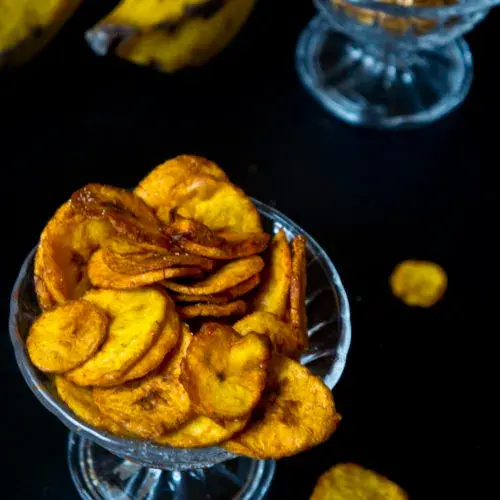
Plantain Chips
London, United Kingdom · Voir toutes les recettes
Aperçu
Green plantain sliced paper-thin and fried until crisp. It is a snack made across West Africa, the Caribbean and Latin America, and no single country is claimed for it. **One correction to the source, and it matters.** It says plantain chips are "also known as alloco, dodo, or chicharritas". Chicharritas is right, that is the Cuban and Puerto Rican name for exactly this. But alloco and dodo are not chips. Both are the West African dish of *ripe* plantain cut into thick pieces and fried soft: sweet, tender and yielding, the opposite of a crisp. Alloco is the Ivorian name and dodo the Nigerian one, and both have their own pages on this site. Conflating them with chips confuses two quite different foods. The distinction comes down to ripeness. Green plantain is starchy and barely sweet, and sliced thin it dries and crisps. Ripe plantain is full of sugar and moisture; sliced thin it burns before it crisps, and cut thick it fries soft. The source's own instructions are good, do not salt before frying, do not use overripe fruit, season while hot, but they are written as a list of tips rather than as a method. A method has been constructed.
Note de Patrimoine AFN
Plantain chips are made from thinly sliced green plantain, fried or baked until crisp, and eaten as a snack across West Africa, the Caribbean and Latin America. They are distinct from alloco and dodo, which are West African dishes of thick-cut ripe plantain fried soft.
Ingrédients
Les mentions alimentaires sont fournies par les contributeurs à titre indicatif. Elles ne sont pas vérifiées par AFN et dépendent des produits que vous achetez. En cas d’allergie grave, vérifiez vous-même chaque ingrédient. Cuisine, allergies et votre propre jugement
Préparation
- 1
Peel the plantains. Green plantain skin does not come away like a banana's, score it lengthways with a knife and lift it off in sections.
- 2
Slice the plantains as thinly and evenly as you can. A mandoline is the honest answer here unless you are very good with a knife; uneven slices cook unevenly and some will burn while others are still soft.
- 3
Do not salt or season the slices before frying. Salt draws water to the surface and stops them crisping.
- 4
Heat the oil to around 350°F / 175°C. Test with a single slice, it should sizzle immediately without browning instantly.
- 5
Lower the slices into the oil one at a time, or in a single layer, so they do not stick together.
- 6
Turn them continuously as they fry. Watch the colour and listen for the sizzle to drop off, which tells you the moisture has gone.
- 7
Lift them out when golden and drain on kitchen paper.
- 8
Season with salt while they are still hot, so it sticks.
- 9
Cool completely before serving, they crisp further as they cool.
Notes de l’Africook
 Notes personnelles de Nympha Nzeribe
- Use green, unripe plantain. Ripe plantain has too much sugar and moisture to crisp, and it burns instead.
- Slice thinly and evenly. A mandoline is worth using unless your knife work is genuinely good.
- Do not season before frying. Salt pulls water to the surface and the chips go soft rather than crisp.
- Fry in a single layer and turn constantly. Stacked slices stick together and steam.
- Salt them while hot, it will not adhere once they have cooled.
- Cool completely before storing, and keep them in an airtight container. Warm chips in a sealed tin go soft from their own steam.
Questions fréquentes
Are plantain chips the same as alloco or dodo?
No, and the source gets this wrong. Alloco is the Ivorian name and dodo the Nigerian one for thick-cut *ripe* plantain fried until soft, sweet and tender, a side dish rather than a snack. Plantain chips are thin slices of *green* plantain fried until dry and crisp. Chicharritas, the other name the source gives, is correct: that is the Cuban and Puerto Rican term for the same crisp. Alloco and dodo have their own pages here.
Why must the plantain be green?
Because of sugar and water. Green plantain is starchy and barely sweet, so thin slices dry out and crisp in hot oil. Ripe plantain has converted much of that starch to sugar and holds far more moisture, thin slices burn on the outside before the inside dries, and thick slices fry soft. If you want something made from ripe plantain, the dish you are looking for is dodo or alloco.
Why not salt them before frying?
Salt draws moisture out of the plantain and onto the surface by osmosis, and surface moisture is precisely what prevents crisping, the slice steams instead of frying. Season generously the moment they come out of the oil, while they are still hot and slightly oily, and the salt will stick. This is the same reason chips and crisps are salted after frying rather than before.
How do I keep them crisp?
Cool them completely before they go into any container. Warm chips sealed in a tin release steam, which condenses and softens them within an hour. Once fully cool, an airtight container keeps them crisp for several days. Drying them thoroughly on kitchen paper straight from the oil also helps, residual oil goes soft and greasy as it cools if there is too much of it.
Avis
Soyez le premier à noter cette recette
Vous l’avez cuisinée ? Votre note aide la personne suivante à se décider.
Aucun avis sur cette recette pour le moment. Si vous l’avez cuisinée, le vôtre serait le premier.