

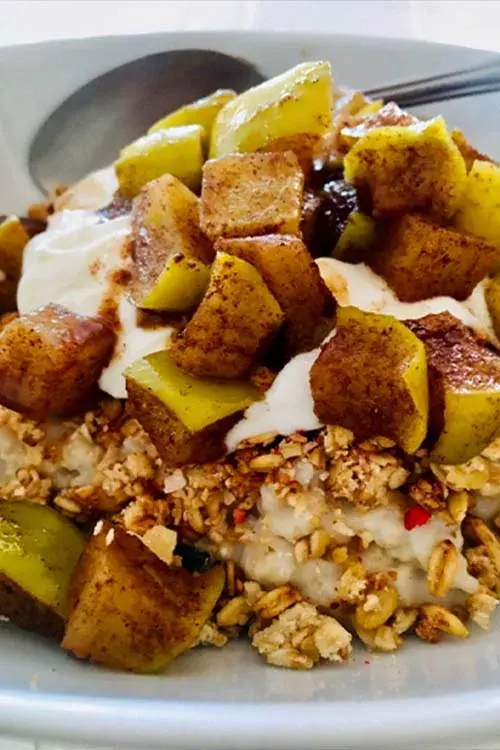
Oatmeal with Water
Aperçu
Quick oats cooked with boiling water in a microwave, topped with jammy cinnamon apples, yoghurt and muesli. No country is claimed, though the contributor is South African. Water rather than milk is the premise, and it is worth understanding what that trades. Oats cooked in water are cleaner and lighter, and the oat flavour comes through more clearly; oats cooked in milk are creamier and richer. Neither is better. What the recipe does is compensate for the leanness at the end rather than during cooking, a dollop of double cream Greek yoghurt goes on top, so the richness arrives as a distinct layer rather than being cooked in. The apples are the useful idea. Chopped apple with cinnamon and a spoonful of apricot jam, microwaved for two or three minutes, collapses into something between a compote and a jam, and takes almost no effort. It does more for a bowl of plain oats than any amount of stirring. Salt is not optional. A pinch in the oats is what stops them tasting flat, and it is the most commonly skipped ingredient in any porridge. The source's ingredient list is scrambled, its section headings were absorbed into it, shifting every quantity that followed onto the wrong item. Rebuilt from the method.
Ingrédients
Les mentions alimentaires sont fournies par les contributeurs à titre indicatif. Elles ne sont pas vérifiées par AFN et dépendent des produits que vous achetez. En cas d’allergie grave, vérifiez vous-même chaque ingrédient. Cuisine, allergies et votre propre jugement
Préparation
- 1
Put the oats into a microwaveable dish.
- 2
Pour in the boiling water and mix in the salt and cinnamon to taste.
- 3
Microwave on full power for 2 minutes, turning the oats through at intervals.
- 4
Take them out and let them stand for a minute.
- 5
Put the chopped apples into a separate microwaveable container.
- 6
Scatter the cinnamon or mixed fruit spice over the apples and mix in the jam. Cover and microwave for 2 to 3 minutes.
- 7
Take the apples out and mix well so they are evenly coated in the cinnamon and jam.
- 8
Mix some of the yoghurt through the oats and transfer to a serving bowl.
- 9
Top with a dollop of yoghurt, the jammy cinnamon apples and a scattering of muesli, and serve.
Notes de l’Africook
 Notes personnelles de Nozuko M
- Salt the oats. A pinch is what stops porridge tasting flat, and it is the most commonly skipped ingredient in any oatmeal.
- Let it stand for a minute after microwaving. The oats keep absorbing and the texture settles.
- The apples take three minutes and transform the bowl. Do not skip them for a plain version.
- Use boiling water rather than cold. It cuts the microwave time and gives a smoother result.
- The yoghurt goes on top rather than in. That is the point, the richness arrives as a layer rather than being cooked through.
- Quick oats are what this recipe assumes. Rolled or steel-cut oats need considerably longer and more liquid.
Questions fréquentes
Is oatmeal better with water or milk?
Neither is better; they give different results. Water produces a cleaner, lighter porridge where the oat flavour comes through clearly. Milk produces something creamier and richer but heavier. This recipe uses water and then adds a dollop of double cream yoghurt on top, so the richness arrives as a distinct layer rather than being cooked in, which is arguably the best of both.
Do I have to salt it?
You should. A pinch of salt in porridge is the difference between oats that taste of something and oats that taste of nothing, and it is the single most commonly skipped ingredient in any oatmeal recipe. It does not make the porridge salty, it makes the oats and whatever you put on them taste more like themselves. Scottish porridge is traditionally made with salt and no sugar at all.
What oats should I use?
Quick-cooking oats, which is what this recipe assumes and what makes the two-minute microwave timing work. Rolled oats need longer and more liquid; steel-cut oats need considerably longer still and are not suited to a microwave at all. If you are using anything other than quick oats, adjust both the liquid and the time upward and expect a chewier, more textured result.
Is this an African recipe?
No, and none is claimed, oats are a temperate cereal and porridge of this kind is a Northern European tradition. The contributor is South African, and the double cream yoghurt and apricot jam are both South African supermarket staples. The page sits in Worldwide Recipes under Global with its URL unchanged. Africa has its own extensive porridge traditions, ogi, koko, uji, madeeda, all with their own pages here.
Avis
Soyez le premier à noter cette recette
Vous l’avez cuisinée ? Votre note aide la personne suivante à se décider.
Aucun avis sur cette recette pour le moment. Si vous l’avez cuisinée, le vôtre serait le premier.
Vous Aimerez Aussi

Pap En Vleis
Pork Trotters
Tapalapa