We use essential cookies to make the site work. We would also like to set analytics cookies and advertising cookies, but only if you agree. You can choose each one separately. Read our cookie policy

Loading
Recipes
Browse the archive by country, course and cooking time.
Fried yam is called dundun in Yoruba, and it is one of the most eaten street foods in Nigeria. Yam is peeled, cut into thick chips, salted and fried until the outside crisps and the inside stays soft and floury. It is sold from roadside stands with a pepper sauce, and it is eaten at breakfast, at lunch and late at night.
Yam is the crop that Nigeria produces more of than anywhere else in the world, and dundun is the most direct thing to do with it. It costs almost nothing, needs three ingredients, and the frying takes minutes. That combination is what makes it street food: a vendor with a pot of oil and a sack of yam is in business.
Its usual partner is akara, the fried bean cake, and the pairing of dundun and akara with a ground pepper sauce is a standard Nigerian breakfast. It is also eaten with egg sauce, with fried fish, with stew, or on its own. The word dundun covers the fried treatment specifically, as distinct from the plain, pounded and porridge treatments of the same tuber, each of which occupies its own place on the Nigerian table.
Oyster mushrooms grilled and tossed in suya spice. It is a plant-based version of the Nigerian street food, and it works better than most meat substitutions do.
**The traditional suya spice contains ground peanuts, and this recipe includes them.** The source flags it and offers to leave them out, which is honest, but it is worth stating clearly, because a peanut allergy and a suya spice blend are a genuinely dangerous combination and the name gives no warning.
Suya proper is skewered beef, ram or chicken rubbed in yaji, the spice blend of ground roasted peanuts, ginger, cayenne, garlic, onion powder and paprika, and grilled over open coals. It is Hausa in origin, from northern Nigeria, and it is sold across Nigeria, Cameroon, Niger, Ghana and parts of Sudan. Kyinkyinga is the Ghanaian name, agashe the Sudanese.
Oyster mushrooms are the right substitution and not an arbitrary one. Shredded, they have a fibrous, layered structure that genuinely resembles pulled meat, they take on the dry rub readily, and they char well. Most vegetables do neither.
The source's method is very compressed, one step reads "put in a preheated medium", with the word oven missing, and has been filled out below.
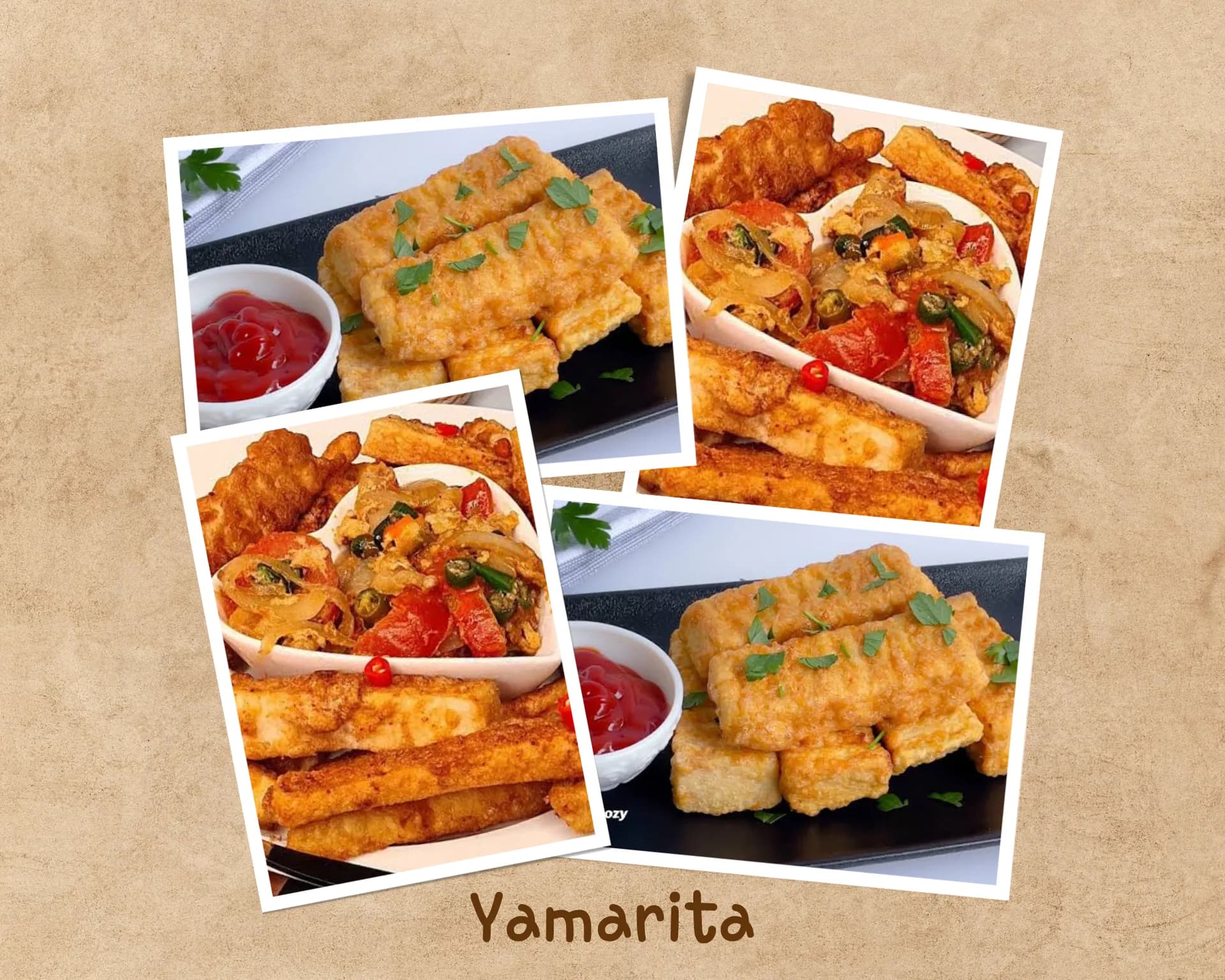
Yamarita is yam in an egg and flour coating, fried until the crust is crisp and the inside stays soft. It is a Nigerian treatment of the country's most important tuber, and it is straightforwardly a modern dish rather than an inherited one.
The name gives away its logic. Yamarita is yam plus the ending of dundun ata or, by the more commonly repeated account, a play on the Yoruba way of naming a fried thing. Whatever the derivation, it belongs to the same family of inventions as yam chips and yam balls: ways of turning a starch that is usually eaten soft into something you can pick up with your fingers at a party.
It sits alongside the older Nigerian yam preparations rather than replacing them. Pounded yam is ceremonial, yam porridge is domestic, yam with egg sauce is breakfast, and yamarita is what appears on a small chops platter next to puff puff and spring rolls. That is a real position in Nigerian eating even if it is a recent one, and the dish has spread well beyond the households that first made it.
The Nigerian egg roll is a whole hard cooked egg wrapped in a slightly sweet dough and deep fried, and it has nothing to do with the Chinese egg roll beyond the name. The closest comparison is a Scotch egg, with dough in place of sausage meat, and the resemblance ends at the structure.
It is street food and travel food. Egg rolls are sold from glass cases at bus stops, from hawkers' trays in traffic, and from the small kiosks that cluster around Lagos offices, and they exist because they solve a specific problem: something substantial, cheap and self contained that can be eaten with one hand in a stationary car. Anyone who has spent time in Lagos traffic understands the appeal without further explanation.
The dough is what makes it Nigerian rather than generic. Flour, baking powder, sugar, margarine and nutmeg produce something between a bread and a cake, faintly sweet against the plain salted egg inside, and that sweet and savoury combination is a Nigerian snack signature that also runs through buns, puff puff and chin chin. It is eaten with tea, fruit juice or chilled zobo, and it is substantial enough that people eat it as breakfast or lunch rather than as a snack.
Dietary tags are provided by contributors as a guide, not verified by AFN, and they depend on the products you buy. If you have a serious allergy, check every ingredient yourself. Cooking, allergies and your own judgement