We use essential cookies to make the site work. We would also like to set analytics cookies and advertising cookies, but only if you agree. You can choose each one separately. Read our cookie policy
Loading
Recipes
Browse the archive by country, course and cooking time.
Thiakry is millet couscous stirred into sweetened yogurt and milk, served cold, and it is one of the most widely eaten sweet things in Senegal and the Gambia. It is also written thiakri, chakery, caakiri and degue, and the spelling shifts with the language and the writer while the dish stays the same.
Millet is the reason it exists. It is one of the principal grains of Senegal, grown across the drier interior where rice does not do well, and thiakry is among the most common things made from it. The grain is milled to a couscous and steamed, then cooled and folded into the dairy. In Dakar it is sold in every grocery store, which is a fair measure of how ordinary a food it is.
It is eaten at breakfast as readily as at the end of a meal, which puts it in the same category as yogurt everywhere: sweet, cold, and not confined to dessert. Raisins, mango, grated coconut and chopped almonds are all standard on top, and vanilla and nutmeg are the usual flavourings. Its close relation ngalakh, made with peanut paste and baobab, is the elaborated festival version of the same base. Thiakry is the everyday one.
Alkubus is a Hausa steamed wheat bread from Northern Nigeria, plain by design and made to be eaten with something else. It is soft, faintly sour from the yeast, and it holds its shape well enough to be cut into rounds or wedges.
Its role on the plate is the role bread plays across the north: the thing that carries the soup. Alkubus is eaten most often with miyan taushe, the pumpkin and groundnut soup, and it also goes with agushi soup, vegetable soup, cabbage stew or a plain tomato sauce. That pairing with miyan taushe is the one Northern Nigerians name first.
There are two ways to make it and they produce different things. Baked in a greased pan and topped with carrot and onion, it is a loaf to be cut and eaten in slices. Portioned into wrappers and steamed over boiling water, it comes out softer and denser, closer to a dumpling, and that is the method the recipe here follows. Steaming rather than baking runs through a great deal of Hausa cooking, from dambu to danwake to masa, and alkubus belongs to that family more than it does to any oven tradition.
How to prepare instant couscous: boiling water or stock poured over, covered, left to steam, then fluffed. This is a technique page for a staple ingredient rather than a recipe for a dish, and it is filed as such.
Couscous is North African, specifically Berber in origin, and it is a staple across Morocco, Algeria, Tunisia and Libya. Its status was recognised by UNESCO in 2020, when the knowledge and practices around couscous were inscribed on the Representative List of the Intangible Cultural Heritage of Humanity in a joint submission by Algeria, Mauritania, Morocco and Tunisia.
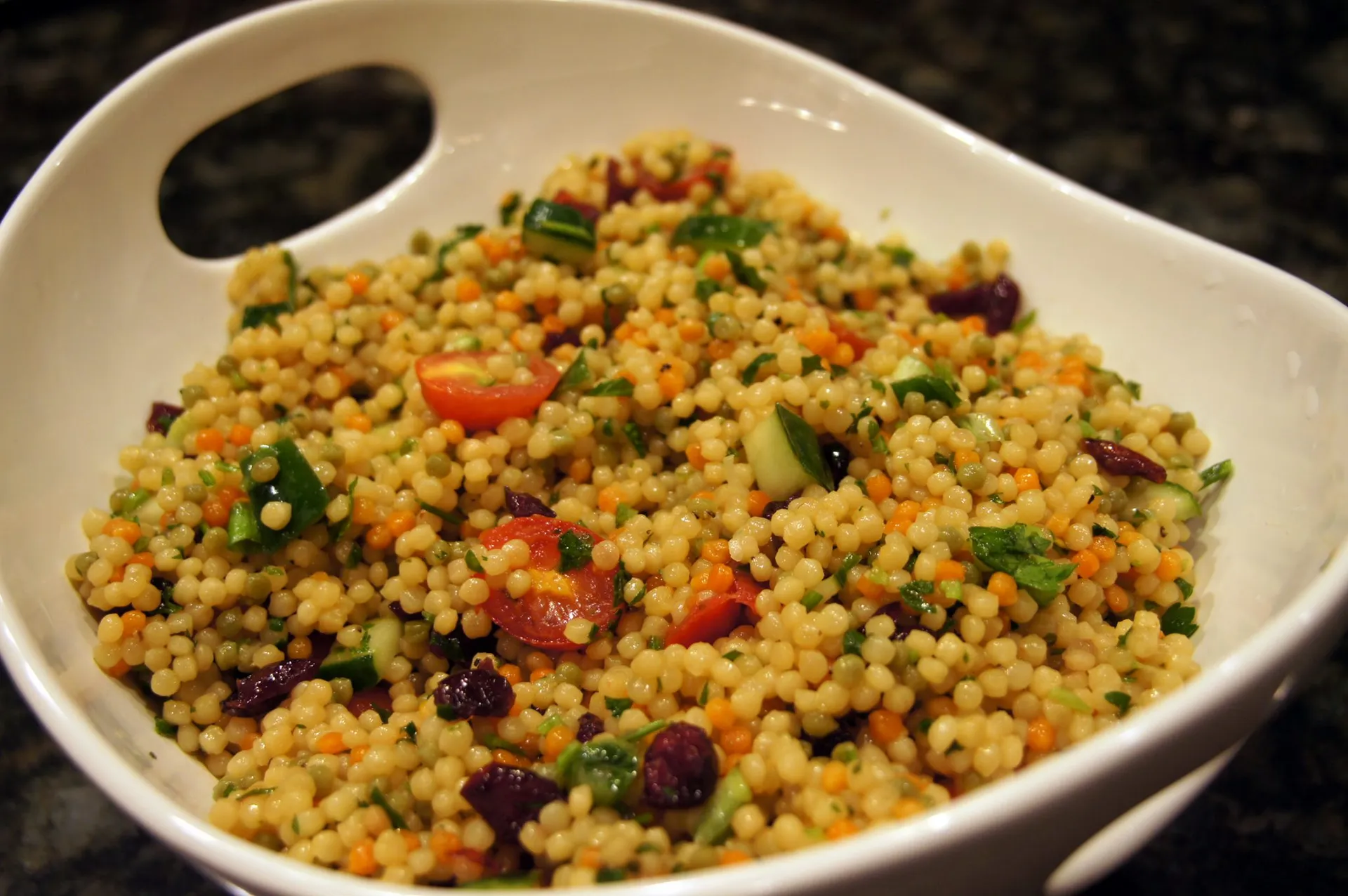
It is not a grain, despite looking like one. Couscous is pasta, durum wheat semolina moistened, rolled into tiny granules and dried. Three sizes are common: Moroccan, the smallest; Israeli or pearl couscous, about the size of peppercorns; and Lebanese, the largest.
The traditional method has nothing to do with pouring boiling water on. Couscous is steamed, usually more than once, in the upper chamber of a couscoussier over a stew whose vapours flavour it as it cooks. That is how it is made for a proper meal in North Africa and the results are much lighter.
Almost all couscous sold in supermarkets is pre-steamed and dried, which is why the rehydration method here works.
Oyster mushrooms grilled and tossed in suya spice. It is a plant-based version of the Nigerian street food, and it works better than most meat substitutions do.
**The traditional suya spice contains ground peanuts, and this recipe includes them.** The source flags it and offers to leave them out, which is honest, but it is worth stating clearly, because a peanut allergy and a suya spice blend are a genuinely dangerous combination and the name gives no warning.
Suya proper is skewered beef, ram or chicken rubbed in yaji, the spice blend of ground roasted peanuts, ginger, cayenne, garlic, onion powder and paprika, and grilled over open coals. It is Hausa in origin, from northern Nigeria, and it is sold across Nigeria, Cameroon, Niger, Ghana and parts of Sudan. Kyinkyinga is the Ghanaian name, agashe the Sudanese.
Oyster mushrooms are the right substitution and not an arbitrary one. Shredded, they have a fibrous, layered structure that genuinely resembles pulled meat, they take on the dry rub readily, and they char well. Most vegetables do neither.
The source's method is very compressed, one step reads "put in a preheated medium", with the word oven missing, and has been filled out below.
Dietary tags are provided by contributors as a guide, not verified by AFN, and they depend on the products you buy. If you have a serious allergy, check every ingredient yourself. Cooking, allergies and your own judgement