We use essential cookies to make the site work. We would also like to set analytics cookies and advertising cookies, but only if you agree. You can choose each one separately. Read our cookie policy
Loading
Recipes
Browse the archive by country, course and cooking time.
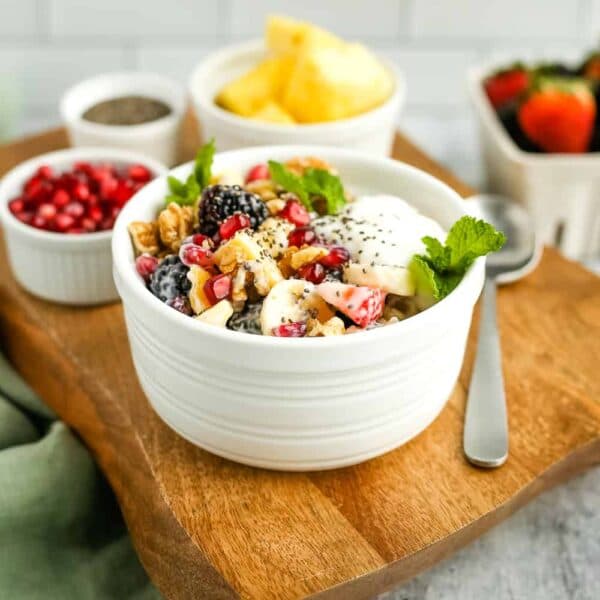
Fruit salad is chopped fruit served in its own juices, sometimes with a light syrup or dressing, and it is about as universal as food gets.
The one technique worth knowing is that it improves with time. Fruit cut and left to sit releases juice, and that juice becomes the dressing, which is why a fruit salad made an hour ahead is noticeably better than one assembled at the last minute. The source makes exactly this point: it is tastier the longer it soaks.
The other thing worth knowing is which fruits misbehave. Apples, pears and bananas brown quickly once cut; a squeeze of citrus slows it considerably. Melon releases a lot of water and dilutes everything else, so it is better added late. Berries collapse if stirred much.
A dressing is optional. Honey with lime, orange juice, or a light sugar syrup are all common, and any of them draws out more juice from the fruit itself.
**Filed as Worldwide.** Fruit salad has no particular national claim, and the page is kept and reclassified rather than removed.
Vegetables tossed in oil and smoked paprika and cooked low and slow in a barbecue smoker for one to two hours. Like smoked shrimp, this belongs to American barbecue rather than to any African tradition, and no country is named in the source.
Which vegetables work is the useful part. Dense, firm vegetables hold up to the long, low process: potatoes, carrots, beets, brussels sprouts, cauliflower, onions, mushrooms, aubergine and winter squash such as butternut. Softer ones collapse before they take on any smoke. The recipe here uses courgette, yellow squash, onion, bell peppers, asparagus and carrots, which is at the softer end of that range and accordingly needs the shorter end of the time.
Smoked paprika in the seasoning is doing something worth noticing: it brings smoke flavour independently of the smoker, which means the dish reads smoky even before the wood does its work. That is a useful trick in itself, and it means a version of this can be made in an oven with no smoker at all. Africa's charred vegetable traditions are different things entirely, Moroccan zaalouk, Egyptian baba ganoush, West African roasted pepper bases, where vegetables are blackened directly over flame rather than smoked slowly.
Taktouka is roasted peppers and grated tomato cooked down with onion, garlic, cumin and paprika into a thick warm salad. It is Moroccan, also popular in Algeria, and it is a mezze dish rather than a leaf salad.
The name explains the texture. It comes from the Arabic taktak, meaning to grind or pound, and the vegetables end up soft and broken down rather than crisp. That is why the source opens by pre-empting the obvious question, why a salad needs a recipe, and it is a fair point: taktouka requires cooking, and cooking is most of it.
It has regional names worth knowing. In eastern Morocco it is called flifla; in Algeria, felfla mechouia. Zaalouk, the aubergine version, is its closest sibling and works the same way.
Grating the tomatoes rather than dicing them is the technique the source recommends and it is a good one. Cutting a tomato in half and grating the cut face against a box grater extracts the pulp and leaves the skin behind in your hand, no peeling, no blanching, and a smoother result.
This dish is closely related to matbucha, the Moroccan-Jewish version, which is on this site. Matbucha is cooked longer, without onion or cumin, and the two are genuinely distinguished by community and by seasoning rather than being the same recipe under two names.
Salatu niebe is cooked black-eyed peas tossed with finely diced cucumber, tomato, bell pepper, spring onion and chilli, dressed with lime juice and olive oil. It is Senegalese and is usually served after the main meal rather than before it.
Niebe is the Wolof word for black-eyed peas, and the bean is not an import. Cowpeas were domesticated in West Africa thousands of years ago and travelled to the Americas through the transatlantic slave trade, which is why black-eyed peas are as fundamental to Southern American cooking as they are to Senegalese. The direction of that journey is frequently reversed in the telling.
The technique is in the cutting. Everything except the peas is diced very finely, so each spoonful carries a bit of everything rather than separate components. That is what makes it read as a composed salad rather than beans with vegetables in.
It travels and keeps well, which is why it is a standard dish for feeding a crowd, made ahead, it improves as the peas absorb the lime and oil.
The source credits Chef Pierre Thiam with popularising it outside Senegal, and that attribution is well founded. Its ingredient list omits the olive oil and parsley that its own description requires.
Dietary tags are provided by contributors as a guide, not verified by AFN, and they depend on the products you buy. If you have a serious allergy, check every ingredient yourself. Cooking, allergies and your own judgement