We use essential cookies to make the site work. We would also like to set analytics cookies and advertising cookies, but only if you agree. You can choose each one separately. Read our cookie policy

Loading
Recipes
Browse the archive by country, course and cooking time.
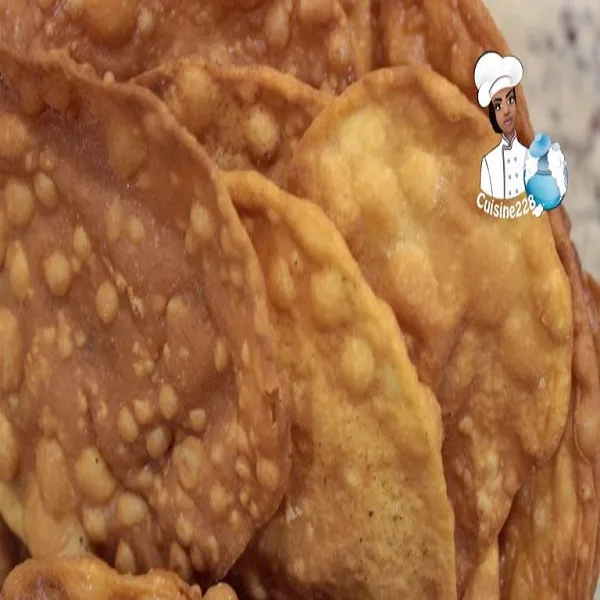
Merveilles are thin strips of fried sweet dough dusted with icing sugar, and they are sold as street food in Togo and Senegal. They are crunchy rather than soft, closer to a biscuit than a doughnut, and comparable to the fried pankere sold in Nigeria.
The pastry is European in origin and travelled with colonisation. Its original name is Fasnachtschuechli in German-speaking Switzerland, and it appears in Italy as frittelle di carnevale, both carnival pastries eaten in the weeks before Lent. French speakers took the name merveilles, meaning wonders, and it is under that name that the pastry reached francophone West Africa.
That it arrived from Europe does not make it any less genuinely a Togolese and Senegalese street food now. It is fried and sold locally, eaten locally, and made at home. What it is not is a dish with African origins, and the About says so rather than implying otherwise. Nutmeg in the dough is a small local touch. The source's method calls for yeast, which does not appear in its ingredient list, and no rise time is given, so the dough as written is unleavened.
Oyster mushrooms grilled and tossed in suya spice. It is a plant-based version of the Nigerian street food, and it works better than most meat substitutions do.
**The traditional suya spice contains ground peanuts, and this recipe includes them.** The source flags it and offers to leave them out, which is honest, but it is worth stating clearly, because a peanut allergy and a suya spice blend are a genuinely dangerous combination and the name gives no warning.
Suya proper is skewered beef, ram or chicken rubbed in yaji, the spice blend of ground roasted peanuts, ginger, cayenne, garlic, onion powder and paprika, and grilled over open coals. It is Hausa in origin, from northern Nigeria, and it is sold across Nigeria, Cameroon, Niger, Ghana and parts of Sudan. Kyinkyinga is the Ghanaian name, agashe the Sudanese.
Oyster mushrooms are the right substitution and not an arbitrary one. Shredded, they have a fibrous, layered structure that genuinely resembles pulled meat, they take on the dry rub readily, and they char well. Most vegetables do neither.
The source's method is very compressed, one step reads "put in a preheated medium", with the word oven missing, and has been filled out below.
Djablani is a Malian drink of ginger, lemon and baobab, served cold and sharply flavoured. It belongs to the family of fresh homemade drinks sold in bags and bottles across West Africa, alongside bissap made from hibiscus and dakar made from tamarind, prepared in quantity in households and sold by the roadside.
The baobab is what places it. The tree grows across the Sahel and is one of the defining plants of the Malian landscape, distinctive in shape, able to survive extreme heat and poor soil, and long lived on a scale that has made it a landmark in its own right. Its fruit gives a pale tart pulp used in drinks and porridges across the region, and its leaves are dried and ground for soup.
Ginger carries the rest. West African ginger drinks are made strong, and the heat in a properly made djablani is genuine rather than suggested, which is what the sugar and the lemon are there to balance. It is served cold, often with mint, and it is refreshment in a climate where that word means something specific. Fresh drinks of this kind are a category of their own in West African hospitality: made at home, given to guests, and sold cheaply on the street.
The Nigerian pancake, known colloquially as diet, is thin, dense and slightly crisp at the edges, and it is savoury as often as it is sweet. Onion and ground pepper go into the batter alongside the sugar, which produces something no other pancake tradition attempts: sweet, savoury and faintly hot in the same mouthful.
It sits a long way from the thick fluffy pancake of the American breakfast table. There is no raising agent and no attempt at height. The batter is loose, the pan is tilted to spread it thin, and the result has a dense bite and a lacy edge. Nigerians eat it at breakfast with tea, and just as readily as an afternoon snack with a cold drink.
What it is served with follows the same double logic as the batter. Honey, sugar, condensed milk, peanut butter and fresh fruit on the sweet side; pap, custard, oats and yogurt drinks such as kunu aya or zobo alongside. It is home food and street food at once, cheap to make from things most Nigerian kitchens already hold, and it belongs to no particular region of the country, which is unusual enough to be worth noting.