We use essential cookies to make the site work. We would also like to set analytics cookies and advertising cookies, but only if you agree. You can choose each one separately. Read our cookie policy
Loading
Recipes
Browse the archive by country, course and cooking time.
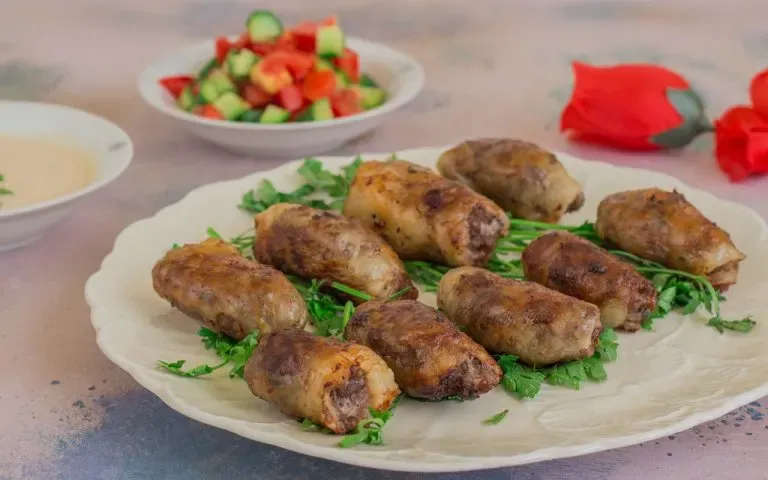
Tarb is kofta wrapped in caul fat and grilled, and the caul is what the dish is named for. Tarb is the Egyptian word for the lacy membrane of fat that surrounds a lamb's stomach, and wrapping seasoned minced lamb in it produces something that ordinary kofta cannot: the fat renders during cooking, bastes the meat from the outside in, and crisps to a golden shell.
Its occasion is Eid al-Adha, the festival of sacrifice, and the connection is direct rather than customary. Eid al-Adha involves the slaughter of an animal and the distribution of its meat, and caul fat is one of the parts that becomes available when a whole lamb is broken down at home. A dish built on caul is a dish that belongs to the moment when a whole animal is being used, which is why tarb appears then and rarely otherwise.
Kofta itself runs across Egypt and the whole Middle East, minced meat with onion, parsley and spices, formed and grilled. Tarb is the version that takes it somewhere richer, and Egyptians treat it as a heavy dish for a family celebration rather than everyday food. It is found in the grilled meat restaurants that specialise in kofta, kebab and grilled chicken across Egypt, served with rice or pasta.
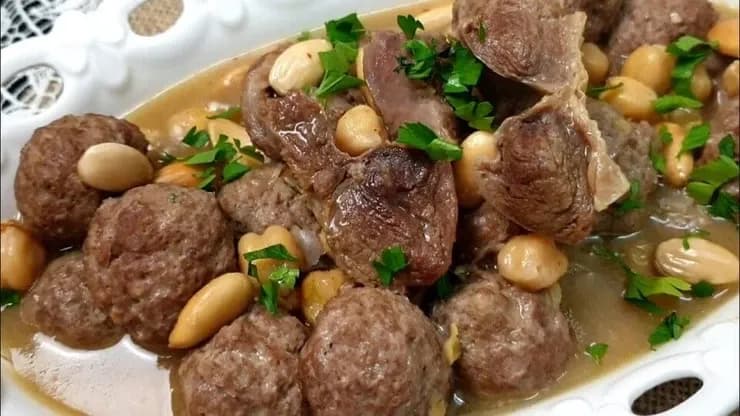
Mtewem is an Algerian dish of meatballs and meat cooked together with chickpeas in a garlic heavy sauce, and the name says exactly what it is. Mthawem derives from the Arabic for garlic, and the quantity used is the point rather than an aromatic detail.
It belongs to Algiers, where the original preparation is made with a white sauce, and it appears at the occasions that matter: Ramadan evenings, weddings and celebrations. Most families now make it with a red tomato based sauce, which has become the more common version, and cooks disagree about which is correct in the way that families always do about a dish attached to celebration.
Cumin carries it alongside the garlic. The meatballs are formed small, about the size of a walnut, and are added to the sauce only after the meat and chickpeas have already cooked, so they poach gently rather than breaking up. Some households press a blanched almond into the centre of each one, a touch that belongs to the wider North African habit of hiding something in a dish for the person who finds it. Cinnamon divides opinion and is entirely optional.
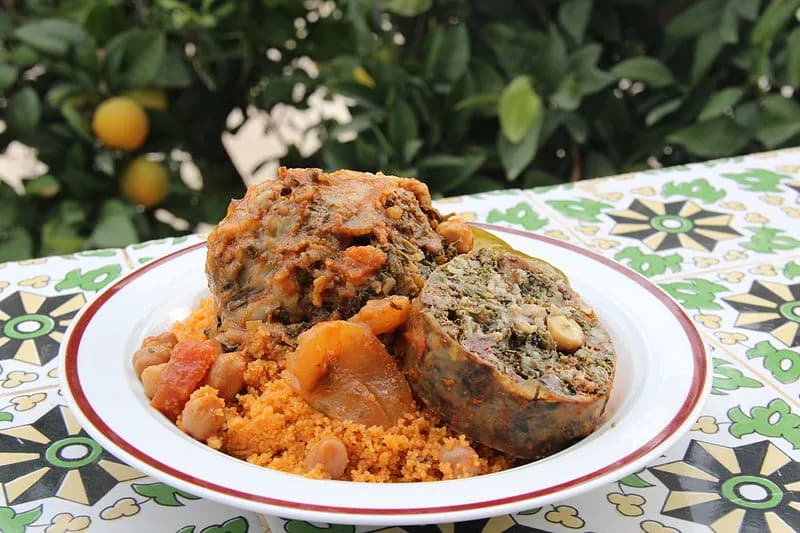
Usban is a North African sausage made from the parts of a sheep that a whole animal butchery yields and nothing else does: the stomach, the liver, the lungs and the heart, chopped and mixed with rice, herbs and spices, sewn into pouches and cooked in a sauce. It is eaten in Tunisia, Algeria and Libya, and it is written both usban and osban.
Its occasion is Eid al-Adha, and the connection is structural rather than customary. The festival involves the sacrifice of an animal and the use of all of it, and usban is what the offal becomes. It cannot be made casually because it requires a quantity of organ meat that only arrives when a whole sheep is broken down at home. Tunisian households make it on the day of Eid despite the considerable labour, and the effort is part of what the dish means.
The work is real. The stomach must be scrubbed, blanched, scraped of its lining until it turns white, cut and sewn into pouches by hand with a needle and butcher's twine, then filled and sewn shut. Usban is documented in Tunisian references as far back as the 13th century, and it is held up as a demonstration of skill: proof that a cook can use every part of the sacrifice properly. It is served alongside rice or couscous.
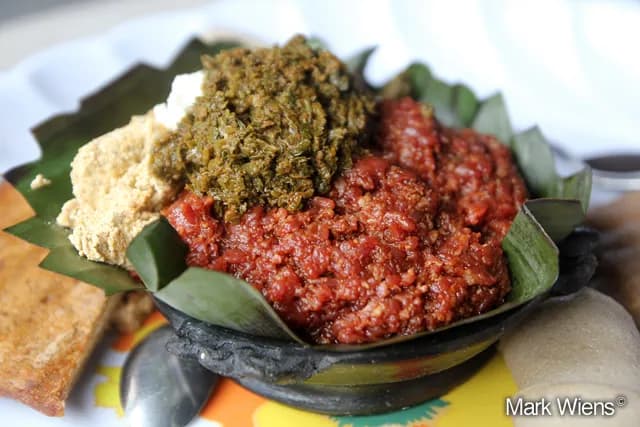
Kitfo is very finely minced raw beef, warmed through with spiced clarified butter and chilli. The name says what it is: kitfo comes from the Amharic for chopping finely. It is Ethiopian and Eritrean, and it is celebration food, a dish for major holidays, weddings and family occasions rather than an ordinary weeknight.
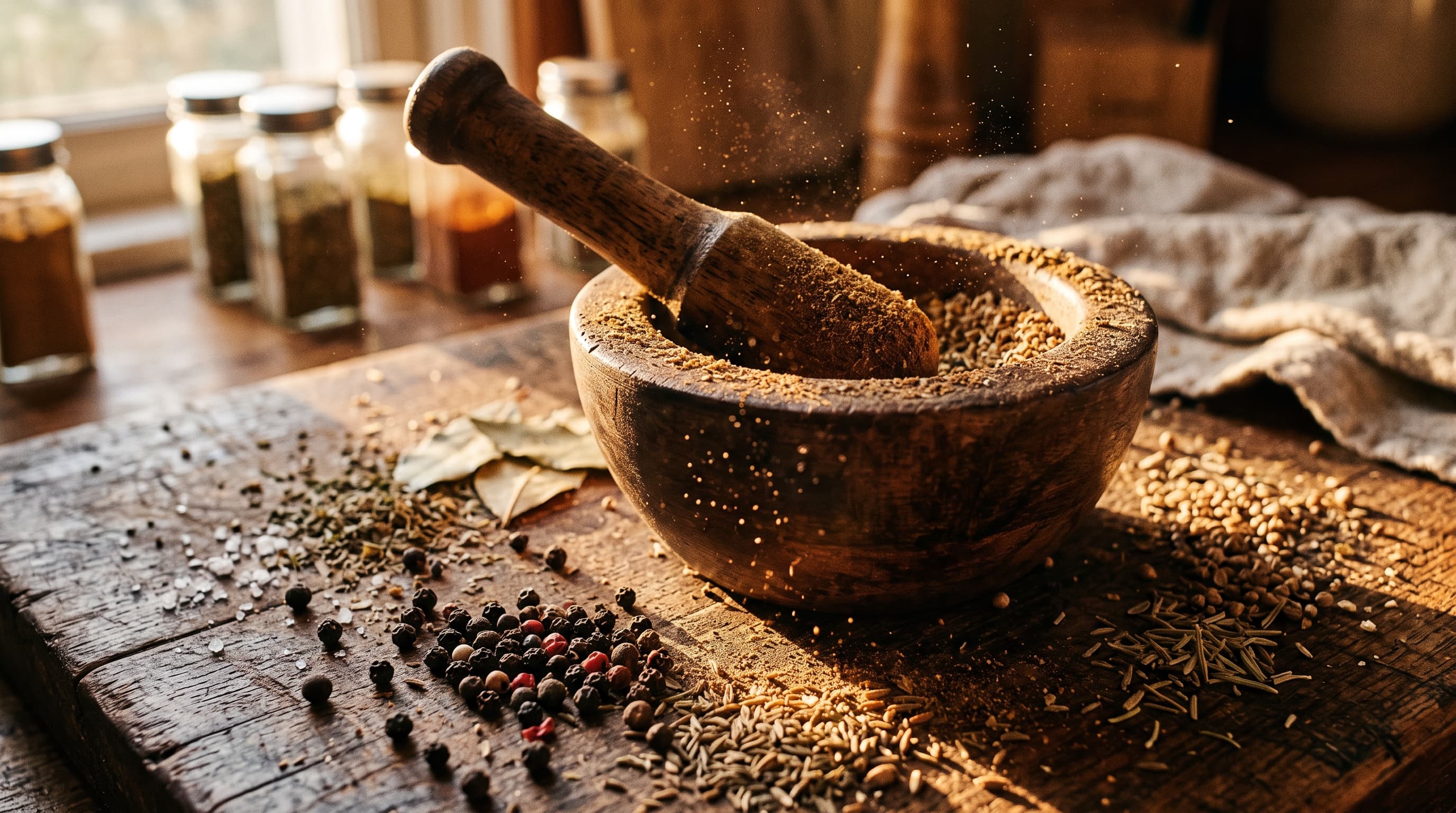
Two things define it. The first is niter kibbeh, the clarified butter infused with garlic, ginger, cardamom, fenugreek and other spices, which is what carries flavour into meat that is never exposed to direct heat. The second is mitmita, the fierce Ethiopian chilli blend built on pili-pili peppers with cardamom, cloves and salt. Both are what separate kitfo from any other steak tartare.
Doneness has its own vocabulary, and the names matter because they are what you order by. Tere kitfo is fully raw. Leb leb is warmed just enough to melt the butter through it. Yebesele is taken further still. Gored gored, which is on this site as its own recipe, is the closely related dish where the beef is cut into cubes rather than minced, same tradition, different knife work, noticeably different in the mouth.
It is served with injera, and usually alongside gomen, the collard greens, and ayib, the fresh Ethiopian cheese, whose mildness is there to answer the heat.