Nous utilisons des cookies essentiels au fonctionnement du site. Nous aimerions aussi déposer des cookies de mesure d’audience et des cookies publicitaires, uniquement avec votre accord. Vous pouvez choisir séparément pour chacun. Lire notre politique relative aux cookies

Loading
Recettes
Parcourez les archives par pays, par plat et par temps de cuisson.
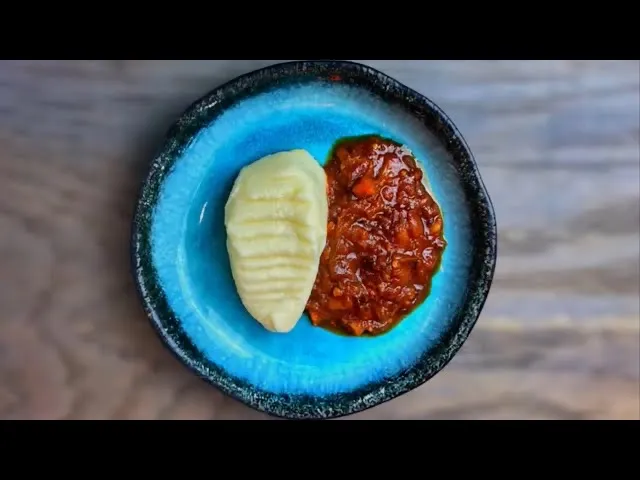
Pap and sous is maize porridge with tomato gravy, and between them they account for a very large share of what is eaten in South Africa on an ordinary day. Pap is the smooth, firm maize meal that anchors the plate. Sous, Afrikaans for sauce, is the tomato and onion gravy that goes over it.
The comparison South Africans reach for when explaining pap to outsiders is grits or polenta, and it holds up as far as the grain goes. What it misses is the position the dish occupies. Pap is not a side. It is the centre of the plate, and everything else is arranged in relation to it, which is why the quality of a household's pap is noticed and remarked on.
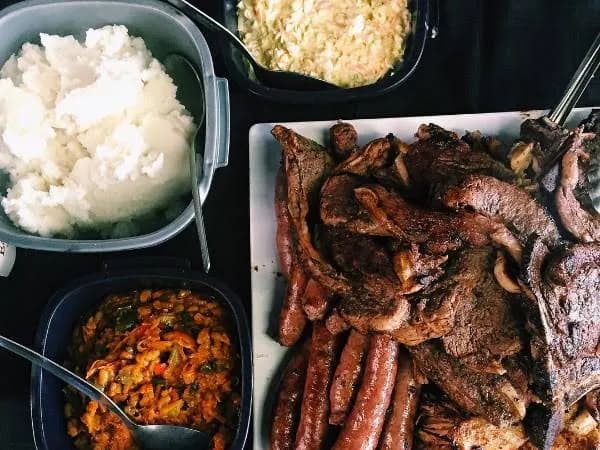
The gravy is where the cook is visible. A sous is built from onion, pepper, chilli, garlic and tomato with paprika and a little sugar and vinegar, and every household has a version. Pap and sous is eaten on its own as a complete meal and served alongside grilled meat and boerewors when there is a fire going, which is the same dish playing two different roles depending on the day.
Pap en vleis is Afrikaans for porridge and meat, and the name describes the whole of it. Maize meal cooked to a smooth, firm mass, and grilled meat beside it. Two components, no sauce required, and a dish that the entire country recognises regardless of which language its household speaks.
Its natural setting is outdoors and social. Pap en vleis is what comes off a braai and what is served at a shisanyama, the grill and gathering place where meat is bought, cooked over open fire and eaten on site. The dish exists in the same space as the fire and the people standing around it, and eating it indoors at a table is possible but slightly beside the point.
Maize is the foundation of the South African diet, and pap is its most direct expression: nothing added, nothing disguised, judged entirely on texture. The meat is whatever the household or the grill has, and its variability is why the dish has stayed universal rather than becoming the property of any one community. A dish defined by two nouns leaves room for everyone's version.
Bunny chow is a hollowed loaf of white bread filled with curry, and it comes from the Indian community of Durban in KwaZulu-Natal. The bread is the bowl, the plate and the cutlery, and it is eaten by tearing pieces off the hollowed lid to scoop with.
Its history is tied directly to apartheid. The most widely repeated account holds that it developed as a way to sell food to Black customers who were barred from eating in certain restaurants: the bread served as the container, so nothing had to be handed back. It was cheap, portable, filling enough for a day's work, and needed no crockery, which made it well suited to the indentured Indian labourers brought to work the sugarcane fields of KwaZulu-Natal.
The name is generally traced to banya chow. Banya was an older term for the Indian trading community in Durban and chow is slang for food. Accounts of the origin do differ and none is settled. The filling is a Durban curry, aromatic with curry leaves, cardamom and cinnamon, made with chickpeas and potatoes and with or without meat, and mutton is the version Durban is best known for.
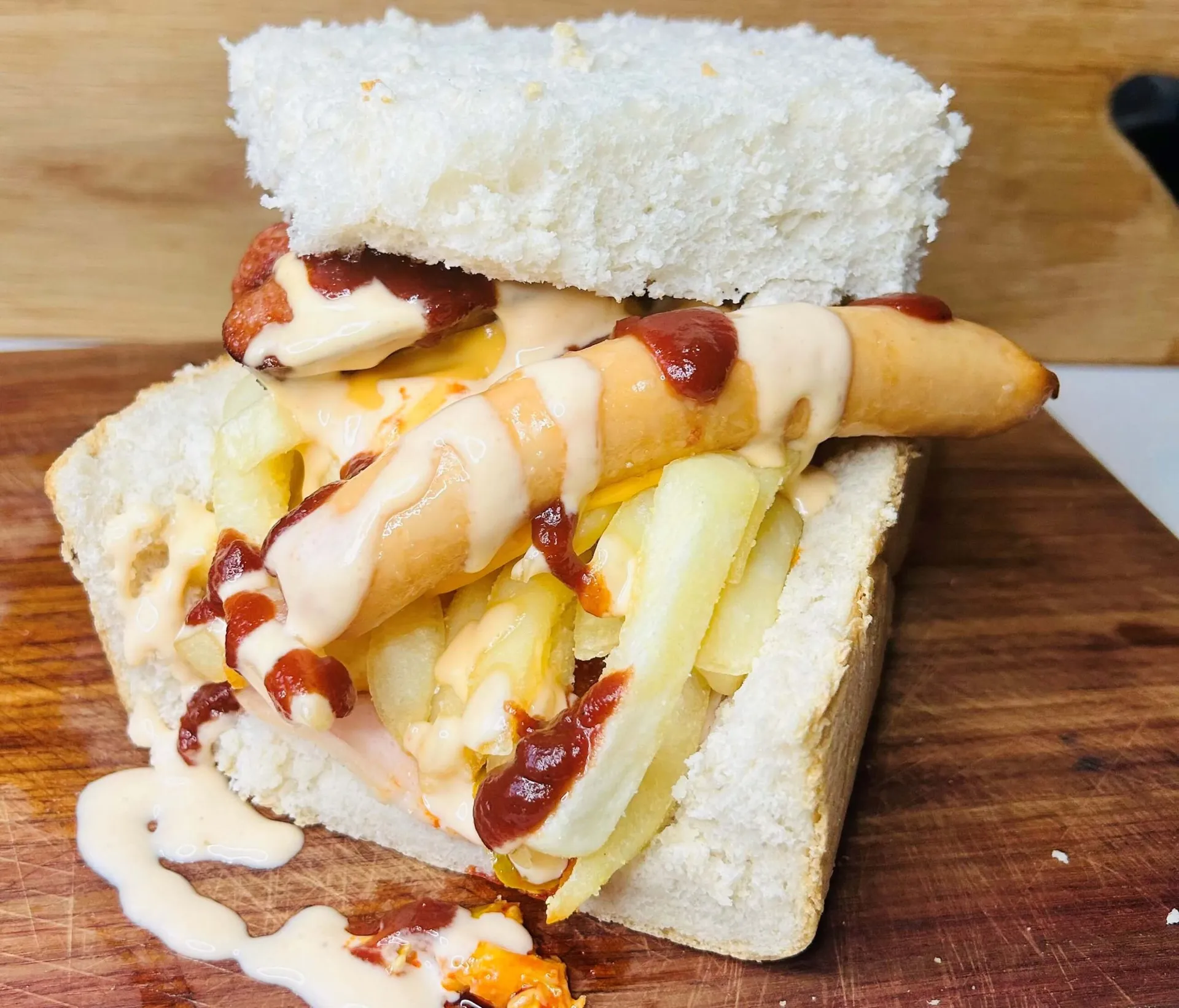
A kota is a quarter loaf of bread, hollowed out and packed with fried food. The word is township English for quarter, and that is the whole description: bread cut in four, the soft centre pulled out, and the cavity filled with chips, polony, russians, viennas, cheese, egg, atchar and sauce, then capped with the bread that was removed.
It belongs to the townships of Gauteng, where it is sold from small takeaway windows and eaten in the hand without a plate. Kota shops compete on what they will fit into a quarter loaf, and the size of the fill is a large part of the reputation. It is cheap, it is a complete meal, and it is built for people who need to eat between one thing and the next.
Atchar is what makes it South African rather than generically stuffed bread. The pickled green mango relish, oily and sour and hot, came to South Africa through Indian indenture and cuts the fried starch that dominates everything else in the cavity. Kota is often described as a version of bunny chow, and the two are related without being the same: bunny chow is Durban Indian, a hollowed loaf filled with curry, and kota is a Gauteng township form filled with fried items. They share an ancestor and are not interchangeable.