Nous utilisons des cookies essentiels au fonctionnement du site. Nous aimerions aussi déposer des cookies de mesure d’audience et des cookies publicitaires, uniquement avec votre accord. Vous pouvez choisir séparément pour chacun. Lire notre politique relative aux cookies
Loading
Recettes
Parcourez les archives par pays, par plat et par temps de cuisson.
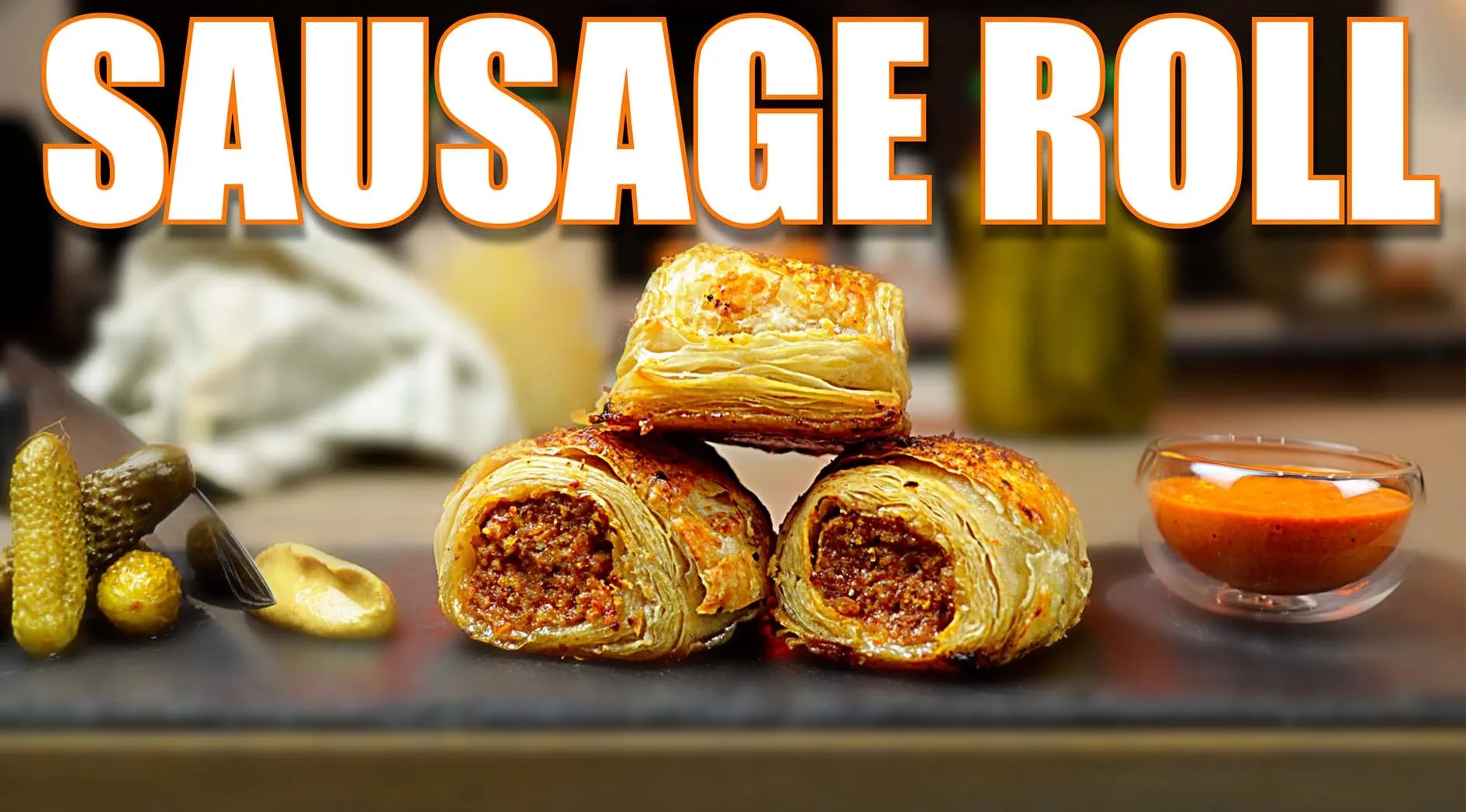
This is a British sausage roll carrying a Southern African sauce, and it is worth being precise about which part comes from where. The sausage roll itself, seasoned pork in puff pastry, is British. Peri peri is the contribution from Africa, and it is a substantial one.
Peri peri, also spelled piri piri, is the Swahili name for the African bird's eye chilli, a small and ferociously hot capsicum that grows wild across Mozambique, Angola and southern Africa. Portuguese traders encountered it in their African territories and built a sauce around it with garlic, lemon, vinegar and paprika, and that sauce travelled back through Portugal and outward again. Its association with grilled chicken in Mozambique and South Africa is where most people meet it.
So this is a fusion piece rather than a traditional dish of anywhere, and it makes no claim otherwise. It is also a genuinely demanding recipe: the pastry is laminated from scratch, which means rolling and folding butter into dough across several chilled stages, and that is the bulk of the work. Shop bought puff pastry produces a perfectly good sausage roll and removes about ninety minutes.
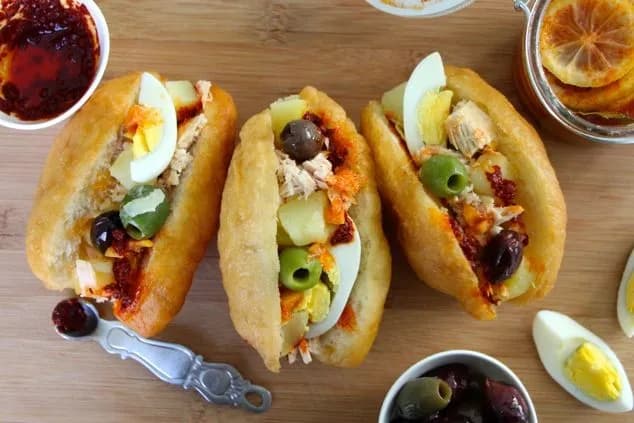
A fricassé is a small oval roll of enriched dough, deep-fried and then split and packed with tuna, potato, olives, egg and harissa. It is Tunisian street food, and it is one of the country's most recognisable things to eat.
The word does not mean what it means elsewhere. In French, a fricassée is a braise of meat in a white sauce; in Tunisia and its diaspora it means this sandwich and nothing else. That divergence is complete enough that searching the French term will not find you the Tunisian food.
The filling is the point and it is fixed by convention rather than by recipe: tuna in olive oil, cooked potato, black olives, egg and harissa, with slata méchouia, the grilled pepper and tomato salad, very often alongside. Capers and preserved lemon appear in some versions. What matters is that the bread is fried rather than baked, which gives a rich, slightly greasy roll that stands up to a wet filling.
**A significant gap in the source.** Its ingredient list contains only the dough, yeast, water, flour, egg, oil, salt. Not one of the filling ingredients it spends its article describing appears in it. The filling below has been reconstructed from that description and flagged.
**It contains eggs and fish.**
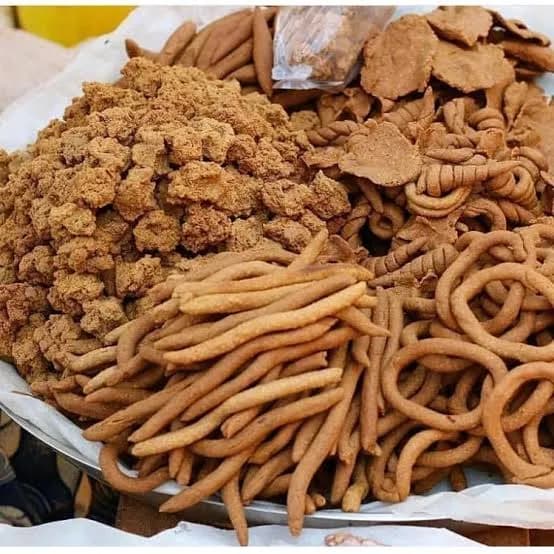
Kuli kuli is a peanut snack eaten across Nigeria, Benin, northern Cameroon and Ghana, and it is one of the most widely recognised street foods in West Africa. It is made from peanuts alone, and the technique is what makes it: the oil is deliberately pressed out of the ground paste before the remaining solids are shaped and fried.
That extraction is the point. Removing the oil leaves a dense, dry paste that fries into something genuinely crunchy rather than soft, and it also produces the frying oil as a by-product, so nothing is wasted. It is a piece of processing knowledge that predates industrial oil pressing and is still done by hand in Hausa communities in northern Nigeria, where the snack has its strongest association.
It takes different shapes in different places: small sticks, rings, flat discs and irregular pieces are all standard, and the form varies by region and by seller. English names for it, groundnut cake and peanut snack among them, are approximations rather than translations. Kuli kuli is eaten on its own, mixed into garri with sugar and water, crumbled over salad, or served alongside fura and koko. Crushed to a powder it becomes the peanut component of suya spice, which is where most people outside the region encounter it without knowing.
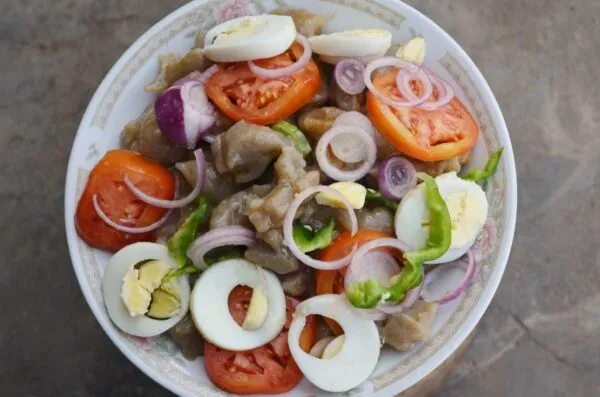
Danwake is a Northern Nigerian dish of small dumplings made from bean flour and ground baobab leaf, then cooled and dressed with oil and pepper. The dumplings are pale green from the kuka, soft and slightly springy, and they are eaten in quantity rather than as a delicate portion.
Its origin is given as Niger, and it has been adopted so completely across Northern Nigeria that it now reads as a staple of the region rather than an import from it. The flour blend varies from one part of the north to another, which means there is no single correct danwake and households treat the mix as something to have an opinion about.
Traditionally it is eaten as danwake da mai da yaji, which is Hausa for danwake with oil and pepper, and that is the whole dish in its plain form. The eating method is part of the memory people carry of it: children pick up a single ball with a broomstick, swirl it in the oil and pepper, and eat it that way, one at a time. A fork is the modern substitute and is more hygienic, which is not the same as saying it is better. The assorted version here carries egg, tomato, onion and bell pepper alongside the base.