

Nous utilisons des cookies essentiels au fonctionnement du site. Nous aimerions aussi déposer des cookies de mesure d’audience et des cookies publicitaires, uniquement avec votre accord. Vous pouvez choisir séparément pour chacun. Lire notre politique relative aux cookies
Loading
Recettes
Parcourez les archives par pays, par plat et par temps de cuisson.
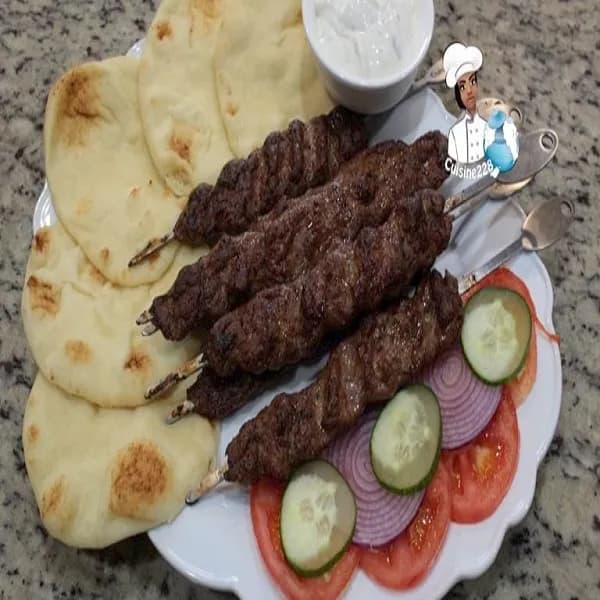
Kofta is minced meat, seasoned and shaped by hand, and it runs across an enormous stretch of the world: from the Balkans through Turkey, the Levant and Egypt, across the Arabian peninsula, into Central Asia and the Indian subcontinent, and along the North African coast. The Egyptian version is lamb or beef with onion, parsley, mint and a warm spice mix, moulded onto skewers and grilled.
Its written history is old. Recipes appear in the earliest surviving Arab cookbooks, where large ground lamb meatballs were glazed in saffron and egg yolk, a technique that later reached Europe and was known there as gilding or endoring. From the Arab world it travelled east, and nargisi kofta was served at the Mughal court in India.
In Egypt, kofta belongs to the grilled meat restaurants that exist in every town, where it is cooked alongside kebab, grilled chicken and tarb and served with rice, bread and salad. The distinction Egyptians draw between kofta and kebab is worth knowing: kebab is cubed meat on a skewer, kofta is minced meat shaped by hand. It is essentially sausage without a casing, and the comparison to a hamburger, sometimes made, misses that it is almost never served in bread.
Kebab is a Middle Eastern preparation, and the source says so directly. Cut or ground meat cooked on a skewer over open flame is one of the oldest cooking methods there is, and the word and the technique both come from that region before spreading almost everywhere.
Mutton and lamb are the traditional meats. Regional versions use beef, goat, chicken or fish, and pork rarely, given religious constraints across much of the region where kebab originates. Not every kebab involves a skewer either: tas kebab is baked in a skillet or served as a stew, which shows how loosely the word travels.
Africa has a great deal of skewered grilled meat of its own, and this recipe is not it. Nigerian suya is coated in yaji, a peanut based spice blend. Sudanese agashe works the same way. Moroccan brochettes are marinated in cumin and paprika. Egyptian kofta is ground and shaped rather than cubed. This version is marinated in soy sauce, olive oil, oregano, garlic and lemon, which is a Mediterranean and Levantine profile, so it sits in the Worldwide Recipes collection rather than being presented as African.
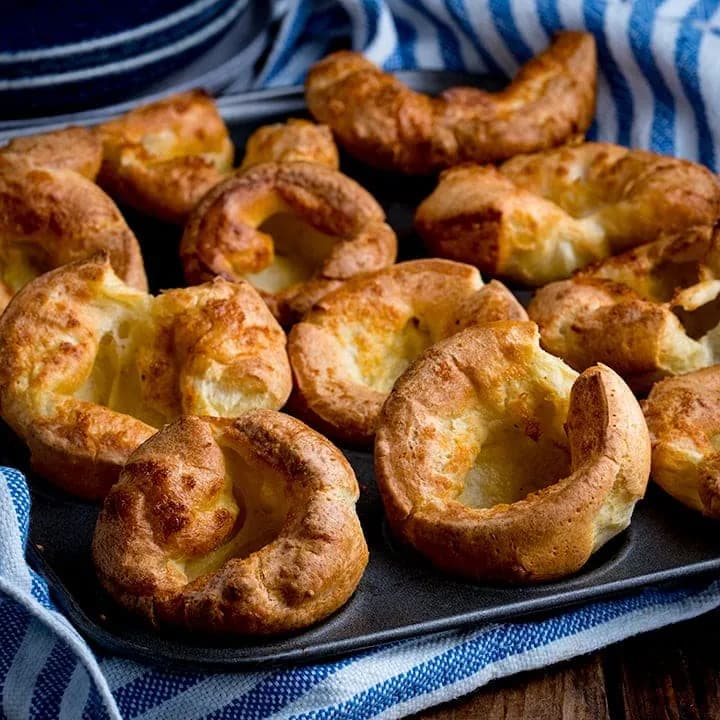
A batter of eggs, flour, milk and water poured into smoking hot fat and baked until it quadruples in volume. It is British, and it sits in Worldwide Recipes with its URL unchanged.
It is one of the few dishes where the physics is the recipe. The batter must go into fat that is genuinely smoking hot, the instant heat turns the water in the batter to steam, which inflates the structure before the egg and flour set around it. Fat that is merely hot gives you a flat, greasy disc. Preheating the tin with the fat in it for a full ten minutes is not padding.
The overnight rest is the other thing that separates good Yorkshires from adequate ones. Resting lets the flour hydrate fully and the gluten relax, which produces a more dramatic rise. The source says up to three days in the fridge and it is right, the batter genuinely improves.
This recipe is unusually precise, giving weights in grams alongside cup measures, which is rare in the archive and welcome. The water alongside the milk is deliberate: water produces more steam than milk, so it rises higher, while the milk gives flavour and colour.
Beef dripping is traditional. Lard, shortening and vegetable oil all work.
Africa has no equivalent, though popovers and Dutch baby pancakes are relatives.
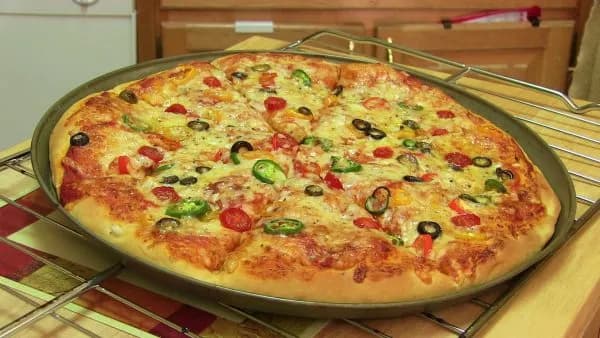
Pizza dough shaped, topped with sauce, cheese and whatever else you want, and baked hot. No country is claimed here, though pizza is Neapolitan in origin.
**This page had no recipe card in the source**, only an article. The ingredients and method below are reconstructed from what that article describes, and that is flagged.
The one genuinely useful technique in it is the parchment paper. Shaping the dough directly on a sheet of parchment solves the hardest part of home pizza-making: getting a topped, floppy raw pizza off a peel and into a hot oven without it folding in on itself. The dough sticks to the parchment, the parchment slides, and the pizza releases from it partway through the bake so you can pull the paper out.
Beyond that, home pizza comes down to heat. Domestic ovens run far cooler than the wood-fired ovens pizza was developed for, so the standard advice is to run the oven as hot as it will go with a stone or steel preheated inside it for at least half an hour.
Africa has its own substantial flatbread-and-topping traditions, Moroccan mhajeb, Tunisian fricassé, South African bunny chow in a different register, and several are on this site.