Nous utilisons des cookies essentiels au fonctionnement du site. Nous aimerions aussi déposer des cookies de mesure d’audience et des cookies publicitaires, uniquement avec votre accord. Vous pouvez choisir séparément pour chacun. Lire notre politique relative aux cookies

Loading
Recettes Tunisia
Parcourez les archives par pays, par plat et par temps de cuisson.
Couscous is the national dish of Tunisia, and it is also the national dish of Algeria, Morocco, Mauritania and Libya, which tells you something about how the Maghreb understands itself. The same steamed semolina appears across all five countries under names that shift with the language: kousksi in Tunisia, taam or kesksu in Algeria, seksu in Morocco, and cuscusu in Sicily, where it crossed the water.
The Tunisian version is distinguished by its heat and its colour. Harissa goes into the broth rather than being offered alongside it, and the finished couscous runs orange to deep red depending on how much broth and harissa it has taken up. Caraway is the other Tunisian signature, appearing in a quantity that Moroccan and Algerian couscous would not use.
What goes with it depends on the coast. In Sfax and the other coastal cities, couscous is made with fish. Inland it more often carries lamb, sometimes with dried fruit. Turnip, carrot, courgette, potato, pumpkin and chickpeas are the usual vegetables, cooked in the broth and removed as each becomes ready. The word itself is traced either to the Arabic kaskasa, to pound small, or the Amazigh seksu, meaning rounded or well rolled, and both derivations describe the grain rather than the dish.
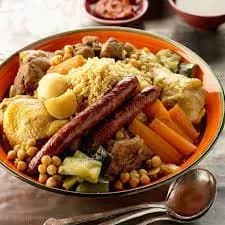
Couscous royale is a plate of fluffy couscous piled with grilled meats and a saffron-scented chickpea and vegetable stew, and it is celebration food. Meatball skewers, lamb chops, chicken skewers and merguez sausage all appear on the same plate, which is what the royale in the name is describing.
Couscous itself is Amazigh in origin. It is a staple across Tunisia, Algeria, Morocco and Libya, and it is Tunisia's official national dish. The food historian Charles Perry places its origin among the Berbers of Algeria and Morocco somewhere between the end of the 11th-century Zirid dynasty and the rise of the 13th-century Almohad Caliphate. The precise origin is not known, and since couscous is made from ground wheat it is unlikely to predate about 6000 BC.
The word names both the semolina grain and the dish built around it. Traditionally the grain is steamed in a couscoussier, a two-tier pot with a steamer sitting above the broth, and it is removed, rolled between the hands to separate the grains, and returned to the steamer four or five times. Pre-steamed couscous has made that unnecessary for everyday cooking. Couscous royale is not everyday cooking: it takes roughly two hours of preparation before the chickpeas are even accounted for.
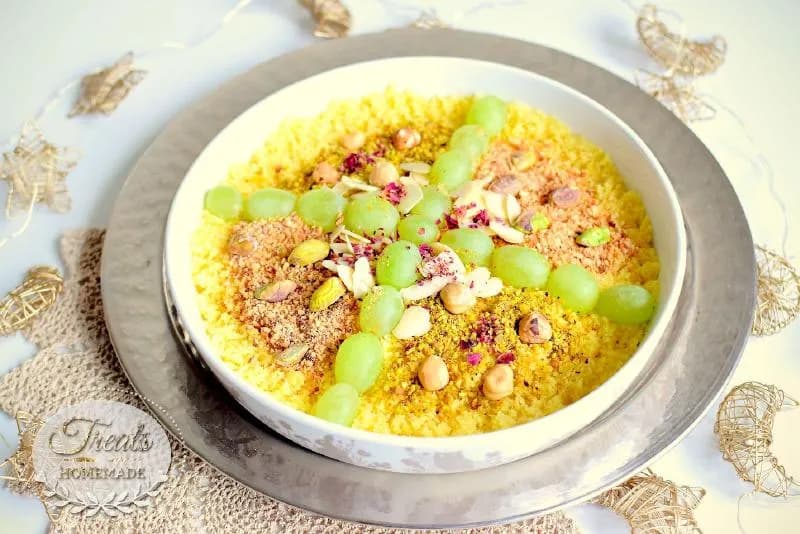
Masfouf is steamed couscous sweetened with milk and honey and mixed with dates, raisins, nuts and banana, layered with a vanilla custard. It is Tunisian and it belongs to Ramadan.
It is the sweet counterpart to Tunisian couscous, which is otherwise a savoury dish, and that inversion is the whole idea, the same grain, the same steaming technique, turned into a dessert or a breakfast. During Ramadan it appears at suhoor, the meal before dawn, because it is filling and sustaining, and at iftar as a sweet.
Geranium water is the ingredient that places it. Distilled from scented geranium leaves, it is used across Tunisian sweets in the way rose water and orange blossom water are used further east, and it has a green, faintly citrus perfume that neither of those reproduces. Middle Eastern and North African grocers stock it.
Steaming the couscous properly rather than pouring boiling water over it is what the recipe asks for, and it is the difference between light separate grains and a claggy mass. This is a dessert made from properly cooked couscous rather than instant.
**It contains almonds and walnuts, which the title gives no indication of.**
The source's ingredient list repeats milk, honey and geranium water without indicating that the second set belongs to the custard.