Nous utilisons des cookies essentiels au fonctionnement du site. Nous aimerions aussi déposer des cookies de mesure d’audience et des cookies publicitaires, uniquement avec votre accord. Vous pouvez choisir séparément pour chacun. Lire notre politique relative aux cookies
Loading
Recettes
Parcourez les archives par pays, par plat et par temps de cuisson.
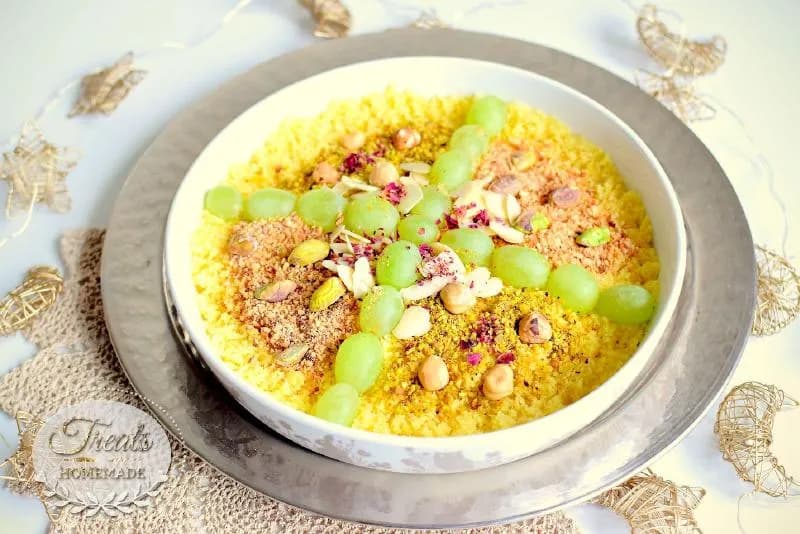
Masfouf is steamed couscous sweetened with milk and honey and mixed with dates, raisins, nuts and banana, layered with a vanilla custard. It is Tunisian and it belongs to Ramadan.
It is the sweet counterpart to Tunisian couscous, which is otherwise a savoury dish, and that inversion is the whole idea, the same grain, the same steaming technique, turned into a dessert or a breakfast. During Ramadan it appears at suhoor, the meal before dawn, because it is filling and sustaining, and at iftar as a sweet.
Geranium water is the ingredient that places it. Distilled from scented geranium leaves, it is used across Tunisian sweets in the way rose water and orange blossom water are used further east, and it has a green, faintly citrus perfume that neither of those reproduces. Middle Eastern and North African grocers stock it.
Steaming the couscous properly rather than pouring boiling water over it is what the recipe asks for, and it is the difference between light separate grains and a claggy mass. This is a dessert made from properly cooked couscous rather than instant.
**It contains almonds and walnuts, which the title gives no indication of.**
The source's ingredient list repeats milk, honey and geranium water without indicating that the second set belongs to the custard.
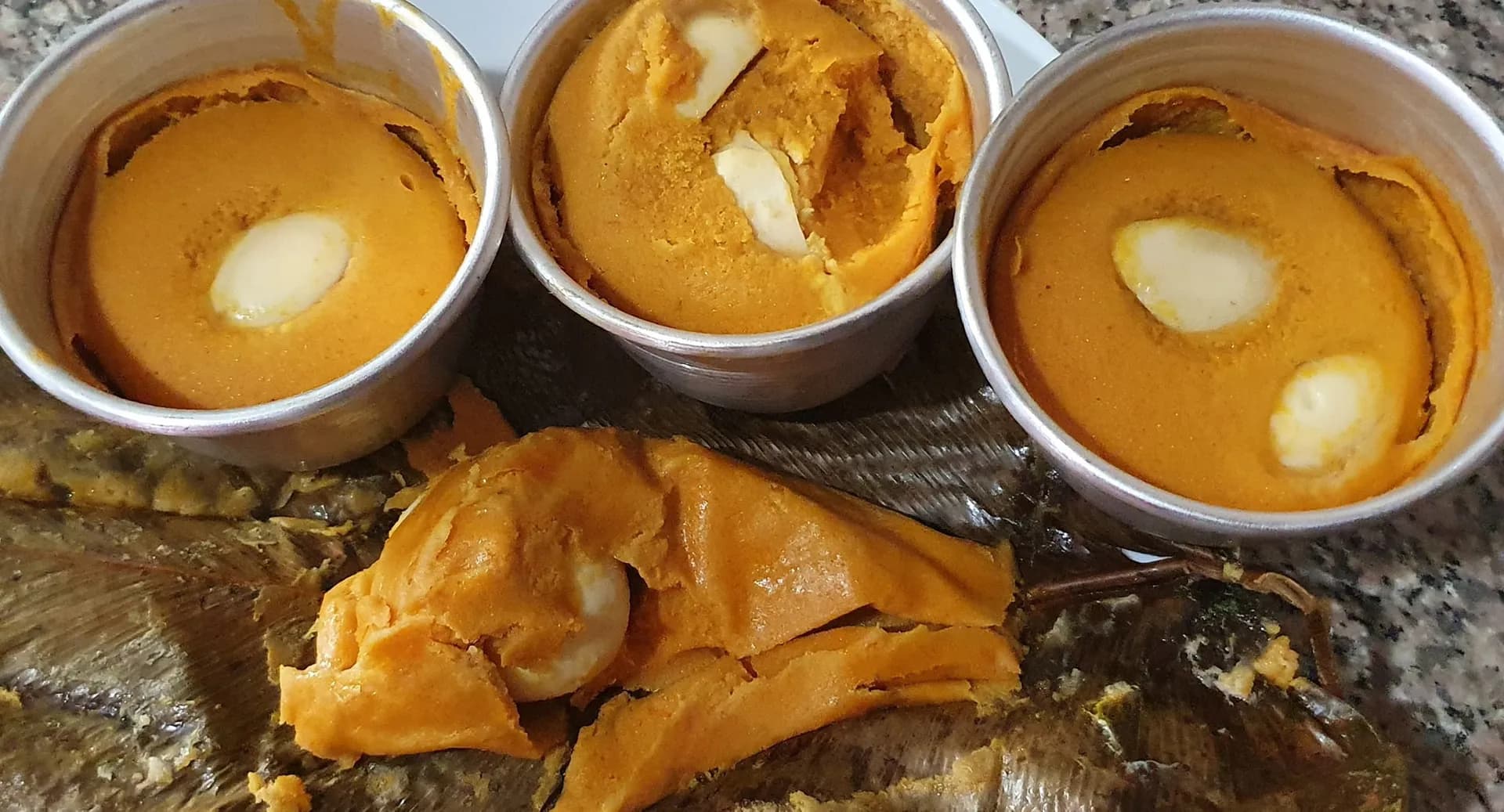
Moi moi is steamed bean pudding, and it is among the small group of Nigerian dishes that turn up everywhere: at breakfast, at parties, at weddings, in lunchboxes, beside jollof rice, and on its own. Black eyed peas or brown beans are soaked, peeled, blended with pepper and onion, seasoned, and steamed until they set.
The peeling is what most people underestimate. The bean skins have to come off before blending, because they are what stands between a smooth moi moi and a gritty one, and the quality of the blend decides the texture of the finished dish more than any other single factor. Nigerian markets have heavy duty commercial mills for exactly this reason, and home blenders often cannot manage it.
What it is steamed in changes the result and the name. Uma leaves, from Thaumatococcus daniellii, give the best flavour and cook fastest; banana leaves are the common alternative; aluminium foil and heatproof containers are the modern route. Nutmeg is the ingredient people leave out and then wonder why their moi moi does not taste like the one at the party. Egg, corned beef or bone marrow goes into the middle, and moi moi appears as a side to jollof and fried rice, as breakfast with pap or bread, and as a meal in itself.
Thiakry is millet couscous stirred into sweetened yogurt and milk, served cold, and it is one of the most widely eaten sweet things in Senegal and the Gambia. It is also written thiakri, chakery, caakiri and degue, and the spelling shifts with the language and the writer while the dish stays the same.
Millet is the reason it exists. It is one of the principal grains of Senegal, grown across the drier interior where rice does not do well, and thiakry is among the most common things made from it. The grain is milled to a couscous and steamed, then cooled and folded into the dairy. In Dakar it is sold in every grocery store, which is a fair measure of how ordinary a food it is.
It is eaten at breakfast as readily as at the end of a meal, which puts it in the same category as yogurt everywhere: sweet, cold, and not confined to dessert. Raisins, mango, grated coconut and chopped almonds are all standard on top, and vanilla and nutmeg are the usual flavourings. Its close relation ngalakh, made with peanut paste and baobab, is the elaborated festival version of the same base. Thiakry is the everyday one.
Ka'ak is a ring-shaped bread, crisp outside and soft within, scattered with sesame seeds. It is Libyan in this version, and made across a wide stretch of the Arabic-speaking world, Egypt, Iraq, Iran, Jordan, Lebanon, Palestine and Syria all have their own.
The shape is what defines it. Ka'ak is formed into a large ring, bigger and thinner than a bagel, which is why street vendors across the region can carry stacks of them on a pole or a cart. In Libya it is eaten at breakfast alongside hummus and falafel, and it comes in savoury and sweet versions.
The name travels further than the shape does. Ka'ak, sometimes kahk or kahqa, covers a whole family of baked goods across the Arabic-speaking world, from this ring bread to the small filled Egyptian cookies eaten at Eid, which are a completely different thing. The word means something closer to "baked good" than to any specific item.
One technique in this recipe is worth borrowing for other breads. A tray of water is placed in the bottom of the oven while it heats, so the loaves bake in a steamy environment. Steam keeps the crust soft for the first minutes, letting the bread rise fully before the surface sets, and then produces a thin, crisp finish.