Nous utilisons des cookies essentiels au fonctionnement du site. Nous aimerions aussi déposer des cookies de mesure d’audience et des cookies publicitaires, uniquement avec votre accord. Vous pouvez choisir séparément pour chacun. Lire notre politique relative aux cookies
Loading
Recettes
Parcourez les archives par pays, par plat et par temps de cuisson.
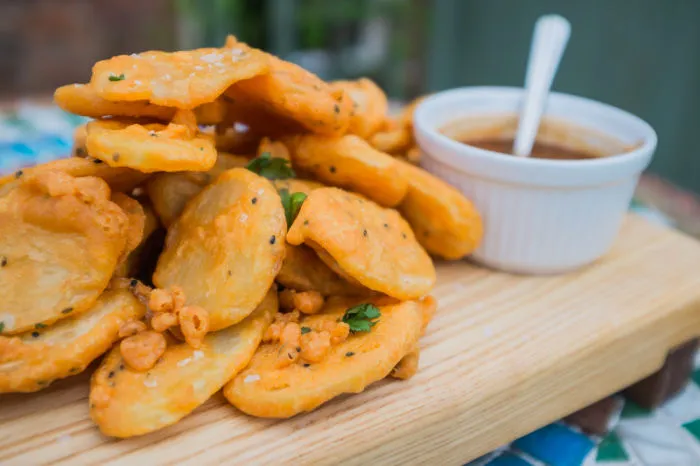
Overripe bananas mashed with grated cassava, seasoned with salt and deep-fried into small golden balls. In Cameroon it is street food sold nationwide, and it is also celebration food, a fixture at Christmas parties and weddings.
What sets it apart from the many other West African banana fritters is the starch. Most versions bind mashed banana with wheat flour, rice flour or cornmeal; this one uses grated cassava, which is why it is also called accra cassava. Cassava is worked into an enormous number of forms in Cameroonian cooking, fufu, garri, bobolo sticks, and this is one more. The result is chewier and denser than a flour-based fritter, with the cassava's faint sourness cutting the sweetness of the fruit.
Overripe bananas are not a compromise here, they are the requirement. A firm banana has neither the sweetness nor the softness the mixture needs, and the dish exists partly as a way of using fruit that has gone too far to eat out of hand.
The usual accompaniment is African pepper sauce, which is worth taking seriously: the contrast between a sweet fried fritter and a fierce chilli sauce is the whole point of eating them together.
Whole tilapia scored, marinated in an oil-based spice mixture, oven-grilled, then coated in a fresh green pepper base and returned to the heat. The two-stage seasoning is what makes it, and it is a West African approach rather than a simple marinade.
The first stage is a dry-spice oil: vegetable oil with fish seasoning, white and black pepper, ginger, garlic, onion powder and lemon juice, worked into the cuts. The second is a green pepper base built in a food processor from green and red scotch bonnets, bell peppers, spinach, dill, coriander, ginger, garlic and onion, fried briefly in oil and then smeared over the part-cooked fish.
That green base is the interesting part. Blending leafy greens and fresh herbs into a pepper sauce is characteristic of Ghanaian and wider West African fish cookery, and it gives colour and a fresh, sharp finish that a marinade applied only at the start cannot. The scoring is not decorative either: two or three cuts on each side let both stages of seasoning reach the flesh rather than sitting on the skin. Tilapia is native to African fresh waters and is the fish most associated with Ghanaian grilling, usually eaten with banku.
Thick slices of brioche soaked in a sweetened egg, milk and cream custard, then baked with chocolate and butter. No country is claimed. French toast in one form or another is eaten across Europe and beyond, and it is considerably older than its English name, a version appears in Apicius, the Roman recipe collection, and it is known in France as pain perdu, lost bread, because its purpose was to rescue bread that had gone stale.
The bread choice is the substance of the recipe and the source is right about it. Brioche and challah are both enriched doughs, made with eggs and butter, which means they are structurally sturdier and can absorb a great deal of custard without collapsing. Plain sandwich bread turns to mush. Cutting the slices thick, around 2 cm, matters for the same reason.
Baking rather than pan-frying is the other decision here, and it solves a real problem. Thick slices fried in a pan brown on the outside long before the custard in the middle has set, which is why so much home-made French toast is soggy inside. The oven cooks it through evenly.
The method has a copy error worth noting: it refers to baguette slices twice, having specified brioche in the ingredients. Brioche is correct.
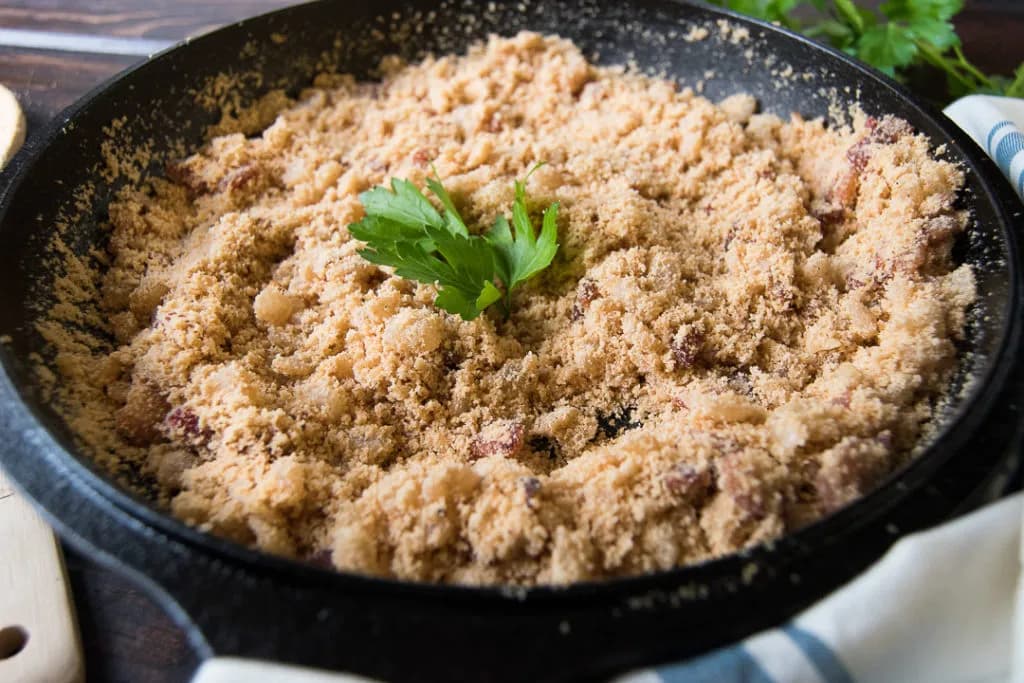
Farofa is cassava flour toasted in fat with onion, garlic and usually bacon, until it turns golden and sandy. It is Brazilian, and it appears on the table at almost every Brazilian meal that involves a stew or grilled meat.
Its job is texture. Brazilian cooking produces a great deal of rich, soupy food, feijoada above all, and farofa is scattered over it to absorb the liquid and give a dry, crunchy contrast. Eaten on its own it makes little sense; eaten over a wet dish it makes complete sense, and that is how it is used.
The African connection is direct and worth stating. Cassava is South American in origin, but the technique of toasting cassava meal into a dry accompaniment moved across the Atlantic in both directions with the transatlantic slave trade, and farofa's closest relatives are West African. Garri, the fermented and toasted cassava granules eaten across Nigeria, Ghana and Benin, is made by essentially the same process. Brazilian cooking, and Bahian cooking in particular, carries an enormous amount of West African influence, and farofa sits squarely in that history, which is precisely why it belongs in a Worldwide collection on an African food site rather than being simply foreign.
The method is short and the one instruction that matters is to keep it moving. Cassava flour burns quickly and unevenly.