Nous utilisons des cookies essentiels au fonctionnement du site. Nous aimerions aussi déposer des cookies de mesure d’audience et des cookies publicitaires, uniquement avec votre accord. Vous pouvez choisir séparément pour chacun. Lire notre politique relative aux cookies

Loading
Recettes
Parcourez les archives par pays, par plat et par temps de cuisson.
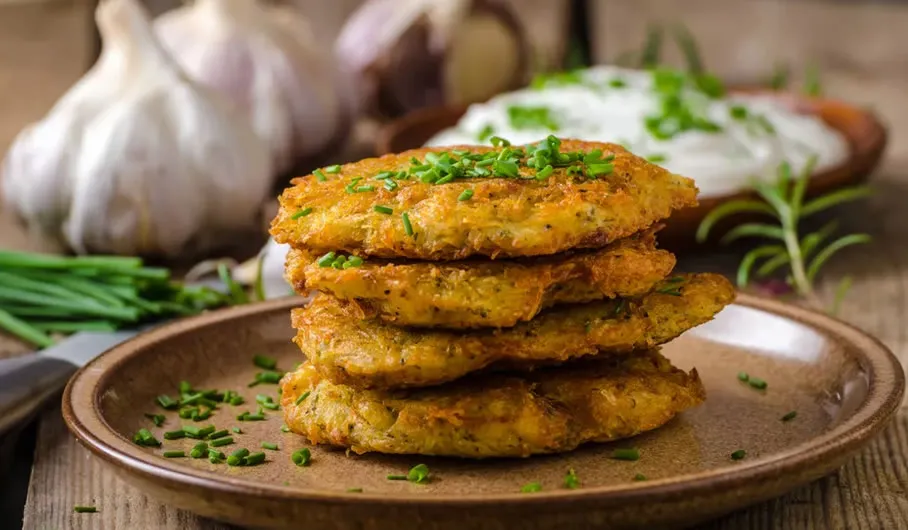
Maakouda is a Moroccan potato cake, mashed potato bound with egg and herbs, floured and deep fried until the outside crisps and the inside stays soft. It is street food, sold cheap and eaten either on its own or stuffed into a small baguette.
Meknes is where it is most associated, and the city is described as the wine capital of North Africa. Maakouda is sold from stalls there and across the country, and it appears in Algeria and Tunisia too under the same set of spellings: maaqouda, maqouda, makouda. The comparison the source draws is with falafel, and it holds up: a cheap fried snack, sold from a stall, eaten in bread. It has simply never travelled the way falafel has.
Ras el hanout is what marks it as Moroccan rather than a generic potato cake. The blend is optional in this recipe and the source strongly recommends it, and turmeric gives the colour. It is also a practical way to use up leftover mashed or baked potato, which is much of how it is made at home. Deep frying is traditional; the oven and the air fryer both work and are given as alternatives.
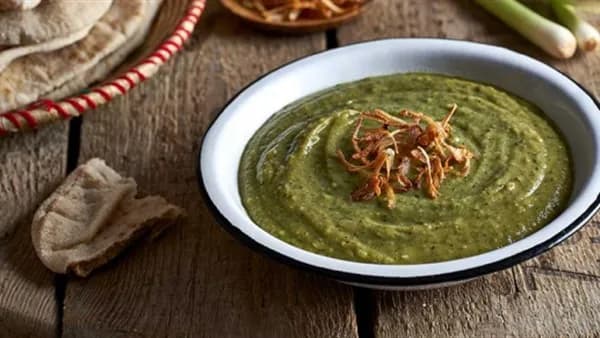
Bessara is dried split fava beans cooked soft with garlic and olive oil, then puréed and seasoned with cumin and paprika. It is street food across Morocco, most strongly associated with the north, and it is eaten for breakfast as often as for anything else.
Its consistency is not fixed, and that is a feature rather than a vagueness. Made thick, it is a dip eaten from a shared plate with Moroccan bread. Made looser, it is a soup served in individual bowls, which is how street vendors serve it on cold mornings. The same pot produces both, depending on how much of the cooking liquid goes back in.
Traditionally the beans were cooked for hours until they collapsed entirely and then passed through a food mill. A blender does the same job in seconds and gives a smoother result, which is what most cooks now use, and the source is right that nothing is lost by it.
The condiments are not optional garnish. Bessara is served with olive oil, cumin, salt and cayenne or harissa on the side, and each person seasons their own bowl. The purée itself is deliberately mild, which only makes sense once you know that.
Note that the same dish appears elsewhere spelt bissara; they are one thing. Some cooks make it with dried split peas in place of some or all of the fava beans, which gives a lighter texture and a greener colour but changes nothing about the method or the seasoning.
Koshari is Egypt's national dish and its most famous street food, rice, lentils and macaroni layered together, topped with a spiced tomato sauce, crisp fried onions and a sharp garlic-vinegar dressing.
It is a dish of components, and none of them is complicated. What makes koshari work is that all of them are made separately and assembled at the end, so each keeps its own texture: the rice and lentils soft, the pasta firm, the onions properly crisp, the sauce sharp with vinegar and cumin.
It is cheap, filling and entirely plant-based as standard, which is why it feeds an enormous number of people every day. Koshari shops exist across Egypt doing nothing else, and it is eaten as often at home. Its ubiquity is genuine, the comparison to macaroni cheese in the source is about how ordinary it is rather than what it tastes like.
The daqqa, the garlic and vinegar dressing, is what stops the whole thing being stodgy, and it is the element most often underdone by people making it for the first time. Be generous with it.
Chickpeas are usually added on top.
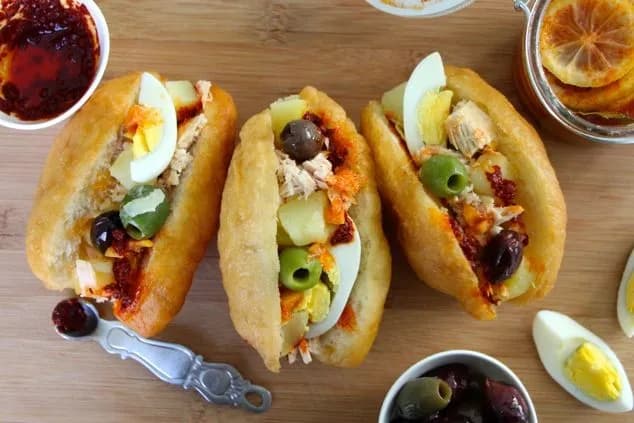
A fricassé is a small oval roll of enriched dough, deep-fried and then split and packed with tuna, potato, olives, egg and harissa. It is Tunisian street food, and it is one of the country's most recognisable things to eat.
The word does not mean what it means elsewhere. In French, a fricassée is a braise of meat in a white sauce; in Tunisia and its diaspora it means this sandwich and nothing else. That divergence is complete enough that searching the French term will not find you the Tunisian food.
The filling is the point and it is fixed by convention rather than by recipe: tuna in olive oil, cooked potato, black olives, egg and harissa, with slata méchouia, the grilled pepper and tomato salad, very often alongside. Capers and preserved lemon appear in some versions. What matters is that the bread is fried rather than baked, which gives a rich, slightly greasy roll that stands up to a wet filling.
**A significant gap in the source.** Its ingredient list contains only the dough, yeast, water, flour, egg, oil, salt. Not one of the filling ingredients it spends its article describing appears in it. The filling below has been reconstructed from that description and flagged.
**It contains eggs and fish.**