Nous utilisons des cookies essentiels au fonctionnement du site. Nous aimerions aussi déposer des cookies de mesure d’audience et des cookies publicitaires, uniquement avec votre accord. Vous pouvez choisir séparément pour chacun. Lire notre politique relative aux cookies

Loading
Recettes
Parcourez les archives par pays, par plat et par temps de cuisson.
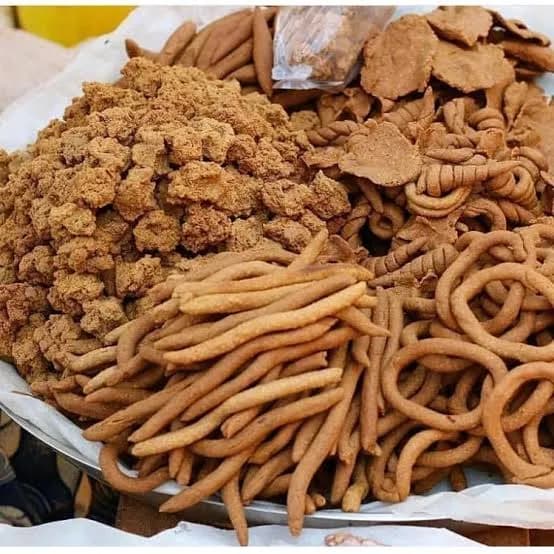
Kuli kuli is a peanut snack eaten across Nigeria, Benin, northern Cameroon and Ghana, and it is one of the most widely recognised street foods in West Africa. It is made from peanuts alone, and the technique is what makes it: the oil is deliberately pressed out of the ground paste before the remaining solids are shaped and fried.
That extraction is the point. Removing the oil leaves a dense, dry paste that fries into something genuinely crunchy rather than soft, and it also produces the frying oil as a by-product, so nothing is wasted. It is a piece of processing knowledge that predates industrial oil pressing and is still done by hand in Hausa communities in northern Nigeria, where the snack has its strongest association.
It takes different shapes in different places: small sticks, rings, flat discs and irregular pieces are all standard, and the form varies by region and by seller. English names for it, groundnut cake and peanut snack among them, are approximations rather than translations. Kuli kuli is eaten on its own, mixed into garri with sugar and water, crumbled over salad, or served alongside fura and koko. Crushed to a powder it becomes the peanut component of suya spice, which is where most people outside the region encounter it without knowing.
Groundnut milk is what you get when raw peanuts are soaked, blended with water and strained, a plant milk made from one of West Africa's most important crops, using a method that predates the shelves of alternative milks now sold everywhere.
The groundnut itself is not originally African. It came from South America and arrived through Portuguese trade, but it settled into West African farming and cooking so completely that it is now difficult to think of the region's food without it. Groundnut stew, kuli kuli, suya's spice base, roasted nuts sold by the cup at every junction, the crop runs right through the cuisine, and milk is one more thing done with it.
It is drunk for straightforward reasons. It contains no dairy, which matters in a region where lactose intolerance is common in adults, and it is made from something cheap and locally grown rather than imported. Flavourings are a matter of household preference: vanilla, a little sugar, sometimes cinnamon or dates.
The one thing it demands is that you make what you will drink. Fresh groundnut milk has nothing preserving it and separates within a day or two, so it is made in small quantities rather than stored, which is why it tends to be a morning thing, made and finished.
It should be shaken before pouring; separation is normal, not spoilage.
Gages is a Sierra Leonean aubergine and tomato salad, marinated in vinegar and oil and finished with flaked coconut and roasted peanuts just before serving. The aubergine is fried in butter first, which is what separates it from a raw salad.
The structure is a marinated salad rather than a cooked dish, and the long chill is where the work happens. Three hours minimum, and overnight is better, lets the vinegar and oil work into the fried aubergine and the raw tomato and onion soften slightly without losing their shape. It is one of very few African dishes served genuinely cold.
Coconut and peanuts go on at the last moment and are the point of the dish. Both go soft within minutes of meeting the dressing, so adding them early loses the crunch that the whole thing is built around. Both are staples of Sierra Leonean cooking, where groundnuts appear in everything from stews to snacks and coconut grows along the coast. Because of the peanuts and the butter, this is neither vegan nor peanut-free, which the ingredient list makes clear but the name does not.
Ripe plantains mashed to a paste, combined with rice flour and turmeric-infused oil, then baked in a loaf tin and sliced. The source places it in Ivory Coast, where plantain in every form is close to universal.
It is worth being clear about what this is, because the title is misleading in two directions. It is not sliced plantain roasted in an oven, which is what most people mean by baked plantain. And the recipe uses rice flour as a binder and turmeric for colour, which makes it a plantain loaf or cake, closer in construction to a steamed pudding than to a side dish. The slug says load rather than loaf, which appears to be a typo in the original; the URL has been kept exactly as it is.
One ingredient does not fit the stated origin. Chilli sambal is Indonesian and Malay, and it is not part of Ivorian cooking. It may be a substitution the contributor made for a local pepper paste, but the source does not say so, and rather than invent an explanation it has been flagged.
The source's nutritional comparisons with potato have not been carried across. What matters for cooking is that ripe plantain is sweet and starchy, and that is what makes the loaf hold together.
Les mentions alimentaires sont fournies par les contributeurs à titre indicatif. Elles ne sont pas vérifiées par AFN et dépendent des produits que vous achetez. En cas d’allergie grave, vérifiez vous-même chaque ingrédient. Cuisine, allergies et votre propre jugement