Nous utilisons des cookies essentiels au fonctionnement du site. Nous aimerions aussi déposer des cookies de mesure d’audience et des cookies publicitaires, uniquement avec votre accord. Vous pouvez choisir séparément pour chacun. Lire notre politique relative aux cookies
Loading
Recettes
Parcourez les archives par pays, par plat et par temps de cuisson.
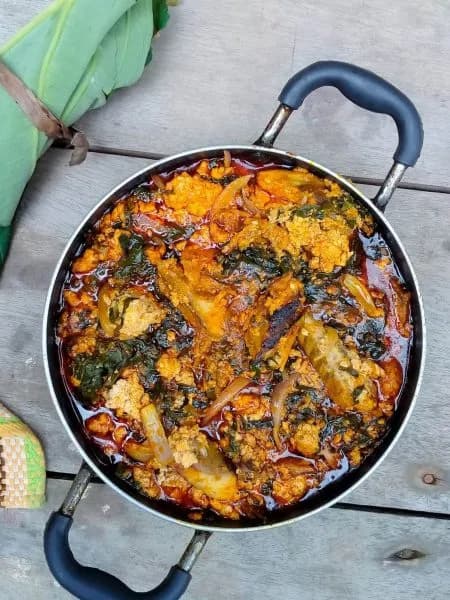
Kontomire is the Twi word for cocoyam leaves, and kontomire stew is the dish that has made them Ghana's most eaten green. The leaves are broad and thick, closer to collard greens in body than to spinach, and they hold their structure through a long cook rather than collapsing.
The stew belongs to Akan cooking and forms one half of ampesi, the pairing of a stew with yam, plantain or cocoyam that is among the most common meals in southern Ghana. It exists in more than one form. Abom, the Asante version, is steamed cocoyam leaves ground with onion, pepper and tomato and finished with palm oil. The version here is tomato based and thickened with ground melon seeds, which Ghanaians call egusi or agushie, and which give it a body and a nuttiness that abom does not have.
Kontomire stew sits inside the wider West African family of leaf stews known collectively as palava sauce, cooked in Ghana, Liberia, Sierra Leone and Nigeria with the greens each country has. Ghana's is distinguished by the cocoyam leaf and by the melon seed.
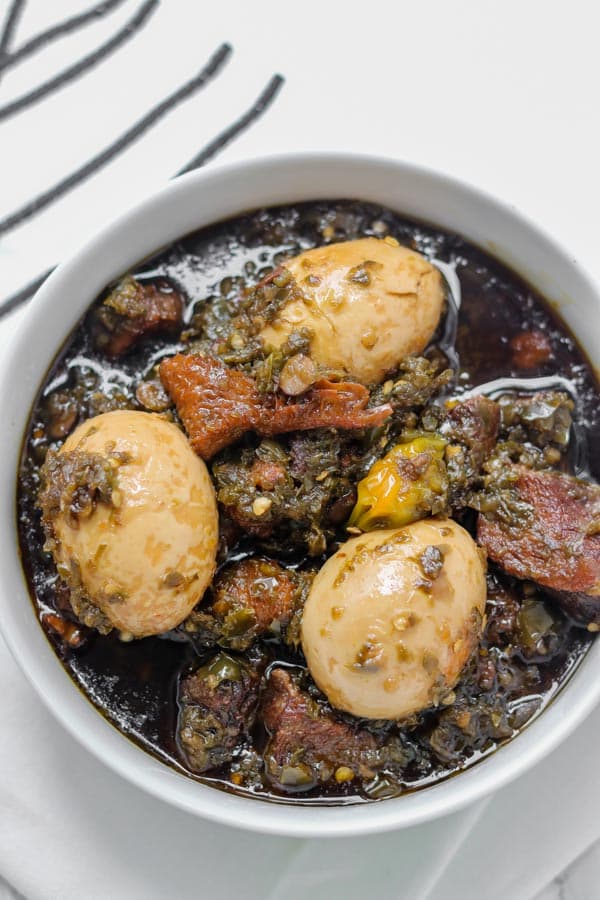
Ayamase is the green pepper stew of southwestern Nigeria, known almost as widely by two other names, ofada sauce, after the rice it is served with, and designer stew, which is what Lagos took to calling it.
It is defined by two things that would be faults in almost any other stew. The peppers are green rather than red, which gives the sauce its unusual dark olive colour. And the palm oil is deliberately bleached, heated until it stops smoking and loses its red pigment, which strips out the characteristic palm flavour and leaves something nuttier and smokier behind. That bleaching step is the whole signature of the dish, and a version made with unbleached oil is a different sauce.
Around that sit iru, the fermented locust bean that carries the deep savoury note, assorted meats including offal, and boiled eggs, which are close to obligatory.
The name points to a person. Ayamase is traced to Ikenne-Remo in Ogun State and to a woman remembered as Mrs Felicia, Iya Mase, the wife of Mase, who is credited with the dish. It travelled from there into Lagos party food, where its reputation as something special was made.
It is served with ofada rice, the short, unpolished local rice whose earthy flavour is the intended partner.
Ayamase is the green pepper stew of southwestern Nigeria, known widely as designer stew, and it is the sibling of ofada stew rather than a version of it. The difference is the pepper: ofada uses red bell peppers and tomatoes and comes out red; ayamase uses green bell peppers and unripe scotch bonnets and comes out dark green.
Bleached palm oil is what defines the technique. The oil is heated until it stops being red and turns clear, which changes its flavour entirely, removing the sweetness and leaving something deeper and more savoury. It is a step that fills a kitchen with smoke and it cannot be skipped without producing a different sauce.
The rest is southwestern Nigerian cooking at full strength: locust beans for fermented depth, ground crayfish, assorted meat including tripe and cow skin, and whole hard eggs that sit in the sauce and take on its flavour. The sign that it is finished is the oil floating to the surface. It is served with ofada rice, the local short-grain rice, or with white rice or rice and beans, and it appears at parties and in restaurants as much as at home.