Nous utilisons des cookies essentiels au fonctionnement du site. Nous aimerions aussi déposer des cookies de mesure d’audience et des cookies publicitaires, uniquement avec votre accord. Vous pouvez choisir séparément pour chacun. Lire notre politique relative aux cookies

Loading
Recettes
Parcourez les archives par pays, par plat et par temps de cuisson.
Dukkah is a dry Egyptian blend of toasted nuts, seeds and spices, pounded to a coarse crumb and eaten by dipping bread into olive oil and then into the dukkah. It is sold in cones of paper in Cairo's spice markets and made at home to family recipes.
**It contains hazelnuts, which is not obvious from the name.**
The name explains the texture. Duqqa comes from the Arabic for to pound, and the defining characteristic is that the mixture is crushed to a state that is neither a powder nor a paste, coarse enough to have texture in the mouth, fine enough to stick to oiled bread. Grind it too far and the nut oils release and it turns into a paste, which is the one thing it must not be.
There is no fixed formula. Sesame, coriander, cumin, salt and pepper are near-universal; beyond that it varies by household and by vendor. A nineteenth-century account mentions marjoram, mint, za'atar and chickpeas; a 1978 report names nigella, millet flour and dried cheese; pine nuts, pumpkin seeds and sunflower seeds are more recent. The simplest market version is nothing but crushed mint, salt and pepper.
Dry-toasting each element separately, as the method does, is not fussiness, nuts, sesame and whole spices all reach their best at different rates.
Pastilla is the Moroccan dish that most confounds people who meet it for the first time: shredded spiced poultry and toasted sweetened almonds, layered inside buttered pastry and dusted with icing sugar and cinnamon. Savoury and sweet are not separated but deliberately built into the same mouthful.
It is celebration food. Pastilla appears at weddings, at Eid, and when a household wants to demonstrate hospitality to a guest, and the effort involved is part of the message. Historically it was made with pigeon; chicken is now standard, and the shift is one of availability rather than taste.
The dish is known by both names. Bastila and pastilla are the same word under different regional pronunciations and are used interchangeably in Morocco. Its regional forms diverge considerably: Fes makes a lamb version, coastal Essaouira a seafood one with prawns and fish, and Atlas households work dried fruit in for extra sweetness.
Two notes on this particular version. Its ingredient list names both phyllo dough and filo sheets, which are the same thing under two spellings. And it gives no oven temperature, deferring to whatever is printed on the pastry packet. A hot oven is what the method needs, and the figure is given below. There are a lot of almonds here, which matters for anyone with a tree nut allergy.
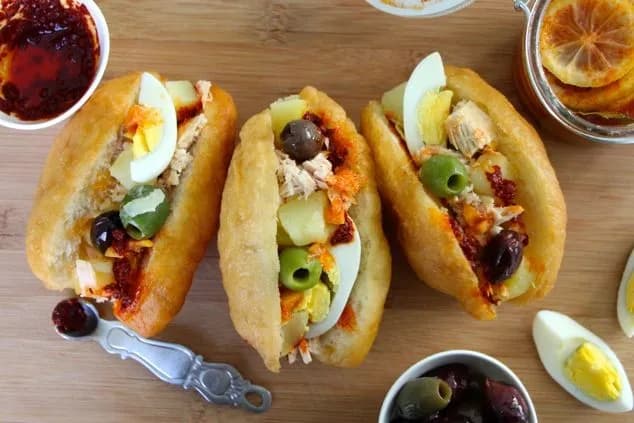
A fricassé is a small oval roll of enriched dough, deep-fried and then split and packed with tuna, potato, olives, egg and harissa. It is Tunisian street food, and it is one of the country's most recognisable things to eat.
The word does not mean what it means elsewhere. In French, a fricassée is a braise of meat in a white sauce; in Tunisia and its diaspora it means this sandwich and nothing else. That divergence is complete enough that searching the French term will not find you the Tunisian food.
The filling is the point and it is fixed by convention rather than by recipe: tuna in olive oil, cooked potato, black olives, egg and harissa, with slata méchouia, the grilled pepper and tomato salad, very often alongside. Capers and preserved lemon appear in some versions. What matters is that the bread is fried rather than baked, which gives a rich, slightly greasy roll that stands up to a wet filling.
**A significant gap in the source.** Its ingredient list contains only the dough, yeast, water, flour, egg, oil, salt. Not one of the filling ingredients it spends its article describing appears in it. The filling below has been reconstructed from that description and flagged.
**It contains eggs and fish.**
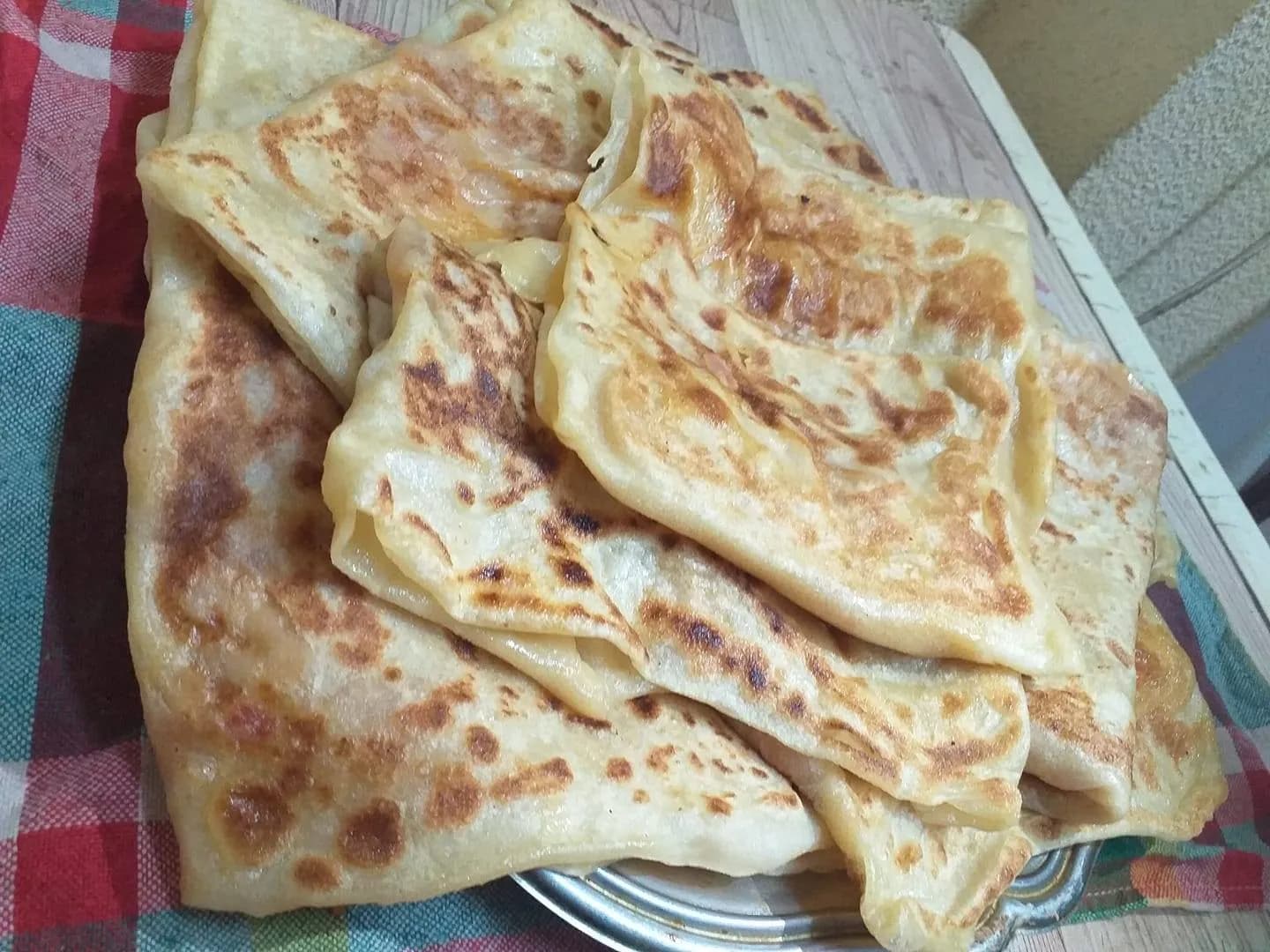
Feteer meshaltet is an Egyptian pastry made by stretching dough until it is almost transparent, brushing it with butter, folding it, and repeating until it consists of a great many paper-thin layers. It is baked in a very hot oven and eaten either plain with honey, molasses and tahini, or filled with anything from cheese to minced meat to custard.
The name means something like flattened or stretched pie, and that describes the method exactly. The dough is not rolled, it is stretched by hand until the surface below is visible through it, then folded with butter between every layer. What produces the texture is the butter turning to steam between the layers in a very hot oven and forcing them apart, which is the same physics as puff pastry arrived at by a completely different route.
The oven temperature the source calls for looks like an error and is not, it is far above ordinary baking heat. Feteer needs that to puff before the layers set, and Egyptian bakeries use wood-fired ovens hotter still. A domestic oven at its maximum with the broiler finishing the top is the practical approximation.
It has a long and reasonably well-attested history, the source traces it to ancient Egypt, where a version was offered in temples. Its claim that feteer became the croissant in Europe is repeated widely but not established, and it has been recorded here as a claim rather than a fact.