

Nous utilisons des cookies essentiels au fonctionnement du site. Nous aimerions aussi déposer des cookies de mesure d’audience et des cookies publicitaires, uniquement avec votre accord. Vous pouvez choisir séparément pour chacun. Lire notre politique relative aux cookies

Loading
Recettes
Parcourez les archives par pays, par plat et par temps de cuisson.
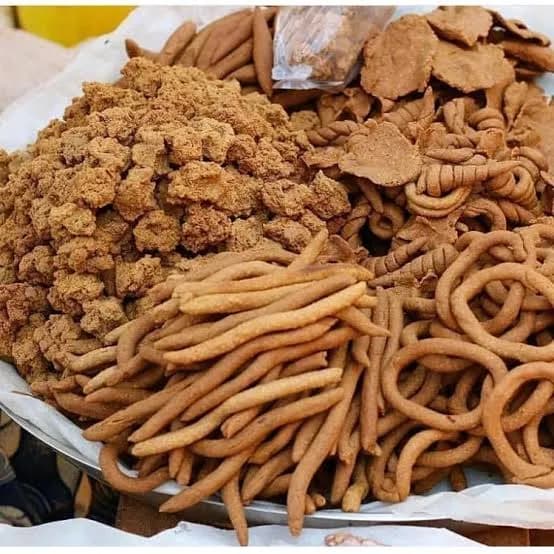
Kuli kuli is a peanut snack eaten across Nigeria, Benin, northern Cameroon and Ghana, and it is one of the most widely recognised street foods in West Africa. It is made from peanuts alone, and the technique is what makes it: the oil is deliberately pressed out of the ground paste before the remaining solids are shaped and fried.
That extraction is the point. Removing the oil leaves a dense, dry paste that fries into something genuinely crunchy rather than soft, and it also produces the frying oil as a by-product, so nothing is wasted. It is a piece of processing knowledge that predates industrial oil pressing and is still done by hand in Hausa communities in northern Nigeria, where the snack has its strongest association.
It takes different shapes in different places: small sticks, rings, flat discs and irregular pieces are all standard, and the form varies by region and by seller. English names for it, groundnut cake and peanut snack among them, are approximations rather than translations. Kuli kuli is eaten on its own, mixed into garri with sugar and water, crumbled over salad, or served alongside fura and koko. Crushed to a powder it becomes the peanut component of suya spice, which is where most people outside the region encounter it without knowing.
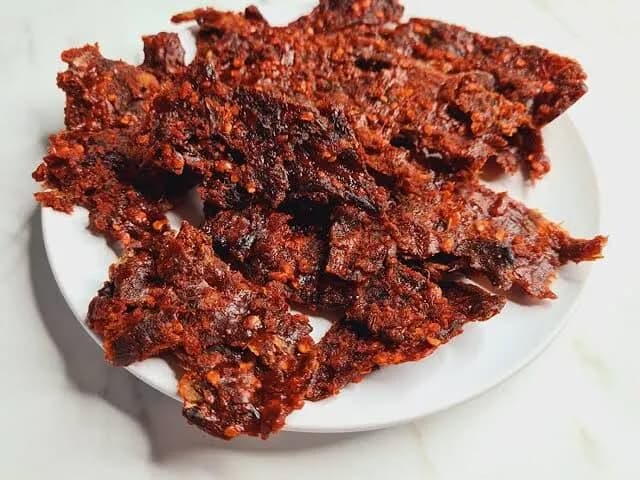
Kilishi is Northern Nigerian dried meat, and it is a considerably more deliberate thing than the jerky it is usually compared to. Beef is sliced thin enough to be translucent, dried, coated in a paste built on ground groundnuts and spices, dried again, and briefly finished over heat. The groundnut coating is what separates kilishi from every other dried meat in the world.
It is a preservation technology first. In the Sahel, where refrigeration was not available and the dry season is long, thin slicing and sun drying kept meat edible for months, and the spice paste added flavour while doing further preservation work. That the result is now sold as a delicacy rather than as survival food does not change what it was built for.
Kilishi is Hausa, sold in markets across the north and increasingly across the whole of Nigeria and among the diaspora, where it travels well precisely because it was designed to. It is eaten as a snack rather than as part of a meal, torn into pieces, often with a cold drink. The heat level varies by maker, and the yaji spice logic that runs through northern Nigerian cooking, the same groundnut and pepper base used on suya, is visible in it.
Tortilla chips baked under seasoned beef and melted cheese, finished with raw onion, bell pepper and avocado. It is Tex-Mex and American, and it has an origin story that is unusually well documented for a snack food.
In 1943, wives of American soldiers stationed at Fort Duncan in Eagle Pass, Texas, crossed into Piedras Negras, Mexico, on a shopping trip. They stopped at the Victory Club to eat and found the restaurant closed for the day. The maître d', Ignacio "El Nacho" Anaya, made something from what was left in the kitchen: tortillas, cheese and pickled jalapeños. The dish took his nickname.
It sits in Worldwide Recipes under American, since nachos belong to Mexican, Tex-Mex and American cooking rather than to anything African. This particular version puts soy sauce in the beef seasoning, which is not conventional and points to a contemporary cook rather than a tradition. Africa's own layered snack dishes are different things: Nigerian gizdodo, South African bunny chow, Egyptian koshari. The technique worth knowing here is that the beef is seasoned and cooked before it goes on the chips, so the assembly only needs long enough to melt the cheese.
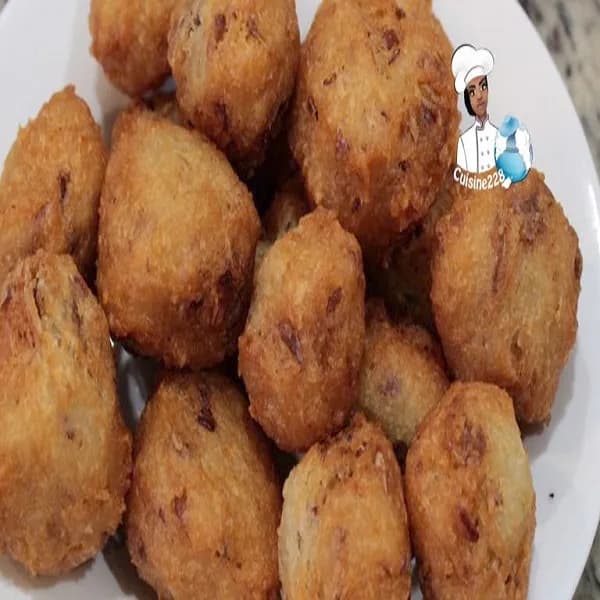
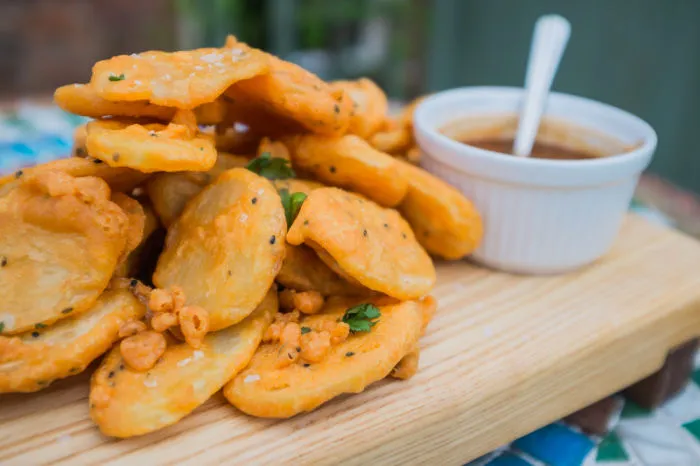
Ojojo is a fritter made from grated water yam, and it belongs to the Yoruba people of southwestern Nigeria. It is finger food and street food, sold from roadside stands and made at home on weekend mornings, and it follows more or less the same procedure as akara without the beans.
Water yam, isu ewura, is what makes it work. It is wetter and more mucilaginous than the white yam used for pounding or frying, and grated it holds together in the oil without any flour or binder at all. That is the whole trick of the dish: no egg, no batter, nothing but yam, onion, pepper and crayfish, held together by the yam's own starch.
The texture people are after is crisp on the outside and soft, almost fluffy, inside, and that balance is what separates a good ojojo from a dense one. Grating by hand is the traditional method and gives the most reliable result; a blender works but has to be used sparingly, since water yam breaks down very quickly and too much added water leaves a mixture that will not hold its shape in the pan. It shares its main ingredient with ikokore, the Ijebu water yam pottage, which is a different dish entirely.
Les mentions alimentaires sont fournies par les contributeurs à titre indicatif. Elles ne sont pas vérifiées par AFN et dépendent des produits que vous achetez. En cas d’allergie grave, vérifiez vous-même chaque ingrédient. Cuisine, allergies et votre propre jugement