Nous utilisons des cookies essentiels au fonctionnement du site. Nous aimerions aussi déposer des cookies de mesure d’audience et des cookies publicitaires, uniquement avec votre accord. Vous pouvez choisir séparément pour chacun. Lire notre politique relative aux cookies
Loading
Recettes
Parcourez les archives par pays, par plat et par temps de cuisson.
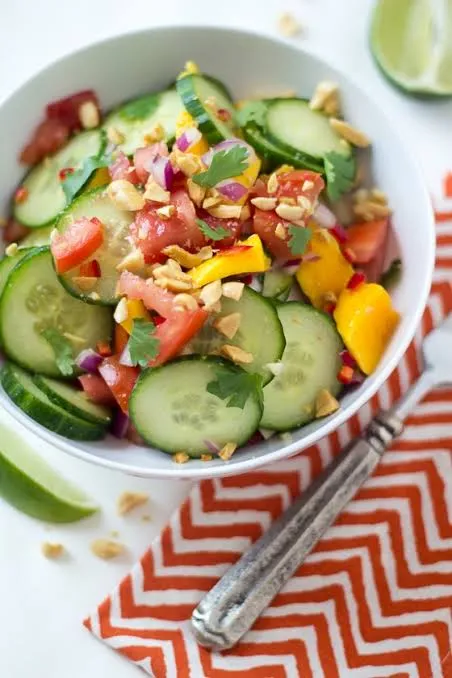
This is an East African salad of mango, cucumber and tomato with chilli, cumin and a little cinnamon, dressed with lime and finished with roasted peanuts. It is served on its own or alongside grilled meat, and its appeal is the contrast: crunchy against soft, sweet against tart.
Mangoes are not indigenous to Africa. They reached the East African coast through Persian traders around the tenth century, part of the same Indian Ocean exchange that brought rice, spices and coconut into Swahili cooking, and they have been grown and eaten there ever since. Kenya and Tanzania are now substantial producers.
The seasoning is what places it. Cumin with a dash of cinnamon in a fruit salad is a Swahili coast combination rather than a Western one, reflecting the same trade history, and the peanuts and lime give it the texture and acidity that hold the whole thing together. Salting the cucumber and onion first and letting them drain for twenty minutes is the technique that matters most: cucumber holds a great deal of water, and skipping it leaves a salad sitting in liquid within minutes of being dressed.
This is couscous with roasted vegetables, chickpeas, raisins and almonds, dressed with lemon, cumin and olive oil. It is a salad in the sense of being served at room temperature rather than a leafy one: the couscous is the bulk of it and the vegetables are folded through.
Couscous was first made by the Amazigh people of North Africa, who worked out how to turn wheat into fine granules, and it remains a staple across Morocco, Algeria, Tunisia and Libya. Moroccan couscous is the smallest of the common grades, finer than Israeli or Lebanese couscous, and it is what this recipe uses.
The technique is absorption rather than steaming. Hot broth is poured over the dry couscous, which has been tossed with olive oil and turmeric, and it is covered and left for five minutes. The raisins go in during that time so the residual heat plumps them. Traditional Moroccan couscous is steamed repeatedly in a couscoussier, which produces a lighter grain; this is the quick domestic method. The vegetables are roasted separately and folded in, which keeps them caramelised rather than steamed into the grain.
Vegetables tossed in oil and smoked paprika and cooked low and slow in a barbecue smoker for one to two hours. Like smoked shrimp, this belongs to American barbecue rather than to any African tradition, and no country is named in the source.
Which vegetables work is the useful part. Dense, firm vegetables hold up to the long, low process: potatoes, carrots, beets, brussels sprouts, cauliflower, onions, mushrooms, aubergine and winter squash such as butternut. Softer ones collapse before they take on any smoke. The recipe here uses courgette, yellow squash, onion, bell peppers, asparagus and carrots, which is at the softer end of that range and accordingly needs the shorter end of the time.
Smoked paprika in the seasoning is doing something worth noticing: it brings smoke flavour independently of the smoker, which means the dish reads smoky even before the wood does its work. That is a useful trick in itself, and it means a version of this can be made in an oven with no smoker at all. Africa's charred vegetable traditions are different things entirely, Moroccan zaalouk, Egyptian baba ganoush, West African roasted pepper bases, where vegetables are blackened directly over flame rather than smoked slowly.
Taktouka is roasted peppers and grated tomato cooked down with onion, garlic, cumin and paprika into a thick warm salad. It is Moroccan, also popular in Algeria, and it is a mezze dish rather than a leaf salad.
The name explains the texture. It comes from the Arabic taktak, meaning to grind or pound, and the vegetables end up soft and broken down rather than crisp. That is why the source opens by pre-empting the obvious question, why a salad needs a recipe, and it is a fair point: taktouka requires cooking, and cooking is most of it.
It has regional names worth knowing. In eastern Morocco it is called flifla; in Algeria, felfla mechouia. Zaalouk, the aubergine version, is its closest sibling and works the same way.
Grating the tomatoes rather than dicing them is the technique the source recommends and it is a good one. Cutting a tomato in half and grating the cut face against a box grater extracts the pulp and leaves the skin behind in your hand, no peeling, no blanching, and a smoother result.
This dish is closely related to matbucha, the Moroccan-Jewish version, which is on this site. Matbucha is cooked longer, without onion or cumin, and the two are genuinely distinguished by community and by seasoning rather than being the same recipe under two names.

