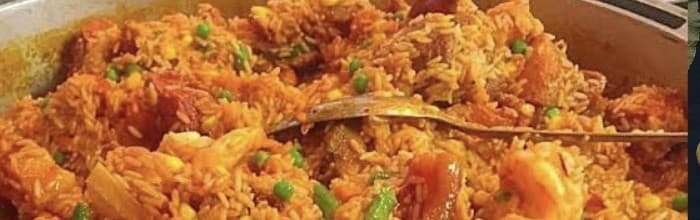
Liberian Jollof Rice
1 hr 20 minEasy


Cookies sur African Food Network
Nous utilisons des cookies essentiels au fonctionnement du site. Nous aimerions aussi déposer des cookies de mesure d’audience et des cookies publicitaires, uniquement avec votre accord. Vous pouvez choisir séparément pour chacun. Lire notre politique relative aux cookies

Parcourez les archives par pays, par plat et par temps de cuisson.
Jollof rice belongs to the whole of West Africa, and every country that claims it claims it as its own. The Liberian version sits inside that family without being anyone's copy. It is a tomato rice, built on long grain parboiled grains, sweetened by onion and sweet pepper, sharpened with garlic and ginger, and carrying a smokiness that Liberian cooks treat as the mark of a pot done properly. Rice is the centre of the Liberian diet rather than an accompaniment to it, and a one pot rice that can be built around whatever protein a household has, or around no protein at all, earns its place in an everyday kitchen as readily as at a gathering. It feeds a room from a single vessel, which is part of why it survives. Across West Africa the jollof pot is argued over with genuine feeling, and the loudest of those arguments runs between Nigeria and Ghana. Liberia is rarely named in that particular fight. That says less about the quality of the Liberian pot than about who is holding the microphone.
1 hr 20 minEasyLiberia · West African
Recette de Laila · Africook
Rien ici pour le moment
