Nous utilisons des cookies essentiels au fonctionnement du site. Nous aimerions aussi déposer des cookies de mesure d’audience et des cookies publicitaires, uniquement avec votre accord. Vous pouvez choisir séparément pour chacun. Lire notre politique relative aux cookies
Loading
Recettes
Parcourez les archives par pays, par plat et par temps de cuisson.
Fish marinated in chermoula, the North African herb, garlic and spice paste, then grilled or baked. Chermoula is used across Morocco, Algeria and Tunisia, so no single country has been assigned to this page.
Chermoula is essentially a marinade built around parsley and coriander in roughly equal measure, with garlic, cumin, paprika, lemon and olive oil. That green colour is the signature and it is also a warning: chermoula is at its best made fresh and used within a day or two, because the herbs darken and dull as they oxidise. Regional versions diverge from there, saffron in Morocco, more chilli in Tunisia, preserved lemon in some Moroccan households, but the parsley, coriander, garlic and cumin core holds everywhere.
Its main job is fish, and the pairing is not arbitrary. Cumin and paprika stand up to oily fish without overwhelming white fish, and the acidity of the lemon does the work that a squeeze of lemon at the table would do, only from the inside.
The one thing to watch is marinating time. Thirty minutes to an hour is what this recipe calls for and that is right; several hours in an acidic marinade begins to cure the fish rather than season it, which changes the texture in a way you probably do not want.
A related page on this site covers braised snapper with chimichurri, which is a South American parallel to the same idea.
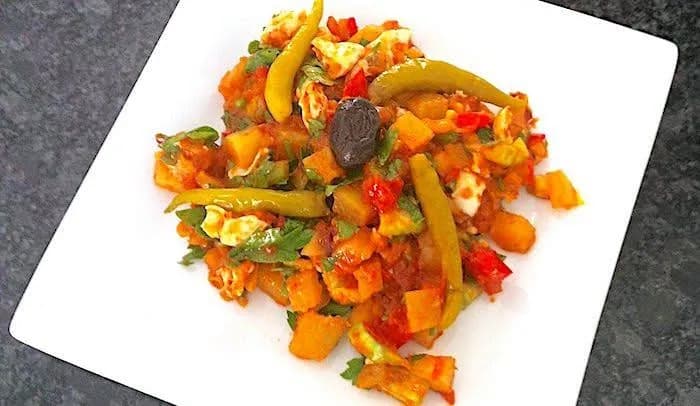
Kafteji is Tunisian street food built on a single idea: fry a range of vegetables separately so each one is properly cooked, then chop them together and serve the result with bread. Potato, courgette, pepper, tomato and aubergine are the usual cast, and the chopping at the end is what makes it kafteji rather than a plate of fried vegetables.
It is sold from small counters and casse-croûte shops across Tunisia and eaten at any hour, most often stuffed into bread as a sandwich. It is inexpensive, which is part of its identity: kafteji is what you eat when you want something substantial and hot without a restaurant. Fried egg is a common addition, and in many Tunisian versions it is the only protein.
The version here includes ground beef or lamb, which puts it at one end of a range. Kafteji is frequently made entirely without meat, and the vegetable only preparation is at least as common in Tunisia as the meat version. Harissa, olives and a squeeze of lemon are the usual finishing touches, and the dish is eaten from a shared plate with bread as the utensil.
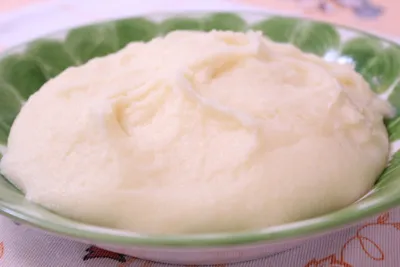
Funge is the Angolan staple, a smooth, elastic cassava porridge that arrives alongside almost everything and asserts nothing on its own. Its neutrality is functional rather than a failure of ambition. A dish with a strong flavour of its own could not do funge's job, which is to carry the flavour of what it is eaten with.
It is made from cassava flour and water, and nothing else is required. Cassava is a tropical root crop grown across Angola, and the flour keeps for months, which is part of why the dish has held its place. In Angola it is funge or funji; the same preparation carries different names and different base starches across the continent, and Angolan households recognise the family resemblance without confusing the members.
Funge is eaten with the fingers. Small pieces are pulled off, rolled between the fingers, and used to lift stew, fish or greens from a shared bowl. That method makes it a communal dish by construction rather than by sentiment, and eating from the same bowl of funge carries the meaning that shared eating carries everywhere: this is a household, and you are in it.
This is couscous with roasted vegetables, chickpeas, raisins and almonds, dressed with lemon, cumin and olive oil. It is a salad in the sense of being served at room temperature rather than a leafy one: the couscous is the bulk of it and the vegetables are folded through.
Couscous was first made by the Amazigh people of North Africa, who worked out how to turn wheat into fine granules, and it remains a staple across Morocco, Algeria, Tunisia and Libya. Moroccan couscous is the smallest of the common grades, finer than Israeli or Lebanese couscous, and it is what this recipe uses.
The technique is absorption rather than steaming. Hot broth is poured over the dry couscous, which has been tossed with olive oil and turmeric, and it is covered and left for five minutes. The raisins go in during that time so the residual heat plumps them. Traditional Moroccan couscous is steamed repeatedly in a couscoussier, which produces a lighter grain; this is the quick domestic method. The vegetables are roasted separately and folded in, which keeps them caramelised rather than steamed into the grain.