

Nous utilisons des cookies essentiels au fonctionnement du site. Nous aimerions aussi déposer des cookies de mesure d’audience et des cookies publicitaires, uniquement avec votre accord. Vous pouvez choisir séparément pour chacun. Lire notre politique relative aux cookies
Loading
Recettes
Parcourez les archives par pays, par plat et par temps de cuisson.
Doro Wat is Ethiopia's most celebrated dish, a deeply spiced, slow-cooked chicken stew made with the country's signature berbere spice blend and niter kibbeh (Ethiopian spiced clarified butter), enriched with whole boiled eggs that absorb the complex, fiery sauce as they cook. It is the dish that defines Ethiopian cuisine for the world. Preparing Doro Wat properly requires patience. Caramelising a large quantity of onions for up to an hour in niter kibbeh forms the foundation, this long-cooked onion base is what gives the stew its extraordinary depth and the sauce its thick, velvet-like body. The berbere adds heat, complexity, and colour. The result is one of the most flavourful chicken dishes in the world.
Dried white beans cooked until tender, then finished with red onion and sliced tomatoes into a thick, soupy stew. It is Malagasy, and it is served everywhere on the island.
It is laoka, which is the useful word here. In Malagasy eating, rice is the meal and laoka is whatever accompanies it, the thing that goes on top of, or beside, a large plate of rice. Tsaramaso is one of the most popular laoka in the country, and it is eaten as a matter of course rather than as an occasion dish.
It is very often not vegetarian. Zebu meat, the humped cattle that are central to Malagasy life, makes it hen'omby sy tsaramaso, and pork makes it tsaramaso sy henakisoa. The shank is the cut the source recommends. This version is the plain one, which is also widely eaten.
The technique in the recipe is worth noting: the beans are cooked separately in water, seasoned only at the end, and a cup of their cooking liquid is kept back. That liquid is what the finished stew is loosened with, and it carries starch and flavour that plain water would not.
The source compares it to cassoulet, which is a reasonable shorthand, beans and meat cooked long and slow, though the seasoning is entirely different.
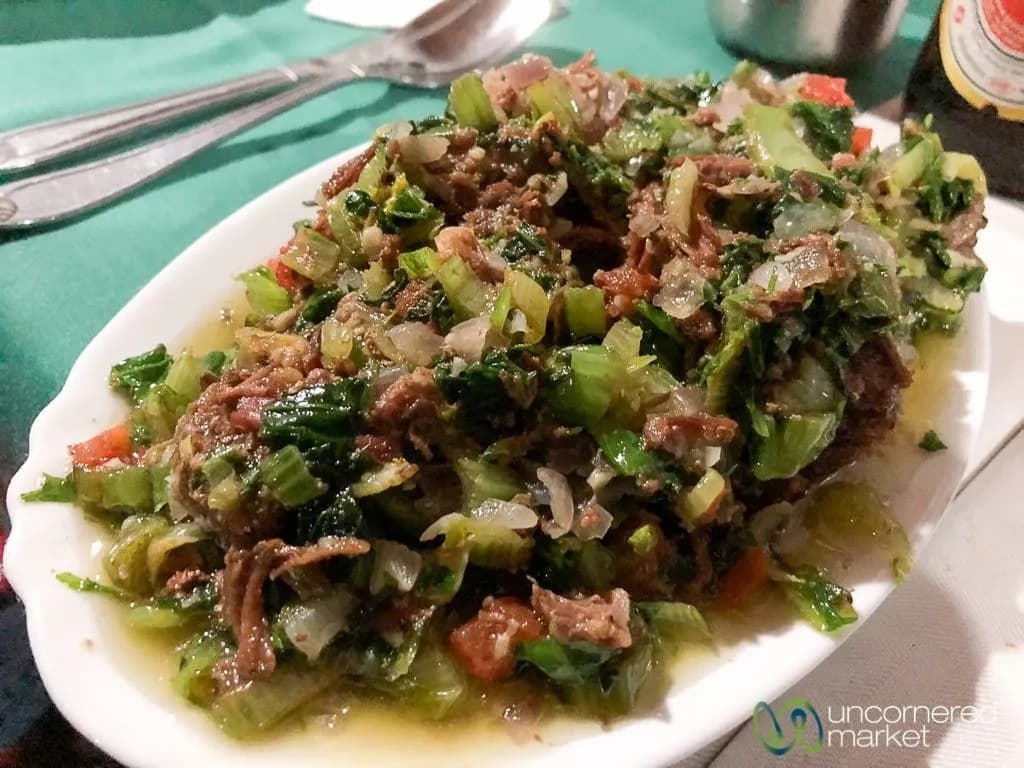
Romazava is the national dish of Madagascar, and the name describes it exactly: ro means broth or soup in Malagasy, mazava means clear. It is meat simmered with leafy greens in a clear broth, served over rice, and it is one of the seven royal dishes known collectively as tatao.
It was once food for the Malagasy sovereign specifically. That association with royalty is part of why it holds the position it does, and it is now eaten by everyone rather than reserved for anyone. Three meats together, beef, pork and chicken, is characteristic of the fuller version, though households vary it.
The greens are what make it Malagasy and they are the hardest part to reproduce elsewhere. Anamamy, paracress and mustard greens are what is used on the island; paracress in particular produces a tingling, numbing sensation on the tongue that is central to the authentic dish and has no European equivalent. Spinach and rocket are the usual substitutes and give a good soup that is missing that specific quality. Zebu, the humped cattle of Madagascar, is the traditional beef. It is served with sakay, the Malagasy chilli condiment, and small eggplants, ginger and tomato are common additions.
Igisafuri means pot in Kinyarwanda, and the dish is named for its vessel in the same way potjiekos is in South Africa. Everything goes into one pot in stages, and what comes out is chicken, plantain and vegetables that have cooked into each other rather than alongside each other.
The plantain is what makes it Rwandan. Cooking bananas and plantains are central to Rwandan agriculture and eating, grown on hillside smallholdings across the country in dozens of varieties, and a stew that uses them as its starch rather than serving rice beside it is doing something specific to the region. The plantains go in late and are submerged so they steam in the broth rather than boiling in water.
It is unpretentious food. Rwandans describe it as a favourite precisely because the preparation asks so little of the cook, with everything going into one pot in stages and almost nothing to watch. The comparison people reach for is the Moroccan tagine, and it holds up as far as the method goes, though the ingredients are entirely different. Spinach goes over the plantains near the end and a whole hot pepper is dropped in for aroma rather than heat, which is a common way of handling chilli across the Great Lakes region.