Nous utilisons des cookies essentiels au fonctionnement du site. Nous aimerions aussi déposer des cookies de mesure d’audience et des cookies publicitaires, uniquement avec votre accord. Vous pouvez choisir séparément pour chacun. Lire notre politique relative aux cookies
Loading
Recettes
Parcourez les archives par pays, par plat et par temps de cuisson.
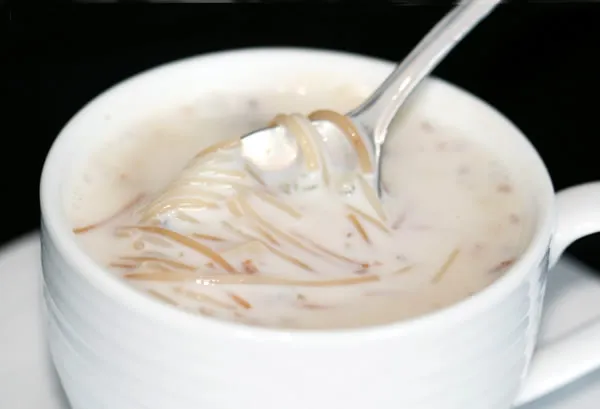
Boeber is a Cape Malay sweet milk drink, thick with vermicelli and sago and scented with cardamom, cinnamon and rose water. It sits somewhere between a drink and a pudding, and Cape Town households do not find the ambiguity a problem.
Its place in the calendar is precise. Boeber is served on the fifteenth night of Ramadan, marking the midpoint of the fast for those who have completed the first fifteen days. That single fixed date gives it a weight that a dish eaten year round does not carry: it belongs to a moment, and its appearance signals that the moment has arrived.
The drink comes from the Cape Malay community, whose ancestors were brought to the Cape from Indonesia, India and East Africa, and boeber carries the marks of all three. It has close relatives across that map. Malaysians break the fast with bubur lambuk, a porridge; Trinidadian households serve sawine at Eid al-Fitr; kheer and payasam on the Indian subcontinent are its nearest kin, most likely carried to the Cape by enslaved and later indentured Indians. In South Africa itself, the Afrikaans melkkos is the comparable dish. Boeber is what all of those became in one place.
Umqombothi is Xhosa beer, brewed from maize meal, maize malt and sorghum malt. It is thick, cloudy, sour smelling and low in alcohol, usually under three per cent, and it is not made to be compared with lager. It is a different category of drink with a different purpose.
Its purpose is ceremonial before it is social. In Xhosa practice umqombothi is brewed for the return of the abakwetha, the young men coming back from ulwaluko, the initiation and circumcision rite. It is central when families communicate with the amadlozi, the ancestors, and it appears at traditional weddings, funerals and imbizo, the community meetings where matters are decided. A gathering of consequence has umqombothi at it, and its absence would be noticed as a statement.
The drink is not confined to South Africa. Sorghum beer is brewed across the continent under many names: dolo in Burkina Faso, pito in Nigeria, ingwebu among the Ndebele of Zimbabwe, which is their word for froth. Brewing is done outdoors over an open fire, cooled at ambient temperature, and the recipes are held within families and passed down rather than written.
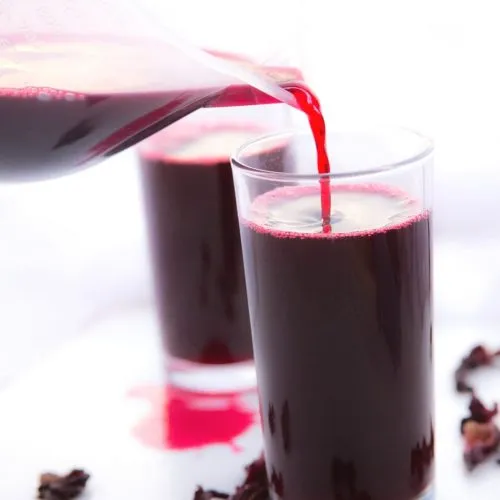
Bissap is the Wolof name for Hibiscus sabdariffa and for the deep red drink made from its dried calyces. It is the most widely drunk thing in Senegal after water, sold from every restaurant, supermarket and street corner, and made at home by buying the dried flowers at the market and steeping them in hot water with sugar.
Its position has something to do with religion. Senegal is overwhelmingly Muslim, alcohol plays almost no part in social life, and the result is a genuinely developed culture of non alcoholic drinks: bissap alongside ginger, tamarind and bouye, made from the fruit of the baobab. These are not soft drinks in the Western sense of an afterthought. They are what people offer guests and what they drink at any hour.
The same flower is drunk across a great deal of the world under other names: zobo in Nigeria, sorrel in the Caribbean, karkade in Egypt and Sudan, agua de jamaica in Mexico. What varies is the flavouring. Senegalese bissap commonly carries mint, and ginger, pineapple, passion fruit and lime all appear. Ginger divides opinion, since a heavy hand overpowers the hibiscus. It is served very cold and generally over ice, which is not a preference but a requirement in the climate it belongs to.