Nous utilisons des cookies essentiels au fonctionnement du site. Nous aimerions aussi déposer des cookies de mesure d’audience et des cookies publicitaires, uniquement avec votre accord. Vous pouvez choisir séparément pour chacun. Lire notre politique relative aux cookies

Loading
Recettes
Parcourez les archives par pays, par plat et par temps de cuisson.
Kebab is a Middle Eastern preparation, and the source says so directly. Cut or ground meat cooked on a skewer over open flame is one of the oldest cooking methods there is, and the word and the technique both come from that region before spreading almost everywhere.
Mutton and lamb are the traditional meats. Regional versions use beef, goat, chicken or fish, and pork rarely, given religious constraints across much of the region where kebab originates. Not every kebab involves a skewer either: tas kebab is baked in a skillet or served as a stew, which shows how loosely the word travels.
Africa has a great deal of skewered grilled meat of its own, and this recipe is not it. Nigerian suya is coated in yaji, a peanut based spice blend. Sudanese agashe works the same way. Moroccan brochettes are marinated in cumin and paprika. Egyptian kofta is ground and shaped rather than cubed. This version is marinated in soy sauce, olive oil, oregano, garlic and lemon, which is a Mediterranean and Levantine profile, so it sits in the Worldwide Recipes collection rather than being presented as African.
Turkey bacon strips cooked in an air fryer until crisp. No country is claimed; turkey bacon is an American product.
It behaves differently from pork bacon and the difference explains the method. Pork bacon renders a great deal of fat as it cooks, and that fat is what fries the meat, it is essentially cooking itself. Turkey bacon has far less fat, so it dries out rather than frying, and in a pan it tends to stick and to go from limp to leathery without passing through crisp. Circulating hot air handles it better: it dehydrates the surface evenly and crisps it without needing rendered fat to do the work.
That also means it needs watching. Six to eight minutes is the window in most machines, and the source is right that timing varies with thickness and with the machine. A minute too long and it is brittle.
Whether it is a healthier choice is a more complicated question than the source allows. Turkey bacon is lower in fat and calories than pork bacon, but it is comparably high in sodium and is still a processed meat. The claim has been left out.
Turkey is not African and neither is bacon in this form. Africa has its own cured and smoked meats, biltong, kilishi, dambu nama, all on this site.
Lamb chops with chermoula and yellow rice is Moroccan, grilled or roasted lamb served with a fresh herb sauce and turmeric-stained rice.
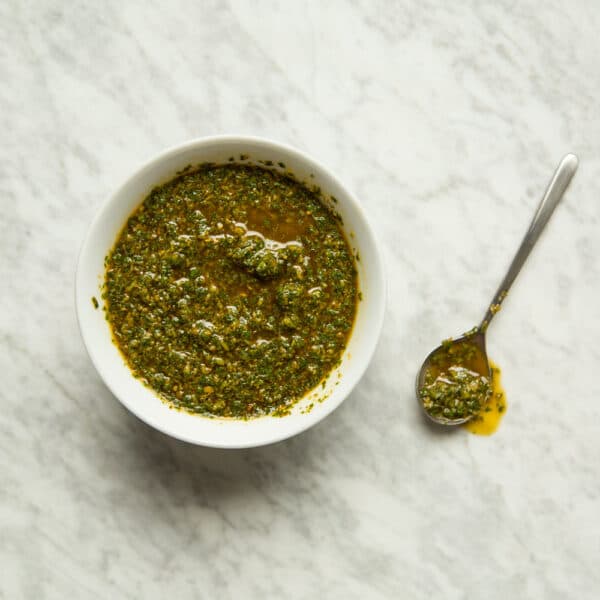
Chermoula is the part worth knowing. It is a North African sauce and marinade built on fresh coriander and parsley, garlic, cumin, paprika, lemon and oil, and its name comes from the Arabic chermel, meaning to rub or to marinate. That etymology describes exactly how it is used: rubbed into meat or fish before cooking, and often served again alongside as a sauce.
It is most associated with fish, where it is close to standard across Morocco and Algeria, but it works with lamb particularly well, the herbs and lemon cut through fat in a way that a heavier sauce would not.
Lamb runs through Moroccan cooking at every level, from long slow tagines to chops straight off a grill, and this is at the fast end of that range.
The rice is coloured and lightly perfumed with turmeric rather than saffron, which is the everyday choice, visually similar, entirely different in flavour and cost.
Oyster mushrooms grilled and tossed in suya spice. It is a plant-based version of the Nigerian street food, and it works better than most meat substitutions do.
**The traditional suya spice contains ground peanuts, and this recipe includes them.** The source flags it and offers to leave them out, which is honest, but it is worth stating clearly, because a peanut allergy and a suya spice blend are a genuinely dangerous combination and the name gives no warning.
Suya proper is skewered beef, ram or chicken rubbed in yaji, the spice blend of ground roasted peanuts, ginger, cayenne, garlic, onion powder and paprika, and grilled over open coals. It is Hausa in origin, from northern Nigeria, and it is sold across Nigeria, Cameroon, Niger, Ghana and parts of Sudan. Kyinkyinga is the Ghanaian name, agashe the Sudanese.
Oyster mushrooms are the right substitution and not an arbitrary one. Shredded, they have a fibrous, layered structure that genuinely resembles pulled meat, they take on the dry rub readily, and they char well. Most vegetables do neither.
The source's method is very compressed, one step reads "put in a preheated medium", with the word oven missing, and has been filled out below.