

Nous utilisons des cookies essentiels au fonctionnement du site. Nous aimerions aussi déposer des cookies de mesure d’audience et des cookies publicitaires, uniquement avec votre accord. Vous pouvez choisir séparément pour chacun. Lire notre politique relative aux cookies
Loading
Recettes
Parcourez les archives par pays, par plat et par temps de cuisson.
This page needs its most important detail stated first, because it is a safety point: **the recipe contains peanut butter, and nothing in its title says so.**
The article attached to this page describes an ordinary chicken and vegetable soup, celery, squash, chicken tenders poached in broth, a little tomato paste. The recipe card is a different dish entirely: a West African groundnut soup, built on peanut butter whisked into stock with tomatoes, chilli flakes, cabbage, sweet potato, carrot, turnip and okra. Anyone with a peanut allergy reading the title and the article would have no reason to expect it.
The recipe itself, taken on its own terms, is a good one and belongs to a real tradition. Groundnut soups are eaten across West Africa, Ghanaian nkatenkwan, Nigerian and Senegalese versions, and the mafe family more broadly, and peanuts, though originally South American, have been grown in West Africa since the sixteenth century and are now completely embedded in its cooking. Okra is used here for both flavour and thickening.
The title has been changed to name the peanut, and the URL is unchanged. The source's stated preparation time is not credible.
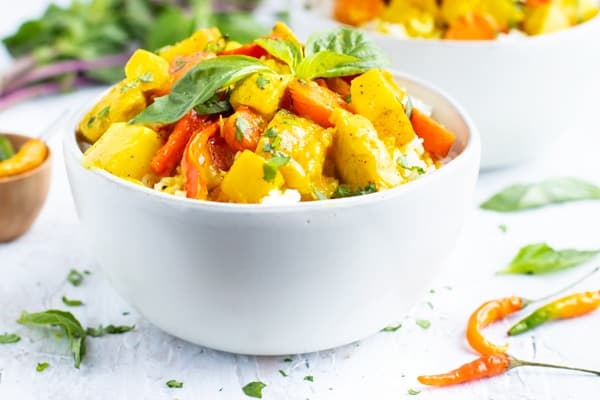
Coconut chicken curry is a one-pan dish of chicken simmered in coconut milk with a curry spice blend and whatever vegetables are to hand, broccoli, cabbage, peppers, potato, carrot.
The word curry is worth being precise about. It is not a single spice or a single dish. It comes from English usage during colonial rule in India, applied broadly to spiced saucy dishes, and it now covers an enormous range of unrelated cooking across South Asia, Southeast Asia, the Caribbean and East Africa. A curry powder sold in a jar is a blend, and the blends differ substantially between manufacturers and regions.
Coconut milk versions belong mainly to the coastal and tropical end of that range, southern India, Thailand, Malaysia, the Caribbean, and the Swahili coast of East Africa, where coconut is grown and used heavily.
This particular recipe is a general one rather than a regional tradition, which is its strength: it tolerates substitution well and is designed to be varied.
**Filed as Worldwide**, the recipe as written makes no specific national claim, so attributing it to any one cuisine would be inventing detail.
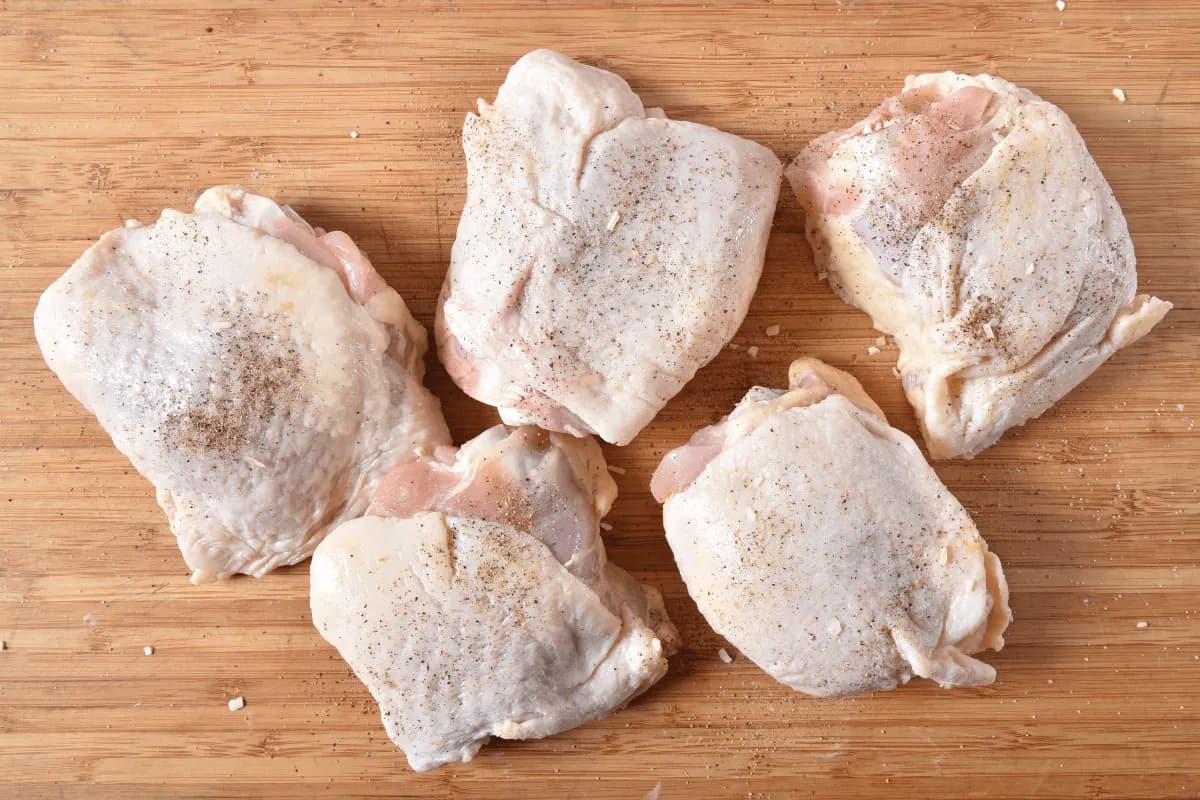
Chicken thighs simmered in seasoned water until cooked through, served with lemon and parsley. The source presents it as a guide to timing rather than as a dish, and its title is phrased as a question, which is why the display title here is a plain one. The slug and URL are unchanged.
The timing is the substance of it. Bone-in thighs take roughly half an hour or a little more over gentle heat; boneless thighs take rather less. What matters more than the clock is the internal temperature, and here the source is inconsistent: its prose gives the standard safe minimum for poultry while its method gives a higher figure. Both are safe, and thighs are often taken above the minimum because the extra heat breaks down more connective tissue and improves the texture.
The technique worth noting is that the water should barely bubble. A hard rolling cook toughens the protein and makes the meat stringy; gentle heat keeps it tender. Aromatics in the water, garlic, onion, herbs, flavour both the chicken and the resulting stock, which is worth keeping. Boiled or poached chicken is used across African cooking as a first stage before frying or stewing rather than as a finished dish, which is a different role from the one here.
Poulet fafa is Tahitian, chicken braised with taro leaves and coconut milk, and one of the defining dishes of French Polynesia.
It takes its name from fafa, the Tahitian word for the taro leaf that goes into it. That leaf is the whole dish. Cooked long enough it collapses into something dark, soft and faintly earthy, closer in character to spinach or callaloo than to anything else, and it is what the coconut milk is there to carry.
It is normally served alongside ahima'a, the Polynesian pit oven, the same underground cooking method found across the Pacific under different names, where food is buried over hot stones and left for hours. Poulet fafa is the pot dish that accompanies that, and it can be made entirely on a stovetop.
Its close relative is chicken luau in Hawai'i, which is the same idea, chicken, taro leaf, coconut milk, under a different name, reflecting the shared Polynesian food culture across a very large stretch of ocean.
**This is not an African dish.** It sits in the Worldwide collection because it is genuinely from Tahiti in French Polynesia, and it is kept on the platform rather than removed because people already visit the page.
One thing matters for safety: taro leaves must be cooked thoroughly.