Nous utilisons des cookies essentiels au fonctionnement du site. Nous aimerions aussi déposer des cookies de mesure d’audience et des cookies publicitaires, uniquement avec votre accord. Vous pouvez choisir séparément pour chacun. Lire notre politique relative aux cookies

Loading
Recettes
Parcourez les archives par pays, par plat et par temps de cuisson.
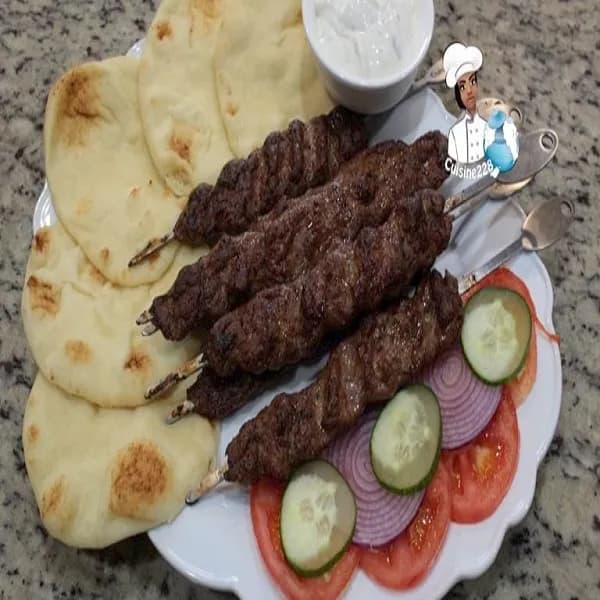
Kofta is minced meat, seasoned and shaped by hand, and it runs across an enormous stretch of the world: from the Balkans through Turkey, the Levant and Egypt, across the Arabian peninsula, into Central Asia and the Indian subcontinent, and along the North African coast. The Egyptian version is lamb or beef with onion, parsley, mint and a warm spice mix, moulded onto skewers and grilled.
Its written history is old. Recipes appear in the earliest surviving Arab cookbooks, where large ground lamb meatballs were glazed in saffron and egg yolk, a technique that later reached Europe and was known there as gilding or endoring. From the Arab world it travelled east, and nargisi kofta was served at the Mughal court in India.
In Egypt, kofta belongs to the grilled meat restaurants that exist in every town, where it is cooked alongside kebab, grilled chicken and tarb and served with rice, bread and salad. The distinction Egyptians draw between kofta and kebab is worth knowing: kebab is cubed meat on a skewer, kofta is minced meat shaped by hand. It is essentially sausage without a casing, and the comparison to a hamburger, sometimes made, misses that it is almost never served in bread.
Tajine el Bey is a Tunisian tajine, and the first thing to understand is that a Tunisian tajine is not a Moroccan one.
The Moroccan tajine is a slow-cooked stew named after the conical earthenware pot it is cooked in. The Tunisian tajine is something else entirely: a baked dish closer to a thick omelette or an Italian frittata, built on eggs and cheese with meat and vegetables folded through, cooked in the oven and cut into squares or diamonds to serve. The two share a name and almost nothing else.
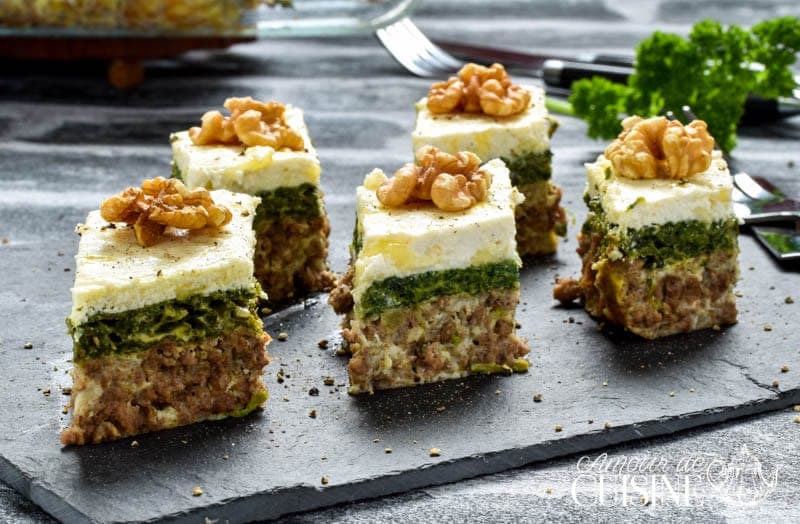
Tajine el Bey is the refined version. It is assembled in three separate layers, meat, spinach, and a ricotta-style cheese, each mixed and cooked apart before being brought together, which gives a cross-section of distinct bands rather than a uniform bake. It is then cut into diamonds and presented the way baklawa el Bey, the tricolour almond pastry, is presented.
The name and the colours are the point. Bey was the title of the ruler of Tunis under Ottoman suzerainty, and the red and green of the finished dish are the Bey's colours. It is a dish designed to be looked at as well as eaten, which is why it belongs at the elegant end of Tunisian cooking despite being straightforward to make.
The texture is its other distinction, soft and yielding rather than set firm.
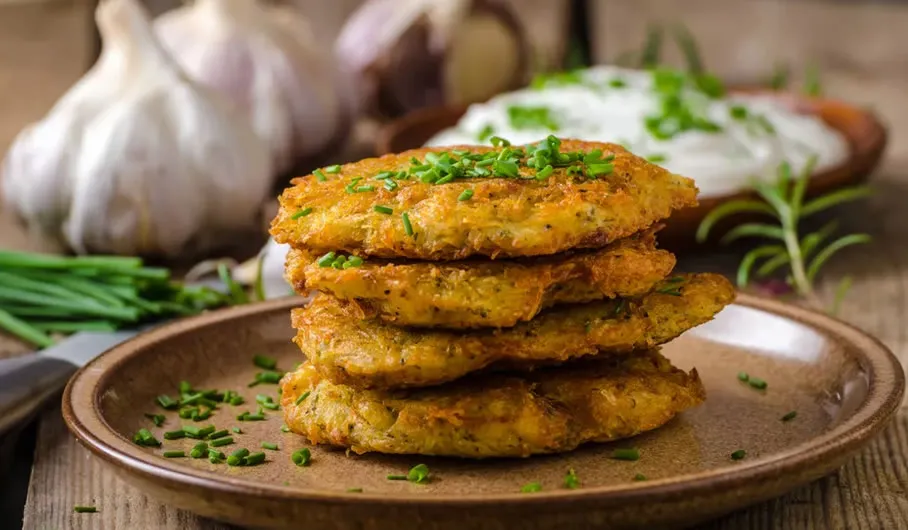
Maakouda is a Moroccan potato cake, mashed potato bound with egg and herbs, floured and deep fried until the outside crisps and the inside stays soft. It is street food, sold cheap and eaten either on its own or stuffed into a small baguette.
Meknes is where it is most associated, and the city is described as the wine capital of North Africa. Maakouda is sold from stalls there and across the country, and it appears in Algeria and Tunisia too under the same set of spellings: maaqouda, maqouda, makouda. The comparison the source draws is with falafel, and it holds up: a cheap fried snack, sold from a stall, eaten in bread. It has simply never travelled the way falafel has.
Ras el hanout is what marks it as Moroccan rather than a generic potato cake. The blend is optional in this recipe and the source strongly recommends it, and turmeric gives the colour. It is also a practical way to use up leftover mashed or baked potato, which is much of how it is made at home. Deep frying is traditional; the oven and the air fryer both work and are given as alternatives.
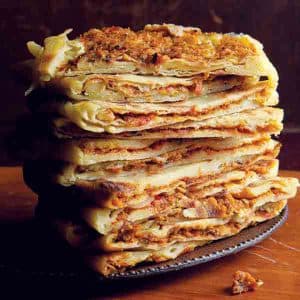
Hawawshi is pita stuffed with heavily spiced minced beef and baked until the meat cooks through and the bread crisps. It is Egyptian street food, sold across Cairo and Alexandria, where it is also known as baladi.
The story attached to it is unusually specific for a street food. It is credited to a butcher named Ahmed Al-Hawash, working in Cairo's Tawfeek Souq in the early 1970s, with the dish taking his name. The source hedges this as legend and that is the right level of confidence, it is widely repeated, plausible given how recent it is, and not documented in a way that settles it.
What makes it work is the raw filling. The meat goes into the bread uncooked, and the fat renders as it bakes, soaking into the pita from the inside while the outside crisps in the oven. Cooking the meat first would lose that entirely and give you a dry sandwich.
The wet-vegetable problem is the one thing to get right, and the source handles it well: the onion, pepper, jalapeño and parsley are processed and then drained in a sieve before they go near the meat. Skipping that step floods the bread.
Related dishes exist across the region, Lebanese arayes is the same idea with different spicing.