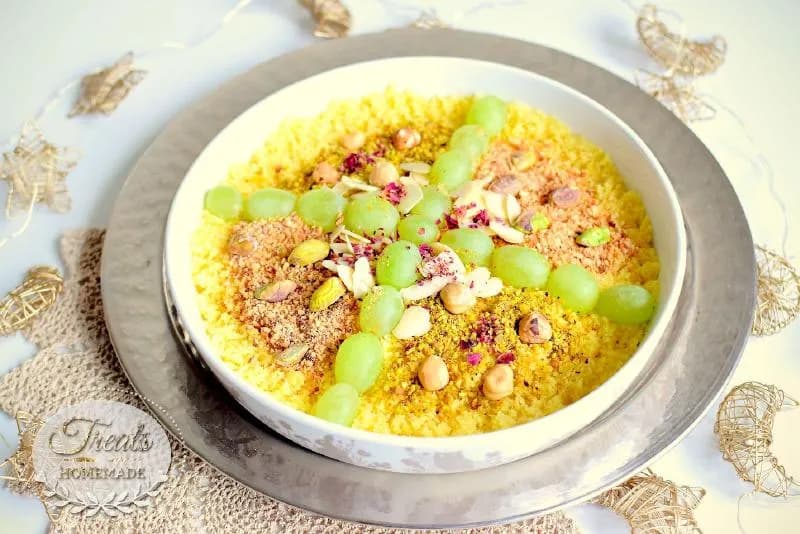
Tunisian Couscous
5.05 out of 5, 2 ratings2 hr


Cookies sur African Food Network
Nous utilisons des cookies essentiels au fonctionnement du site. Nous aimerions aussi déposer des cookies de mesure d’audience et des cookies publicitaires, uniquement avec votre accord. Vous pouvez choisir séparément pour chacun. Lire notre politique relative aux cookies

Parcourez les archives par pays, par plat et par temps de cuisson.
Couscous is the national dish of Tunisia, and it is also the national dish of Algeria, Morocco, Mauritania and Libya, which tells you something about how the Maghreb understands itself. The same steamed semolina appears across all five countries under names that shift with the language: kousksi in Tunisia, taam or kesksu in Algeria, seksu in Morocco, and cuscusu in Sicily, where it crossed the water. The Tunisian version is distinguished by its heat and its colour. Harissa goes into the broth rather than being offered alongside it, and the finished couscous runs orange to deep red depending on how much broth and harissa it has taken up. Caraway is the other Tunisian signature, appearing in a quantity that Moroccan and Algerian couscous would not use. What goes with it depends on the coast. In Sfax and the other coastal cities, couscous is made with fish. Inland it more often carries lamb, sometimes with dried fruit. Turnip, carrot, courgette, potato, pumpkin and chickpeas are the usual vegetables, cooked in the broth and removed as each becomes ready. The word itself is traced either to the Arabic kaskasa, to pound small, or the Amazigh seksu, meaning rounded or well rolled, and both derivations describe the grain rather than the dish.
Les mieux notées
2 hrMediumTunisia · north african
Recette de Blessing · Africook
Rien ici pour le moment
Tout effacer