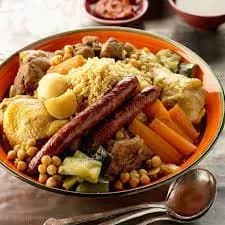
Couscous Royale
4.64.6 out of 5, 5 ratings5 hr


Cookies sur African Food Network
Nous utilisons des cookies essentiels au fonctionnement du site. Nous aimerions aussi déposer des cookies de mesure d’audience et des cookies publicitaires, uniquement avec votre accord. Vous pouvez choisir séparément pour chacun. Lire notre politique relative aux cookies

Parcourez les archives par pays, par plat et par temps de cuisson.
Couscous royale is a plate of fluffy couscous piled with grilled meats and a saffron-scented chickpea and vegetable stew, and it is celebration food. Meatball skewers, lamb chops, chicken skewers and merguez sausage all appear on the same plate, which is what the royale in the name is describing. Couscous itself is Amazigh in origin. It is a staple across Tunisia, Algeria, Morocco and Libya, and it is Tunisia's official national dish. The food historian Charles Perry places its origin among the Berbers of Algeria and Morocco somewhere between the end of the 11th-century Zirid dynasty and the rise of the 13th-century Almohad Caliphate. The precise origin is not known, and since couscous is made from ground wheat it is unlikely to predate about 6000 BC. The word names both the semolina grain and the dish built around it. Traditionally the grain is steamed in a couscoussier, a two-tier pot with a steamer sitting above the broth, and it is removed, rolled between the hands to separate the grains, and returned to the steamer four or five times. Pre-steamed couscous has made that unnecessary for everyday cooking. Couscous royale is not everyday cooking: it takes roughly two hours of preparation before the chickpeas are even accounted for.
Les mieux notées
5 hrHardTunisia
Recette de Nympha · Africook
Rien ici pour le moment
Tout effacer