Nous utilisons des cookies essentiels au fonctionnement du site. Nous aimerions aussi déposer des cookies de mesure d’audience et des cookies publicitaires, uniquement avec votre accord. Vous pouvez choisir séparément pour chacun. Lire notre politique relative aux cookies

Loading
Recettes Tunisia
Parcourez les archives par pays, par plat et par temps de cuisson.
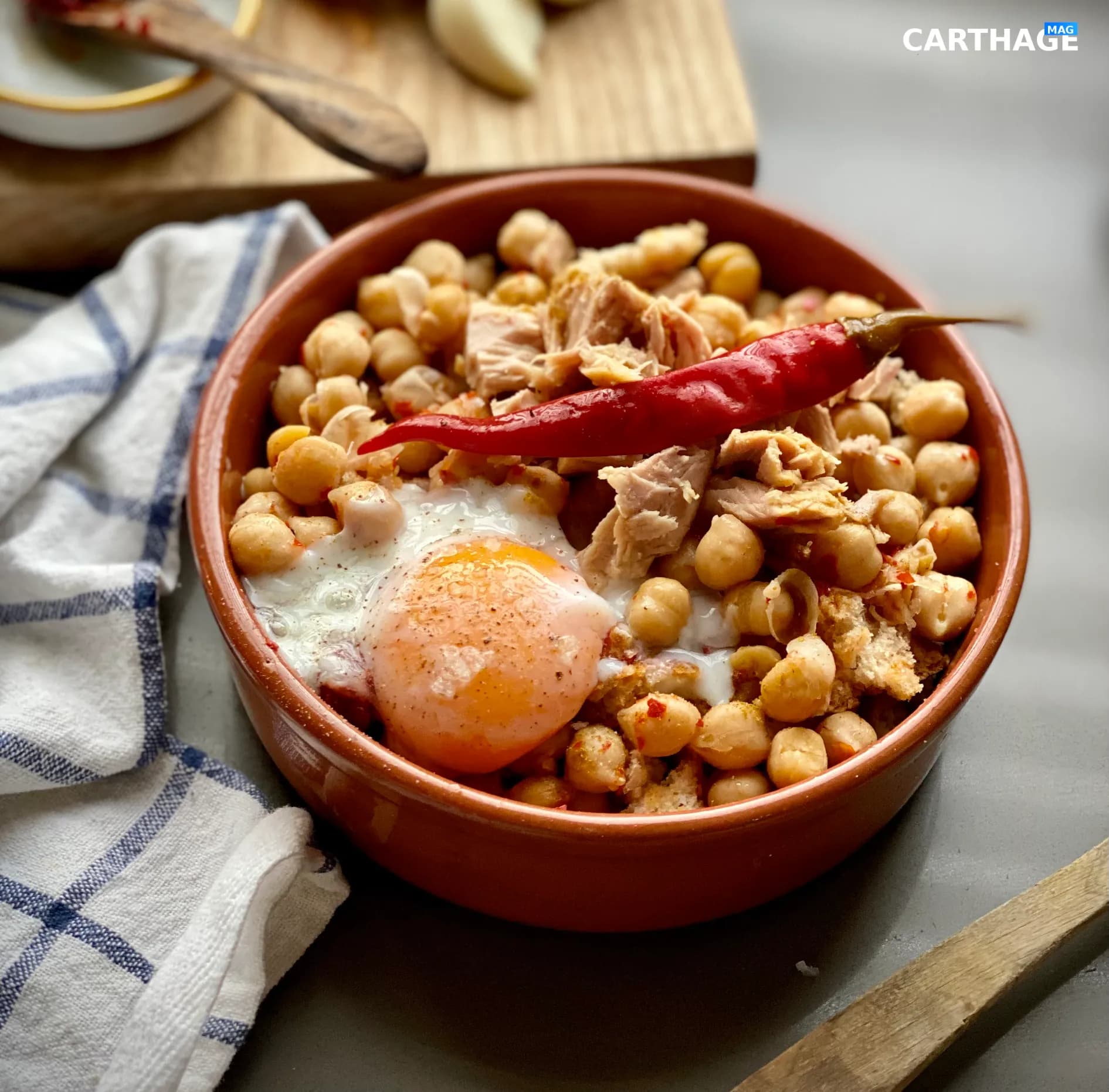
Lablabi is Tunisia's chickpea breakfast: a thin, heavily spiced chickpea broth ladled over torn stale bread, finished with a soft egg, tuna, olives, harissa, cumin, lemon and olive oil. It is served in casual counter-service places across the country and eaten with two spoons, mashing the bread down into the broth as you go.
It is frugal food by design. Stale bread and dried chickpeas are the base, and everything else is a topping. The broth is not thickened or enriched, the flavour comes from cooking the chickpeas slowly in their own water with cumin, caraway and harissa, and that cooking liquid is the dish. This is the reason the source insists on dried chickpeas rather than tinned: the broth is a by-product you cannot buy. If you do use tinned chickpeas, stock in place of water is the compensation.
The name travels. There is an Assyrian chickpea dish also called lablabi, an Iraqi version finished with lemon juice, and the Turkish nohut çorbası, which is made with lamb. The Tunisian one is distinguished by harissa and by the bread at the bottom of the bowl.
Traditionally it is breakfast, eaten to start a cold morning. It is now eaten at any hour, and the modern habit of piling on colourful toppings has made it considerably more photogenic than it used to be.
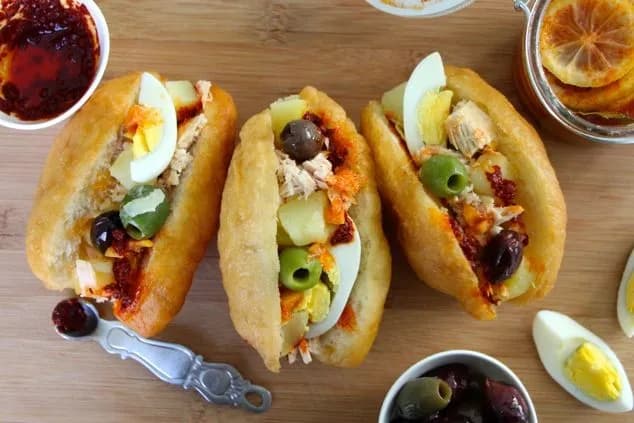
A fricassé is a small oval roll of enriched dough, deep-fried and then split and packed with tuna, potato, olives, egg and harissa. It is Tunisian street food, and it is one of the country's most recognisable things to eat.
The word does not mean what it means elsewhere. In French, a fricassée is a braise of meat in a white sauce; in Tunisia and its diaspora it means this sandwich and nothing else. That divergence is complete enough that searching the French term will not find you the Tunisian food.
The filling is the point and it is fixed by convention rather than by recipe: tuna in olive oil, cooked potato, black olives, egg and harissa, with slata méchouia, the grilled pepper and tomato salad, very often alongside. Capers and preserved lemon appear in some versions. What matters is that the bread is fried rather than baked, which gives a rich, slightly greasy roll that stands up to a wet filling.
**A significant gap in the source.** Its ingredient list contains only the dough, yeast, water, flour, egg, oil, salt. Not one of the filling ingredients it spends its article describing appears in it. The filling below has been reconstructed from that description and flagged.
**It contains eggs and fish.**
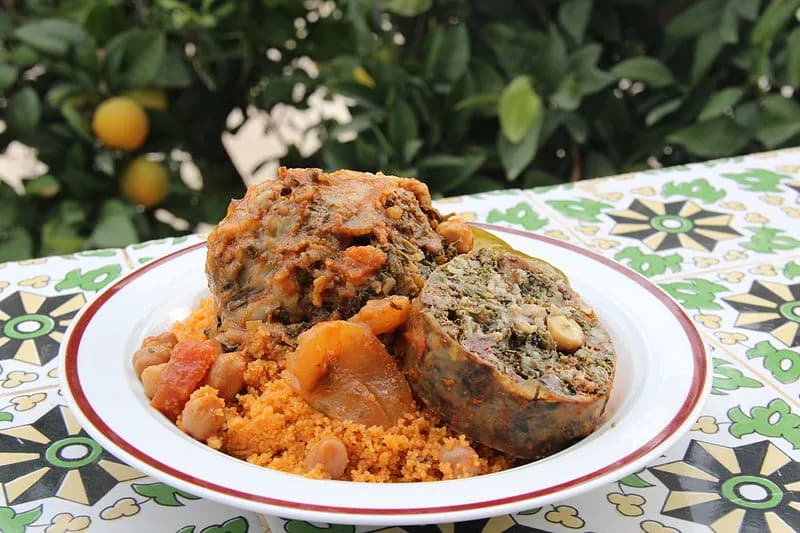
Usban is a North African sausage made from the parts of a sheep that a whole animal butchery yields and nothing else does: the stomach, the liver, the lungs and the heart, chopped and mixed with rice, herbs and spices, sewn into pouches and cooked in a sauce. It is eaten in Tunisia, Algeria and Libya, and it is written both usban and osban.
Its occasion is Eid al-Adha, and the connection is structural rather than customary. The festival involves the sacrifice of an animal and the use of all of it, and usban is what the offal becomes. It cannot be made casually because it requires a quantity of organ meat that only arrives when a whole sheep is broken down at home. Tunisian households make it on the day of Eid despite the considerable labour, and the effort is part of what the dish means.
The work is real. The stomach must be scrubbed, blanched, scraped of its lining until it turns white, cut and sewn into pouches by hand with a needle and butcher's twine, then filled and sewn shut. Usban is documented in Tunisian references as far back as the 13th century, and it is held up as a demonstration of skill: proof that a cook can use every part of the sacrifice properly. It is served alongside rice or couscous.
Couscous is the national dish of Tunisia, and it is also the national dish of Algeria, Morocco, Mauritania and Libya, which tells you something about how the Maghreb understands itself. The same steamed semolina appears across all five countries under names that shift with the language: kousksi in Tunisia, taam or kesksu in Algeria, seksu in Morocco, and cuscusu in Sicily, where it crossed the water.
The Tunisian version is distinguished by its heat and its colour. Harissa goes into the broth rather than being offered alongside it, and the finished couscous runs orange to deep red depending on how much broth and harissa it has taken up. Caraway is the other Tunisian signature, appearing in a quantity that Moroccan and Algerian couscous would not use.
What goes with it depends on the coast. In Sfax and the other coastal cities, couscous is made with fish. Inland it more often carries lamb, sometimes with dried fruit. Turnip, carrot, courgette, potato, pumpkin and chickpeas are the usual vegetables, cooked in the broth and removed as each becomes ready. The word itself is traced either to the Arabic kaskasa, to pound small, or the Amazigh seksu, meaning rounded or well rolled, and both derivations describe the grain rather than the dish.