Nous utilisons des cookies essentiels au fonctionnement du site. Nous aimerions aussi déposer des cookies de mesure d’audience et des cookies publicitaires, uniquement avec votre accord. Vous pouvez choisir séparément pour chacun. Lire notre politique relative aux cookies

Loading
Recettes Tunisia
Parcourez les archives par pays, par plat et par temps de cuisson.
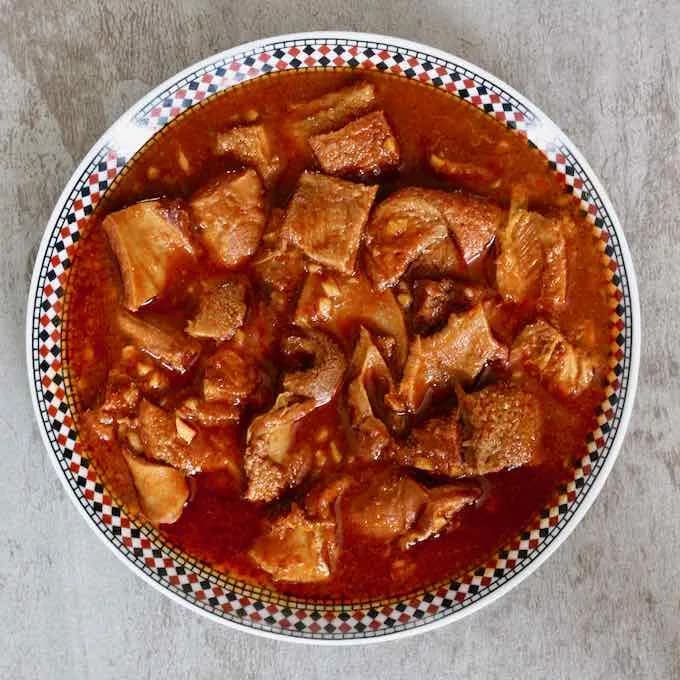
Akod is a tripe dish and it is the emblematic dish of Tunisian Jewish cooking. Beef tripe and a cow's trotter are cleaned, blanched through several changes of water, then cooked for hours with garlic, cumin, tomato paste and harissa until the sauce is thick and the tripe has surrendered completely.
Its place is at the kemia, the Tunisian Jewish spread of small dishes that opens a meal, alongside banatages, briks, fricassés and minina. A host laying out a proper kemia would be expected to have made it. Tunisian Jewish cooking developed over centuries in Tunisia and has since largely relocated to France and Israel with the community, which makes recording dishes like this more urgent than recording better travelled ones.
The wider family is large and worth knowing. Moroccan douara, also called t'qualia or kercha, uses mutton tripe. Algerian bakbouka includes carrots, courgette and chickpeas. Chkamba in Oran and chmenka in Tunisia are seasoned differently again, and the Moroccan Jewish version, tajine al guezar, meaning the butcher's pot, uses cumin and paprika without tomato paste and is cooked for close to ten hours over coals at Pesach. Offal has fallen out of favour with younger generations across the region, which the source for this recipe notes with some regret.
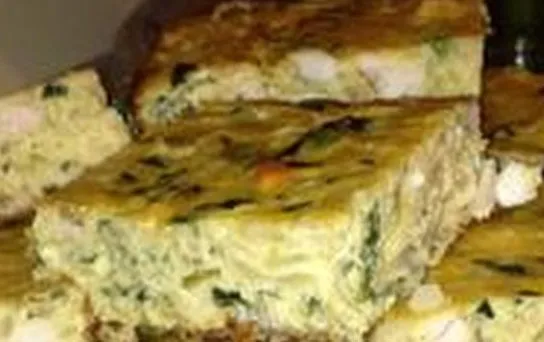
A Tunisian tajine is not a Moroccan tagine, and this dish is the clearest illustration of the difference. Moroccan tagine means a stew cooked slowly in a clay pot under a conical lid. Tunisian tajin, or tajin sibnekh, means a baked egg dish, set firm and cut into squares, much closer to an Italian frittata or a Spanish tortilla.
The confusion is entirely reasonable and entirely common. The same word travelled to two North African countries and attached itself to two different things. In Tunisia the dish is built from eggs beaten with whatever else is going: potatoes, chicken, spinach, peas, cheese, and the North African spices that mark it as Tunisian rather than European.
Harissa and ras el hanout do that marking. Harissa is Tunisia's chilli paste and its most exported product; ras el hanout is the layered spice blend used across the Maghreb. Together they give an egg bake a warmth and heat that a frittata does not have. It is usually served as a starter, though it is substantial enough to be a meal, and it is as good cold the next day as it is hot, which makes it packed lunch and picnic food across the country.
Tajine el Bey is a Tunisian tajine, and the first thing to understand is that a Tunisian tajine is not a Moroccan one.
The Moroccan tajine is a slow-cooked stew named after the conical earthenware pot it is cooked in. The Tunisian tajine is something else entirely: a baked dish closer to a thick omelette or an Italian frittata, built on eggs and cheese with meat and vegetables folded through, cooked in the oven and cut into squares or diamonds to serve. The two share a name and almost nothing else.
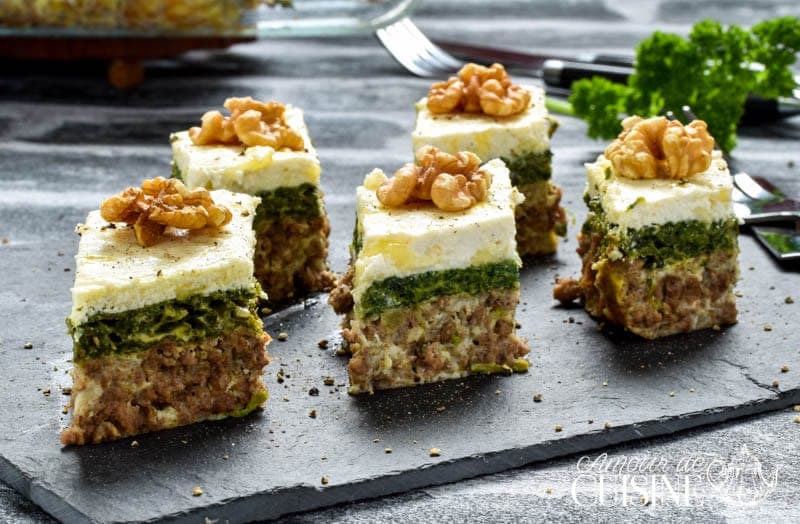
Tajine el Bey is the refined version. It is assembled in three separate layers, meat, spinach, and a ricotta-style cheese, each mixed and cooked apart before being brought together, which gives a cross-section of distinct bands rather than a uniform bake. It is then cut into diamonds and presented the way baklawa el Bey, the tricolour almond pastry, is presented.
The name and the colours are the point. Bey was the title of the ruler of Tunis under Ottoman suzerainty, and the red and green of the finished dish are the Bey's colours. It is a dish designed to be looked at as well as eaten, which is why it belongs at the elegant end of Tunisian cooking despite being straightforward to make.
The texture is its other distinction, soft and yielding rather than set firm.
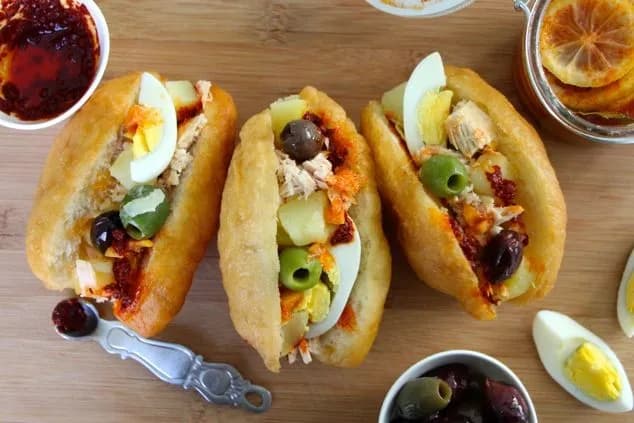
A fricassé is a small oval roll of enriched dough, deep-fried and then split and packed with tuna, potato, olives, egg and harissa. It is Tunisian street food, and it is one of the country's most recognisable things to eat.
The word does not mean what it means elsewhere. In French, a fricassée is a braise of meat in a white sauce; in Tunisia and its diaspora it means this sandwich and nothing else. That divergence is complete enough that searching the French term will not find you the Tunisian food.
The filling is the point and it is fixed by convention rather than by recipe: tuna in olive oil, cooked potato, black olives, egg and harissa, with slata méchouia, the grilled pepper and tomato salad, very often alongside. Capers and preserved lemon appear in some versions. What matters is that the bread is fried rather than baked, which gives a rich, slightly greasy roll that stands up to a wet filling.
**A significant gap in the source.** Its ingredient list contains only the dough, yeast, water, flour, egg, oil, salt. Not one of the filling ingredients it spends its article describing appears in it. The filling below has been reconstructed from that description and flagged.
**It contains eggs and fish.**