Nous utilisons des cookies essentiels au fonctionnement du site. Nous aimerions aussi déposer des cookies de mesure d’audience et des cookies publicitaires, uniquement avec votre accord. Vous pouvez choisir séparément pour chacun. Lire notre politique relative aux cookies

Loading
Recettes Tunisia
De Tunisian Couscous à Usban, de Tunisian Mloukhia à Akod. Toute la cuisine Tunisia, telle qu'on la prépare chez soi.
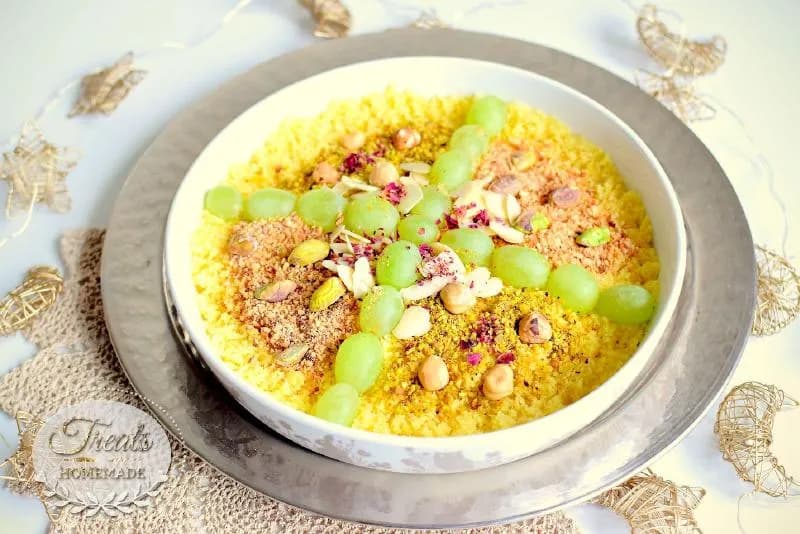
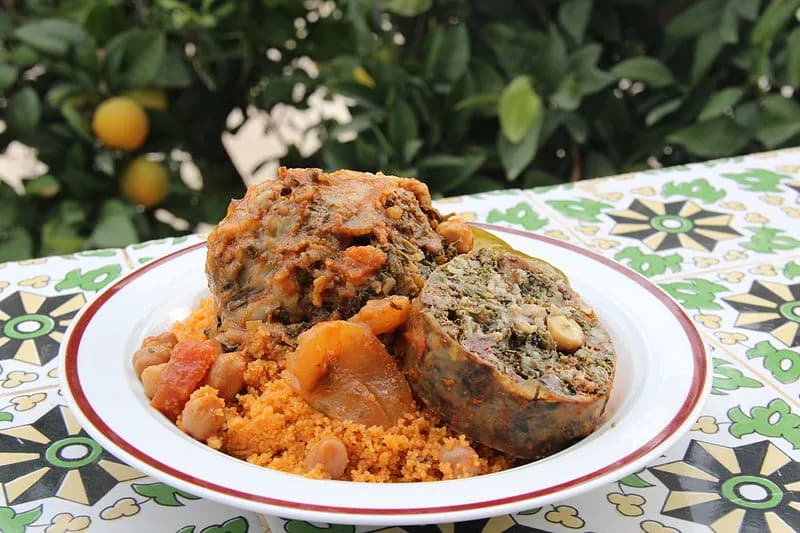
Couscous is the national dish of Tunisia, and it is also the national dish of Algeria, Morocco, Mauritania and Libya, which tells you something about how the Maghreb understands itself. The same steamed semolina appears across all five countries under names that shift with the language: kousksi in Tunisia, taam or kesksu in Algeria, seksu in Morocco, and cuscusu in Sicily, where it crossed the water.
The Tunisian version is distinguished by its heat and its colour. Harissa goes into the broth rather than being offered alongside it, and the finished couscous runs orange to deep red depending on how much broth and harissa it has taken up. Caraway is the other Tunisian signature, appearing in a quantity that Moroccan and Algerian couscous would not use.
What goes with it depends on the coast. In Sfax and the other coastal cities, couscous is made with fish. Inland it more often carries lamb, sometimes with dried fruit. Turnip, carrot, courgette, potato, pumpkin and chickpeas are the usual vegetables, cooked in the broth and removed as each becomes ready. The word itself is traced either to the Arabic kaskasa, to pound small, or the Amazigh seksu, meaning rounded or well rolled, and both derivations describe the grain rather than the dish.
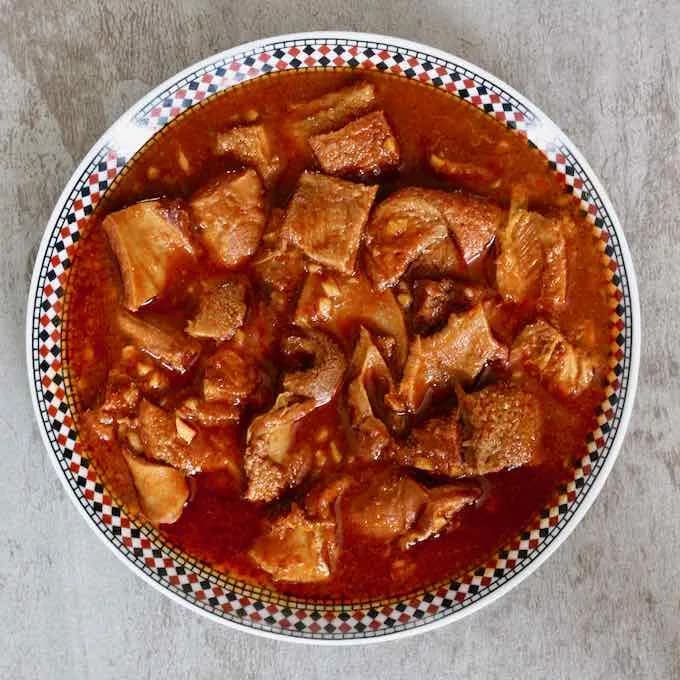
Akod is a tripe dish and it is the emblematic dish of Tunisian Jewish cooking. Beef tripe and a cow's trotter are cleaned, blanched through several changes of water, then cooked for hours with garlic, cumin, tomato paste and harissa until the sauce is thick and the tripe has surrendered completely.
Its place is at the kemia, the Tunisian Jewish spread of small dishes that opens a meal, alongside banatages, briks, fricassés and minina. A host laying out a proper kemia would be expected to have made it. Tunisian Jewish cooking developed over centuries in Tunisia and has since largely relocated to France and Israel with the community, which makes recording dishes like this more urgent than recording better travelled ones.
The wider family is large and worth knowing. Moroccan douara, also called t'qualia or kercha, uses mutton tripe. Algerian bakbouka includes carrots, courgette and chickpeas. Chkamba in Oran and chmenka in Tunisia are seasoned differently again, and the Moroccan Jewish version, tajine al guezar, meaning the butcher's pot, uses cumin and paprika without tomato paste and is cooked for close to ten hours over coals at Pesach. Offal has fallen out of favour with younger generations across the region, which the source for this recipe notes with some regret.
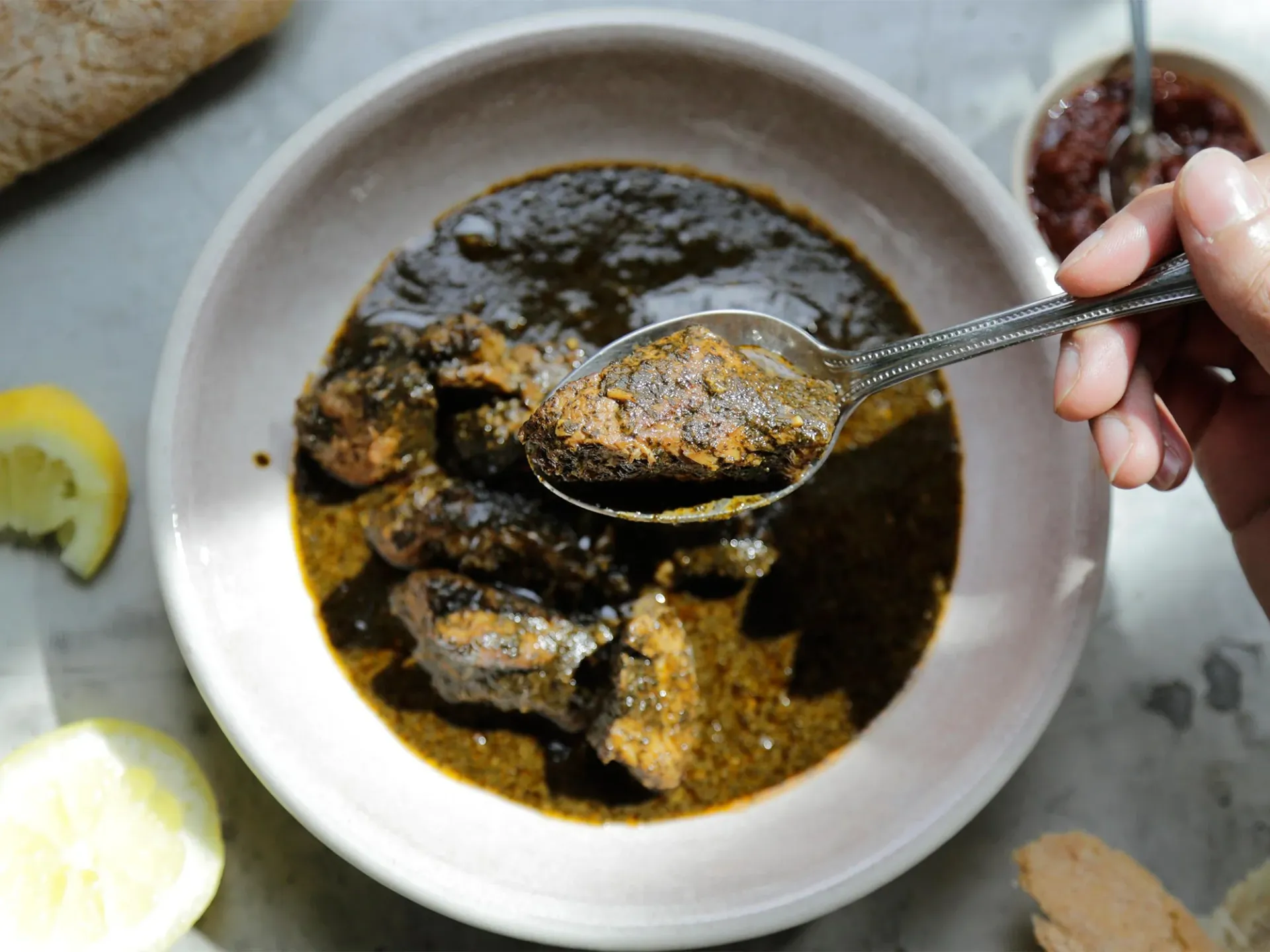
Tunisian mloukhia is not the dish of the same name eaten in Egypt, and the difference is fundamental. Egyptians cook the fresh leaves of jute mallow into a green soup. Tunisians dry the leaves, grind them to a powder, and cook that powder in oil for hours until it turns from green to deep brown and finally to something close to black. The two share a plant and almost nothing else.
The name carries a claim. Mloukhia derives from the Arabic malik, meaning king, and in Tunisia the dish is called the delicacy of the king. It is cooked slowly over the low heat of a kanoun, a charcoal brazier, for at least eight hours in the traditional method, and it is not unusual for the paste to be started the evening before and finished the next day.
Its occasions are precise and they cross religious lines. Tunisian Muslims eat it on Ras el am, the first day of the Hegira new year, so that the year begins under the sign of green, which is the colour of Islam and of hope. It appears at the end of mourning periods and on the first day of Eid al-Fitr. The Jews of Nabeul kept the same custom and now cook mloukhia for Rosh Hashanah. Tunisians say plainly that there is no middle position on it: you love it or you do not.
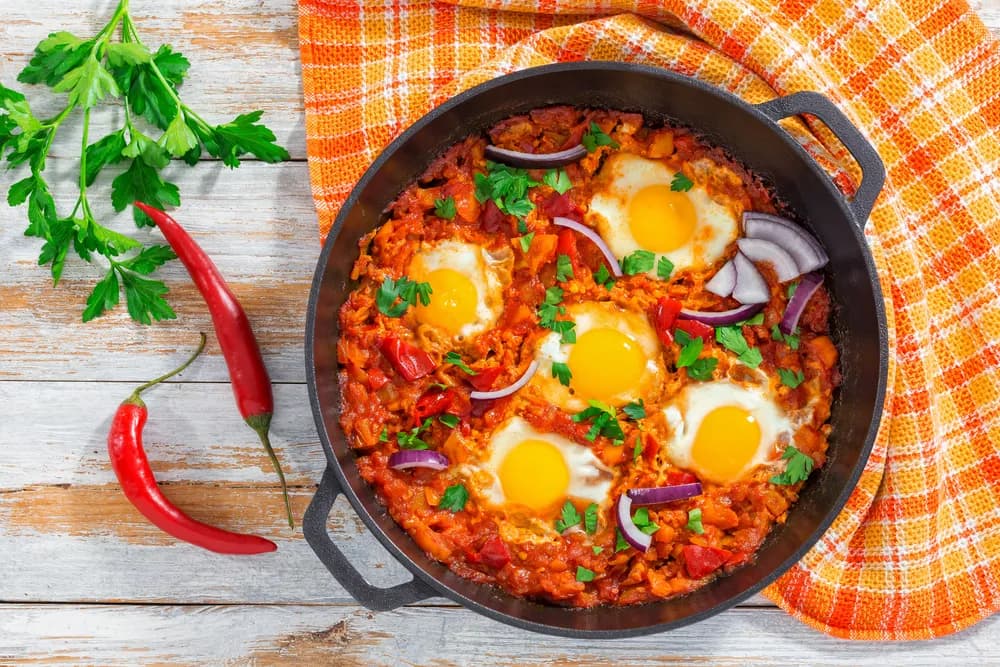
Ojja is a Tunisian dish of eggs cooked in a spiced tomato and pepper sauce, and it is one of the country's most eaten meals. The name comes from Tunisian Arabic slang meaning mixture, which describes it accurately: tomato, pepper, onion, garlic and spice, with eggs finished in the sauce.
Whether ojja and shakshuka are the same thing is genuinely disputed, and the disagreement is worth stating rather than resolving. Some Tunisians hold that ojja is made with garlic and no onion while shakshuka uses both. One published account draws the line differently, arguing that in ojja the eggs are stirred through the sauce while in shakshuka they are poached whole on the surface, which would make ojja a close relative of Turkish menemen. Others say the two words name one dish. The recipe here allows both egg treatments and notes that both are used in Tunisia.
Its origin is generally placed in Tunisia or Yemen, and it is eaten across North Africa. It has also become a fixture of Israeli cooking over the past few decades, where it is eaten at any meal. Merguez, the North African lamb sausage, and harissa are what mark this version as Tunisian rather than anything else, and toasted whole coriander, caraway and cumin ground fresh give it a depth that pre-ground spice does not.