Nous utilisons des cookies essentiels au fonctionnement du site. Nous aimerions aussi déposer des cookies de mesure d’audience et des cookies publicitaires, uniquement avec votre accord. Vous pouvez choisir séparément pour chacun. Lire notre politique relative aux cookies

Loading
Recettes Tunisia
De Tunisian Couscous à Usban, de Tunisian Mloukhia à Akod. Toute la cuisine Tunisia, telle qu'on la prépare chez soi.
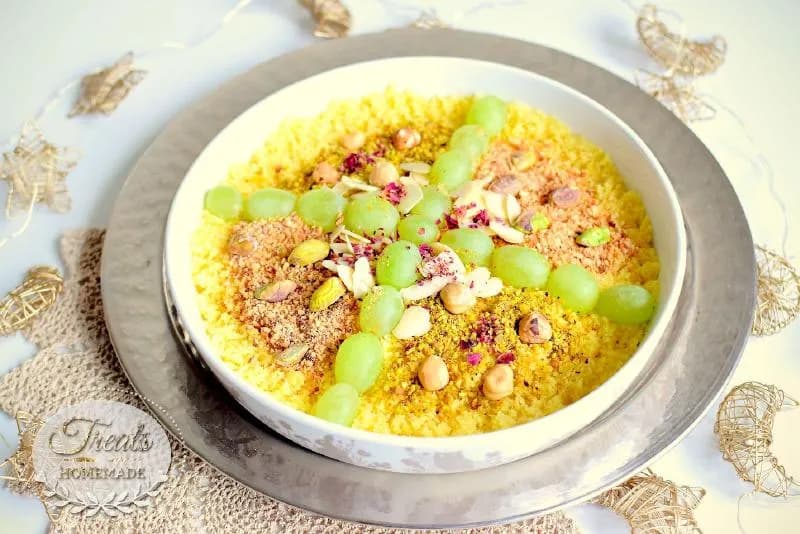
Masfouf is steamed couscous sweetened with milk and honey and mixed with dates, raisins, nuts and banana, layered with a vanilla custard. It is Tunisian and it belongs to Ramadan.
It is the sweet counterpart to Tunisian couscous, which is otherwise a savoury dish, and that inversion is the whole idea, the same grain, the same steaming technique, turned into a dessert or a breakfast. During Ramadan it appears at suhoor, the meal before dawn, because it is filling and sustaining, and at iftar as a sweet.
Geranium water is the ingredient that places it. Distilled from scented geranium leaves, it is used across Tunisian sweets in the way rose water and orange blossom water are used further east, and it has a green, faintly citrus perfume that neither of those reproduces. Middle Eastern and North African grocers stock it.
Steaming the couscous properly rather than pouring boiling water over it is what the recipe asks for, and it is the difference between light separate grains and a claggy mass. This is a dessert made from properly cooked couscous rather than instant.
**It contains almonds and walnuts, which the title gives no indication of.**
The source's ingredient list repeats milk, honey and geranium water without indicating that the second set belongs to the custard.
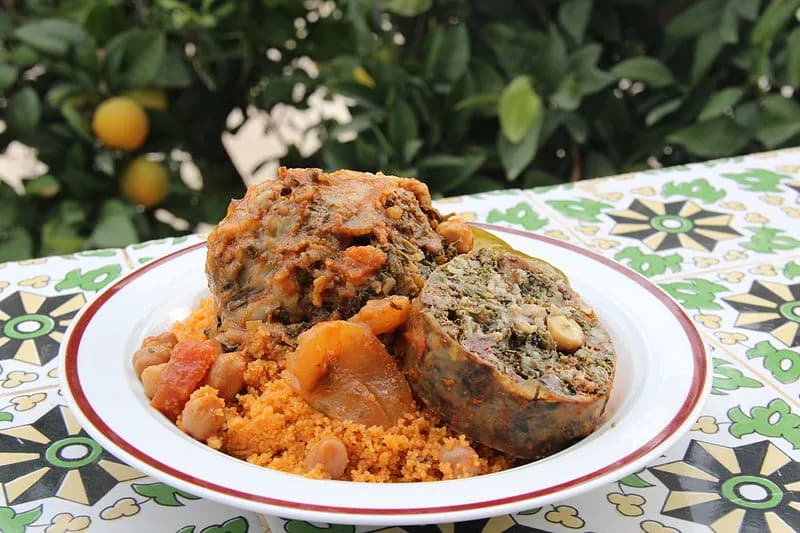
Usban is a North African sausage made from the parts of a sheep that a whole animal butchery yields and nothing else does: the stomach, the liver, the lungs and the heart, chopped and mixed with rice, herbs and spices, sewn into pouches and cooked in a sauce. It is eaten in Tunisia, Algeria and Libya, and it is written both usban and osban.
Its occasion is Eid al-Adha, and the connection is structural rather than customary. The festival involves the sacrifice of an animal and the use of all of it, and usban is what the offal becomes. It cannot be made casually because it requires a quantity of organ meat that only arrives when a whole sheep is broken down at home. Tunisian households make it on the day of Eid despite the considerable labour, and the effort is part of what the dish means.
The work is real. The stomach must be scrubbed, blanched, scraped of its lining until it turns white, cut and sewn into pouches by hand with a needle and butcher's twine, then filled and sewn shut. Usban is documented in Tunisian references as far back as the 13th century, and it is held up as a demonstration of skill: proof that a cook can use every part of the sacrifice properly. It is served alongside rice or couscous.
Couscous is the national dish of Tunisia, and it is also the national dish of Algeria, Morocco, Mauritania and Libya, which tells you something about how the Maghreb understands itself. The same steamed semolina appears across all five countries under names that shift with the language: kousksi in Tunisia, taam or kesksu in Algeria, seksu in Morocco, and cuscusu in Sicily, where it crossed the water.
The Tunisian version is distinguished by its heat and its colour. Harissa goes into the broth rather than being offered alongside it, and the finished couscous runs orange to deep red depending on how much broth and harissa it has taken up. Caraway is the other Tunisian signature, appearing in a quantity that Moroccan and Algerian couscous would not use.
What goes with it depends on the coast. In Sfax and the other coastal cities, couscous is made with fish. Inland it more often carries lamb, sometimes with dried fruit. Turnip, carrot, courgette, potato, pumpkin and chickpeas are the usual vegetables, cooked in the broth and removed as each becomes ready. The word itself is traced either to the Arabic kaskasa, to pound small, or the Amazigh seksu, meaning rounded or well rolled, and both derivations describe the grain rather than the dish.
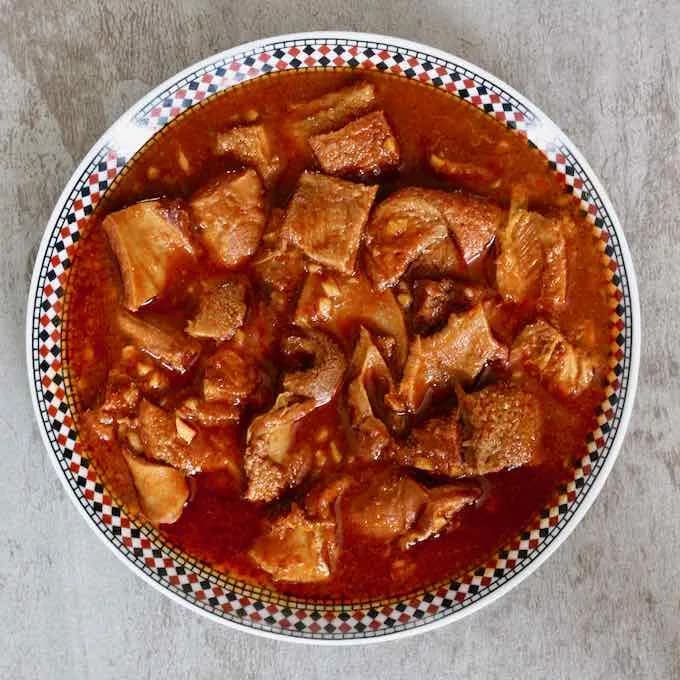
Akod is a tripe dish and it is the emblematic dish of Tunisian Jewish cooking. Beef tripe and a cow's trotter are cleaned, blanched through several changes of water, then cooked for hours with garlic, cumin, tomato paste and harissa until the sauce is thick and the tripe has surrendered completely.
Its place is at the kemia, the Tunisian Jewish spread of small dishes that opens a meal, alongside banatages, briks, fricassés and minina. A host laying out a proper kemia would be expected to have made it. Tunisian Jewish cooking developed over centuries in Tunisia and has since largely relocated to France and Israel with the community, which makes recording dishes like this more urgent than recording better travelled ones.
The wider family is large and worth knowing. Moroccan douara, also called t'qualia or kercha, uses mutton tripe. Algerian bakbouka includes carrots, courgette and chickpeas. Chkamba in Oran and chmenka in Tunisia are seasoned differently again, and the Moroccan Jewish version, tajine al guezar, meaning the butcher's pot, uses cumin and paprika without tomato paste and is cooked for close to ten hours over coals at Pesach. Offal has fallen out of favour with younger generations across the region, which the source for this recipe notes with some regret.