Nous utilisons des cookies essentiels au fonctionnement du site. Nous aimerions aussi déposer des cookies de mesure d’audience et des cookies publicitaires, uniquement avec votre accord. Vous pouvez choisir séparément pour chacun. Lire notre politique relative aux cookies

Loading
Recettes
Parcourez les archives par pays, par plat et par temps de cuisson.
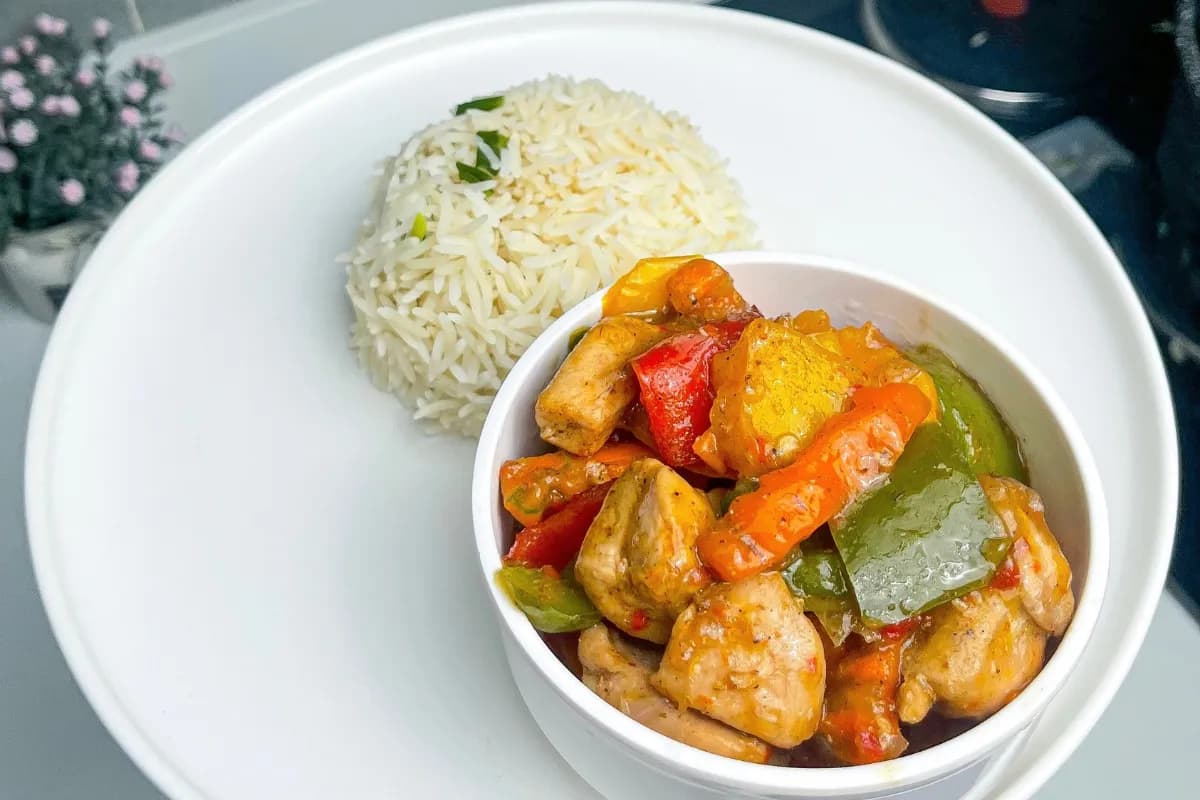
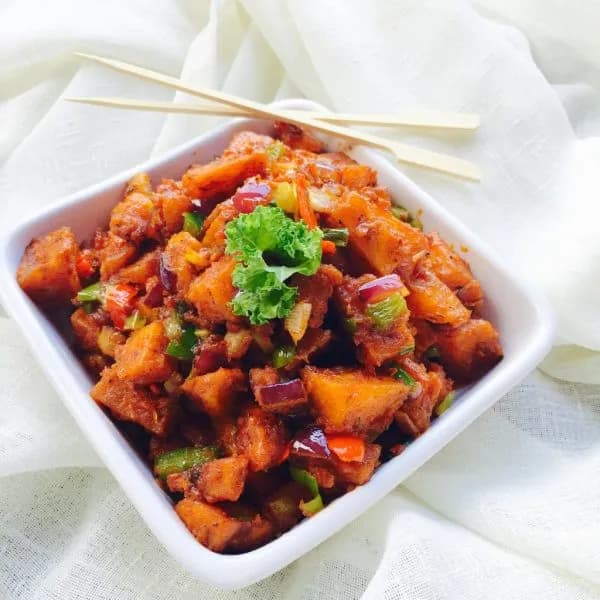
This is a Nigerian take on a curry sauce: chicken breast marinated in ginger, garlic and all purpose seasoning, cooked with carrots and bell peppers, and thickened with a cornstarch slurry rather than reduced or enriched with cream.
Two things mark it as Nigerian rather than South Asian. The first is yaji, the suya spice built on ground peanuts, paprika, cayenne, ginger and garlic, which goes in alongside the curry powder and gives an aromatic depth no Indian curry would have. The second is the cornstarch slurry, which is how a great many Nigerian sauces are thickened, giving a glossy sauce that clings rather than a reduced one.
The vegetables are meant to keep their bite. Carrots and bell peppers go in after the onion and are cooked only until slightly tender, which is characteristic of Nigerian party cooking, where texture and colour matter as much as flavour. The heat is moderate and adjustable through the scotch bonnet. Because yaji contains ground peanuts, this dish carries a peanut allergen despite nothing in its name suggesting one.
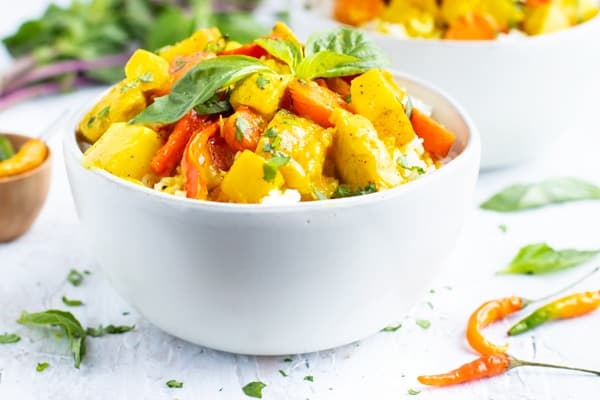
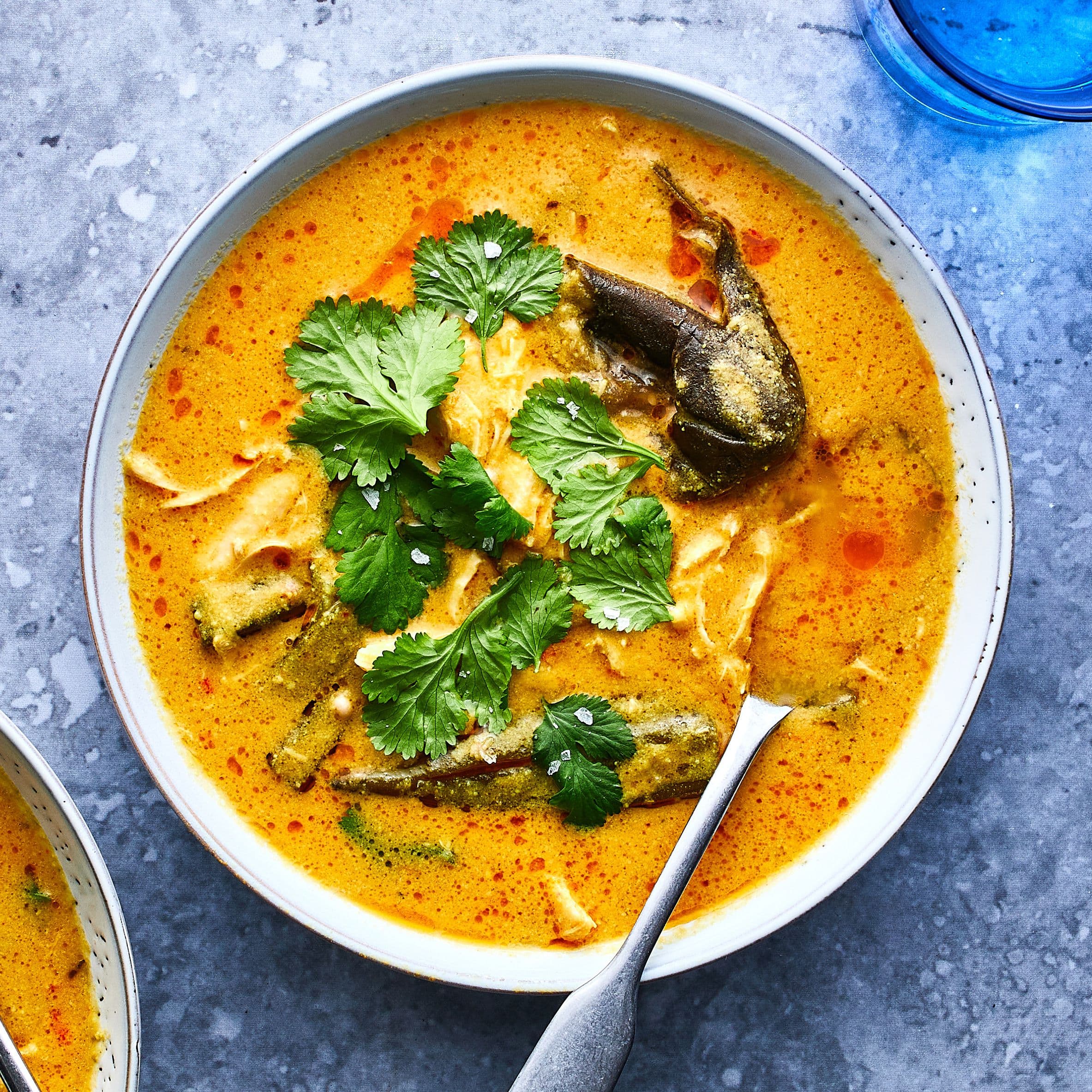
Coconut chicken curry is a one-pan dish of chicken simmered in coconut milk with a curry spice blend and whatever vegetables are to hand, broccoli, cabbage, peppers, potato, carrot.
The word curry is worth being precise about. It is not a single spice or a single dish. It comes from English usage during colonial rule in India, applied broadly to spiced saucy dishes, and it now covers an enormous range of unrelated cooking across South Asia, Southeast Asia, the Caribbean and East Africa. A curry powder sold in a jar is a blend, and the blends differ substantially between manufacturers and regions.
Coconut milk versions belong mainly to the coastal and tropical end of that range, southern India, Thailand, Malaysia, the Caribbean, and the Swahili coast of East Africa, where coconut is grown and used heavily.
This particular recipe is a general one rather than a regional tradition, which is its strength: it tolerates substitution well and is designed to be varied.
**Filed as Worldwide**, the recipe as written makes no specific national claim, so attributing it to any one cuisine would be inventing detail.
Semovita is one of Nigeria's swallows: the family of smooth, firm starch preparations that are pinched off by hand, rolled between the fingers and used to lift soup from a bowl. The swallow is not a side dish. In Nigerian eating it is the vehicle and the soup is the flavour, and a meal is understood as the pairing of the two.
It is made from semolina, the coarse milling of durum wheat, and it belongs to the wheat based end of the swallow spectrum rather than the cassava, yam or maize end. That places it alongside amala, eba, fufu, pounded yam and starch as one option among several, chosen by household preference and by what the soup is. Semovita is smoother and milder than most of the alternatives, which is a large part of its appeal.
Its status is worth stating plainly: Semovita is a brand name that has become the general term for the product, in the way a number of household names have. The dish is Nigerian, industrially produced and comparatively recent, and it earned its place at the table on texture rather than on history. It is eaten with ogbono, okra, efo riro, egusi and every other Nigerian soup.
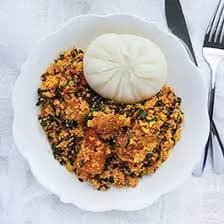
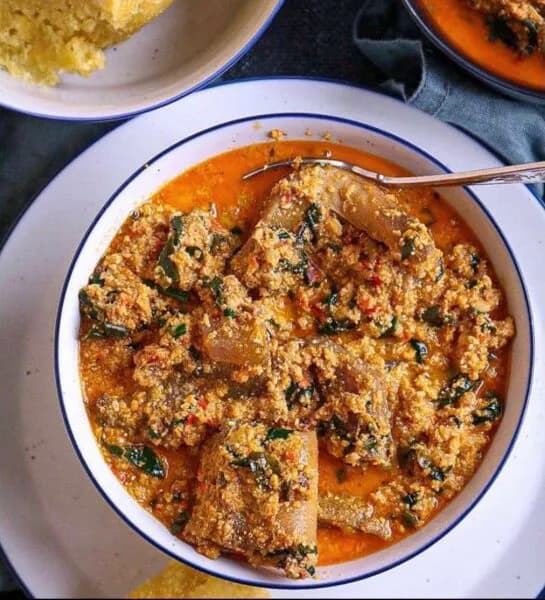
Egusi soup is eaten across every region of Nigeria, every ethnic group and every economic class, which is a claim very few dishes anywhere can support. Its name changes with the language and the dish does not: miyan gushi in Hausa, ofe egusi in Igbo, efo elegusi in Yoruba.
Its defining ingredient is ground egusi, the dried seed of a gourd related to the watermelon, milled to a meal that thickens and enriches the soup around it. The seeds are ground dry, without water, until the powder turns to a paste under the blade. Nothing else produces the particular nutty, faintly bitter depth that egusi gives, which is why the soup is named for the seed rather than for the meat or the greens that also go into it.
There is no single method. The caking approach lets the ground seed set into soft curds in the stock; the frying approach starts the egusi in palm oil; the moulding approach forms it into balls that are eaten like meat. Ijebu cooks in Ogun State make it with no vegetables at all. Every one of these is egusi soup, and Nigerians will argue for their own without seriously disputing anyone else's. It is eaten with pounded yam, fufu, eba, amala or any swallow at hand.