Nous utilisons des cookies essentiels au fonctionnement du site. Nous aimerions aussi déposer des cookies de mesure d’audience et des cookies publicitaires, uniquement avec votre accord. Vous pouvez choisir séparément pour chacun. Lire notre politique relative aux cookies

Loading
Recettes
Parcourez les archives par pays, par plat et par temps de cuisson.
Grilled plantain is street food across West Africa, and in Nigeria it is boli, ripe plantain roasted over charcoal until the outside blackens and the sugars inside caramelise.
It is about as simple as cooking gets. No oil, no seasoning, nothing added. The plantain is put over heat and turned. What makes it work is entirely down to the fruit: a plantain that is ripe enough has developed sugars that caramelise under direct heat, and one that is not will taste starchy and dull no matter how long it is grilled.
Plantains are not bananas, despite the resemblance. They are larger, starchier, and must be cooked before eating, raw they are unpleasant and hard to digest. The ripeness scale runs from green, which is firm and starchy and used for chips and fufu, through yellow, which is what grilling wants, to almost black, which is very sweet and better fried.
Boli is sold from charcoal drums at roadsides and motor parks, usually with roasted groundnuts, and often with a pepper sauce or with fish. The pairing with groundnuts is close to fixed in Nigeria, the salt and fat against the sweetness of the plantain.
It is cheap, filling and energy-dense, which is why it has stayed street food rather than becoming restaurant food.
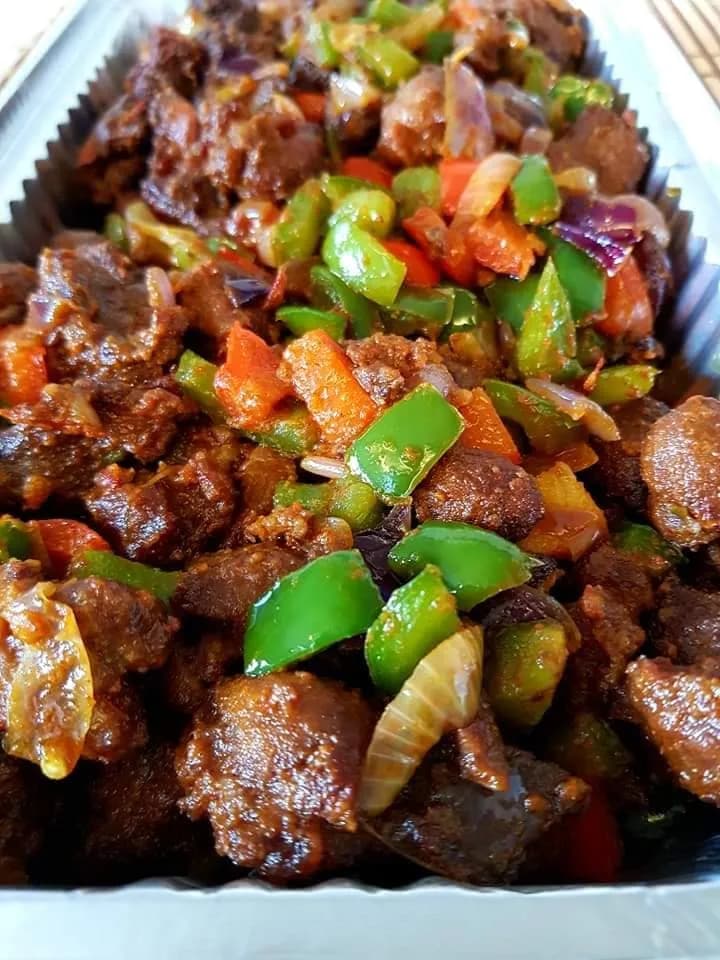
Asun is smoked or roasted goat meat tossed through a fierce pepper and onion mix, and it is one of the fixtures of the Nigerian owambe, the large Yoruba party that runs on food and music. It arrives as part of the small chops circuit, alongside puff puff and peppered snails, and it disappears fast.
Goat is the whole point. Yoruba speakers call it ogunfe, and it carries a stronger, more mineral flavour than beef that stands up to the quantity of scotch bonnet involved. The meat is simmered until tender before it ever meets fire, then roasted or grilled to dry the surface and pick up smoke, and only then does it go into the pepper mix. Skipping the first stage is the most common way it goes wrong, since goat that has not been softened stays tough no matter how long it spends in the pan.
Sliced onions and bell peppers go in for sweetness against the heat rather than for bulk. Whether asun is a starter or something else is a matter people disagree about: the source archive files it under both appetizer and dessert, and Nigerians treat it as a small chop, a side to jollof rice, or a main course with plantain, depending entirely on the occasion.
Oyster mushrooms grilled and tossed in suya spice. It is a plant-based version of the Nigerian street food, and it works better than most meat substitutions do.
**The traditional suya spice contains ground peanuts, and this recipe includes them.** The source flags it and offers to leave them out, which is honest, but it is worth stating clearly, because a peanut allergy and a suya spice blend are a genuinely dangerous combination and the name gives no warning.
Suya proper is skewered beef, ram or chicken rubbed in yaji, the spice blend of ground roasted peanuts, ginger, cayenne, garlic, onion powder and paprika, and grilled over open coals. It is Hausa in origin, from northern Nigeria, and it is sold across Nigeria, Cameroon, Niger, Ghana and parts of Sudan. Kyinkyinga is the Ghanaian name, agashe the Sudanese.
Oyster mushrooms are the right substitution and not an arbitrary one. Shredded, they have a fibrous, layered structure that genuinely resembles pulled meat, they take on the dry rub readily, and they char well. Most vegetables do neither.
The source's method is very compressed, one step reads "put in a preheated medium", with the word oven missing, and has been filled out below.
Kelewele is Ghanaian spiced fried plantain: ripe plantain cut into cubes, tossed in a paste of ginger, chilli, garlic and spices, rested, then fried until the outside crisps and the inside stays soft. It is one of the country's best known street foods and is sold from stalls in the evening across Accra.
The spicing is what distinguishes it, and it is worth being clear about this because the source is not. **Kelewele is not the same as aloco.** Aloco is the Ivorian name for plain fried ripe plantain, salted and nothing more, and the same dish is dodo in Nigeria and makemba in the Congo. Kelewele is marinated first, and the ginger and chilli are the entire reason it has its own name.
Ginger, hot pepper and salt are the base, and nutmeg, garlic, onion and lemon appear in most versions. The rest matters: ten to twenty minutes lets the spice paste get into the cut faces of the plantain rather than sitting on the surface. It is eaten on its own, with roasted peanuts, or alongside rice and bean dishes, and it is sometimes described as vegetarian meat for the substance it lends a plate. Traditionally it is fried in red palm oil.